
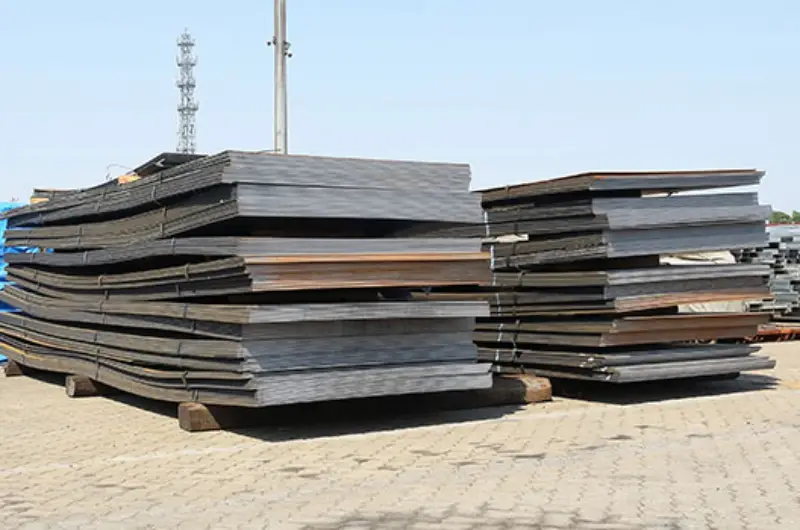
ASTM A533 Gr.C Cl.2 Mn-Mo-Ni Alloy Steel
ASTM A533 Gr.C Cl.2 Mn-Mo-Ni Alloy Steel for Nuclear Pressure Vessels & Boilers
Explore chemical composition, mechanical properties, and equivalents of ASTM A533 Gr.C Cl.2 quenched and tempered alloy steel plate for high-integrity pressure vessel applications.
Quenching and tempering, hot forming, welding, cutting
- Phone : +8618037372205
- Email : [email protected]
- WhatsApp: Contact via Whtsapp
- WeChat: +8618037372205
ASTM A533 Gr.C Cl.2 Mn-Mo-Ni Alloy Steel Introduction
ASTM A533 Grade C Class 2 is a quenched and tempered manganese-molybdenum-nickel alloy steel plate designed for critical pressure vessel and boiler service. It offers high strength with minimum yield of 485 MPa (70 ksi) and tensile between 550–690 MPa (80–100 ksi), combined with excellent toughness at low temperatures. The nickel addition (0.70–1.00%) enhances notch toughness, making it suitable for thick-section welded constructions in nuclear reactor pressure vessels, steam generators, and process columns. This grade is widely adopted under ASME SA533 Gr.C Cl.2 and is recognized for its reliable performance under high-pressure, high-temperature environments.
ASTM A533 Gr.C Cl.2 Mn-Mo-Ni Alloy Steel Chemical Composition
Chemical requirements per ASTM A533 standard for Grade C plates. The controlled levels of nickel and molybdenum provide deep hardenability and toughness.
- Heat analysis is used for initial compliance; product analysis tolerances are specified separately.
- Residual elements such as chromium, copper, and vanadium are not intentionally added but may be present in small amounts without adverse effect.
| Element | Specified Value (wt%) | Remarks |
|---|---|---|
| Carbon (C) | ≤0.25 | For all thicknesses |
| Manganese (Mn) | 1.15–1.50 | Heat analysis |
| Phosphorus (P) | ≤0.025 | |
| Sulfur (S) | ≤0.025 | |
| Silicon (Si) | 0.15–0.40 | Heat analysis |
| Nickel (Ni) | 0.70–1.00 | Heat analysis |
| Molybdenum (Mo) | 0.45–0.60 | Heat analysis |
ASTM A533 Gr.C Cl.2 Mn-Mo-Ni Alloy Steel Physical Properties
Physical properties are not mandated by ASTM A533 but represent typical data for low-alloy Cr-Mo-Ni steels. These values assist in design calculations for thermal expansion, heat transfer, and mass properties.
- Values apply at room temperature unless otherwise indicated.
- Thermal conductivity decreases with increasing temperature; thermal expansion increases.
| Property | Typical Value | Unit | Test Condition |
|---|---|---|---|
| Density (ρ) | 7.85 | g/cm³ | 20°C |
| Elastic Modulus (E) | 205 | GPa | 20°C |
| Shear Modulus (G) | 80 | GPa | Estimated, 20°C |
| Poisson's Ratio (ν) | 0.29 | — | 20°C |
| Thermal Expansion (α) | 11.5 | 10⁻⁶/°C | 20–100°C |
| Thermal Expansion (α) | 12.5 | 10⁻⁶/°C | 20–200°C |
| Thermal Expansion (α) | 13.5 | 10⁻⁶/°C | 20–300°C |
| Thermal Conductivity (λ) | 42 | W/(m·K) | 20°C |
| Thermal Conductivity (λ) | 39 | W/(m·K) | 200°C |
| Specific Heat Capacity | 460 | J/(kg·K) | 20°C |
| Electrical Resistivity (ρe) | 0.25 | μΩ·m | 20°C |
ASTM A533 Gr.C Cl.2 Mn-Mo-Ni Alloy Steel Mechanical Properties
Tensile and impact requirements per ASTM A533 for Class 2 plates. Values depend on plate thickness.
- Yield strength (0.2% offset) and tensile strength apply to transverse specimens.
- Elongation measured on 50 mm (2 in.) gauge length.
- Charpy V-notch impact test is often specified by supplementary requirement for low-temperature toughness.
| Property | Required Value | Unit | Test Condition / Thickness Range |
|---|---|---|---|
| Yield Strength (ReH) | ≥485 | MPa | Plates ≤50 mm (2 in.) |
| Yield Strength (ReH) | ≥450 | MPa | Plates >50 mm to 100 mm (2–4 in.) |
| Tensile Strength (Rm) | 550–690 | MPa | All thicknesses |
| Elongation (A, 50 mm) | ≥18 | % | Plates ≤50 mm |
| Elongation (A, 50 mm) | ≥18 | % | Plates >50 mm to 100 mm |
| Elongation (A, 50 mm) | ≥16 | % | Plates >100 mm to 150 mm (4–6 in.) |
| Charpy V-Notch (KV) | Per S5/S8 | J | At specified test temperature, e.g., -29°C (-20°F) |
ASTM A533 Gr.C Cl.2 Mn-Mo-Ni Alloy Steel Complete Equivalent Grades
| Region / Standard | Specification | Grade / Designation | Remark |
|---|---|---|---|
| USA / ASME | SA533 / SA533M | SA533 Gr.C Cl.2 | Identical; ASME adoption of ASTM A533 |
| Japan / JIS | JIS G 3120 | SQV3B | Equivalent Mn-Mo-Ni plate; approved under JIS for pressure vessels |
| China / GB/T | GB 3531 | 18MnMoNbR | Comparable composition and properties, but Ni not exactly as A533 Gr.C; often referenced |
ASTM A533 Gr.C Cl.2 Mn-Mo-Ni Alloy Steel Application Introduction
ASTM A533 Gr.C Cl.2 is engineered for thick-walled, high-pressure vessels operating at moderate temperatures. It is particularly favored in nuclear power plants, where assurance of fracture toughness in heavy sections is critical.
- Industries: nuclear power generation, petrochemical refining, power boilers, offshore topside modules.
- Products: reactor pressure vessels, pressurizer shells, steam generator shells, high-temperature separators.
- Components: cylindrical shells, hemispherical heads, flanges, tube sheets, reinforcing pads, and nozzles.
The material is readily welded with appropriate preheat and post-weld heat treatment, allowing fabrication of large, complex assemblies.
Product Applications: Nuclear reactor pressure vessels (RPV), Steam generator shells, High-pressure boiler drums, Thick-walled hydrocracking reactors, Ammonia converters, High-temperature heat exchangers
Processed into products: Cylindrical vessel courses and shells, Hemispherical and ellipsoidal heads, Integral and loose flanges, Tube sheets for heat exchangers, Nozzle necks and reinforcement pads, Support skirts and base rings
Application industries: Nuclear power generation, Petrochemical and refinery, Power boiler manufacturing, Heavy machinery and pressure equipment
ASTM A533 Gr.C Cl.2 Mn-Mo-Ni Alloy Steel Similar Alternative Materials with Comparable Performance
| Region / Standard | Specification | Grade / Designation | Remark |
|---|---|---|---|
| USA / ASTM | A508 / A508M | Grade 3 Class 2 | Forging grade with similar Mn-Mo-Ni composition; used for vessel shells and nozzles |
| Europe / EN | EN 10028-2 | 20MnMoNi5-5 (1.6311) | European standard for nuclear plates; slightly higher Ni (0.75–1.15%) but equivalent class |
| USA / ASTM | A533 / A533M | Grade B Class 2 | Same base, but lower Ni (0.40–0.70%); may be used when slightly lower toughness is acceptable |
| Japan / JIS | JIS G 3120 | SQV2B | Equivalent to A533 Gr.B Cl.2; lower Ni, still suitable for many pressure vessels |
Notes:
Supplementary Requirements: ASTM A533 allows numerous supplementary tests, such as S5 (Charpy V-notch), S8 (drop-weight test), and S17 (vacuum carbon-deoxidized steel). For nuclear applications, additional requirements like ultrasonic examination per S18 and tighter chemistry limits are often imposed. Always refer to the purchase specification for the exact testing and certification needed.
- Share



