
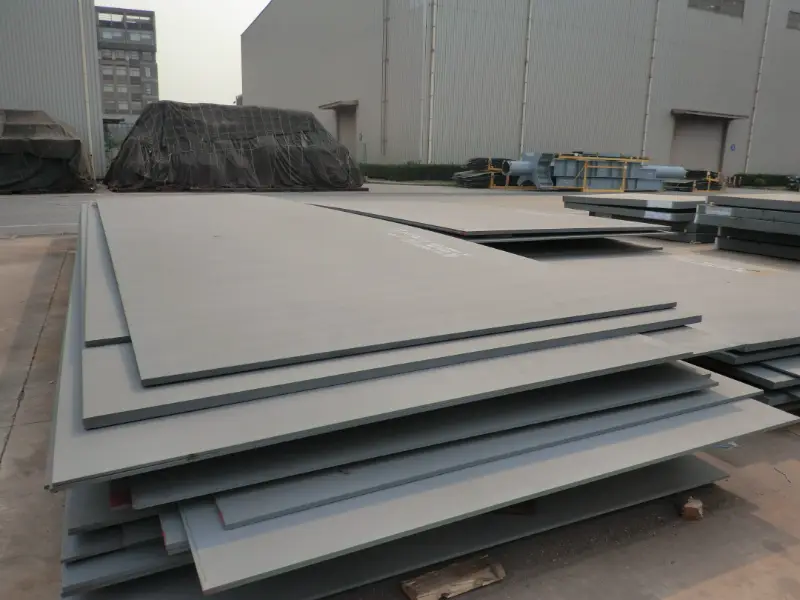
ASTM A533 Gr. C Cl. 3 Pressure Vessel Steel Plate
ASTM A533 Grade C Class 3 Pressure Vessel Steel Plate & Boiler Steel
ASTM A533 Grade C Class 3 is a quenched and tempered Mn-Mo-Ni alloy steel plate for pressure vessels and boilers with high strength and good toughness.
Quenching and Tempering, Welding, Cold Forming, Hot Forming, Cutting
- Phone : +8618037372205
- Email : [email protected]
- WhatsApp: Contact via Whtsapp
- WeChat: +8618037372205
ASTM A533 Gr. C Cl. 3 Pressure Vessel Steel Plate Introduction
ASTM A533 Grade C Class 3 is a quenched and tempered (Q&T) manganese-molybdenum-nickel alloy steel plate designed for pressure vessels and boilers. It belongs to the ASTM A533/A533M standard and is classified as a high-strength grade within the specification. The steel is characterized by its excellent combination of strength and toughness, suitable for moderate and low-temperature service. Class 3 represents the highest strength level for Grade C plates up to 65 mm thick, with minimum yield strength of 585 MPa (85 ksi) and tensile strength in the range 690–860 MPa (100–125 ksi). The addition of nickel (0.70–1.00%) enhances toughness, while molybdenum (0.45–0.60%) provides strength and resistance to softening during post-weld heat treatment. The material is commonly supplied in the quenched and tempered condition and offers good weldability with proper procedures, making it widely used for critical components in pressure vessels, boilers, heat exchangers, and nuclear power plant equipment.
ASTM A533 Gr. C Cl. 3 Pressure Vessel Steel Plate Chemical Composition
Chemical composition according to ASTM A533/A533M for Grade C Class 3. Heat analysis limits are shown. Maximum limits apply unless a range is given. The elements are controlled to ensure the required mechanical properties and weldability.
| Element | Specified Value | Remarks |
|---|---|---|
| Carbon (C) | ≤0.25 | Heat analysis |
| Manganese (Mn) | 1.15 – 1.50 | |
| Phosphorus (P) | ≤0.025 | |
| Sulfur (S) | ≤0.025 | |
| Silicon (Si) | 0.15 – 0.40 | |
| Molybdenum (Mo) | 0.45 – 0.60 | |
| Nickel (Ni) | 0.70 – 1.00 | |
| Copper (Cu) | ≤0.15 | May be present |
| Chromium (Cr) | ≤0.25 | May be present |
| Total of alloying elements (Ni+Cr+Mo+Cu) | ≤1.60 | As per typical practice |
ASTM A533 Gr. C Cl. 3 Pressure Vessel Steel Plate Thermal and Electrical Physical Properties
Typical physical properties for ASTM A533 Grade C Class 3 steel. These values are representative for quenched and tempered low-alloy Mn-Mo-Ni steel and are suitable for engineering design. Actual values may slightly vary with specific heat treatment and composition.
| Property | Typical Value | Unit | Test Condition |
|---|---|---|---|
| Density (ρ) | 7.85 | g/cm³ | Room temperature |
| Elastic Modulus (E) | 205 | GPa | 20°C |
| Shear Modulus (G) | 80 | GPa | 20°C |
| Poisson's Ratio (ν) | 0.29 | – | 20°C |
| Thermal Expansion Coefficient (α) | 11.7 | 10⁻⁶/°C | 20 – 100°C |
| Thermal Expansion Coefficient (α) | 12.7 | 10⁻⁶/°C | 20 – 200°C |
| Thermal Expansion Coefficient (α) | 13.5 | 10⁻⁶/°C | 20 – 300°C |
| Thermal Conductivity (λ) | 42 | W/(m·K) | 20°C |
| Thermal Conductivity (λ) | 39 | W/(m·K) | 200°C |
| Specific Heat Capacity | 460 | J/(kg·K) | 20°C |
| Electrical Resistivity (ρ_e) | 0.25 | µΩ·m | 20°C |
ASTM A533 Gr. C Cl. 3 Pressure Vessel Steel Plate Mechanical Properties
Mechanical properties for ASTM A533 Grade C Class 3 plates in the quenched and tempered condition. The values are mandatory requirements as per the standard for plates ≤65 mm (2.5 in) thickness. Tensile test specimens are taken in the transverse direction unless otherwise agreed. Bend test uses a 180° bend with a designated mandrel diameter. Charpy V-notch impact requirements are subject to supplementary agreement and can vary by service temperature.
| Property | Specified Value | Unit | Test Condition |
|---|---|---|---|
| Yield Strength (ReH) | ≥585 | MPa | Transverse, thickness ≤65 mm |
| Tensile Strength (Rm) | 690 – 860 | MPa | Transverse, thickness ≤65 mm |
| Elongation (A) | ≥18 | % | Gauge length 50 mm (2 in), transverse |
| Bend Test (Mandrel diameter) | 3 × specimen thickness (D=3a) | – | 180° bend, no cracks, nominal thickness up to 65 mm |
| Charpy Impact (KV) | To be agreed | J | Supplementary requirement; typical -12°C, ≥27 J (transverse) for pressure vessels |
ASTM A533 Gr. C Cl. 3 Pressure Vessel Steel Plate Fully Equivalent Material Standards and Recommended Substitutes
Materials that are recognized as direct or functionally equivalent to ASTM A533 Grade C Class 3 based on corresponding international standards. The chemical composition and mechanical properties are closely aligned, although minor deviations may exist.
| Country/Region | Standard | Grade | Remarks |
|---|---|---|---|
| USA | ASME SA533/SA533M | SA533 Grade C Class 3 | Identical to ASTM A533 Gr.C Cl.3, adopted for ASME Boiler & Pressure Vessel Code |
| Europe | EN 10028-2 | 13MnNiMo5-4 (1.6368) | Similar Mn-Ni-Mo alloy; yield ~560 MPa min, tensile 680–820 MPa; comparable but check thickness and toughness requirements |
| Japan | JIS G3120 | SQV3A | Equivalent for pressure vessel plate; similar strength class and composition, often used with JIS G3120 |
| International | ISO 9328-2 | 13MnNiMo5-4 | Same designation as EN, aligned with global pressure vessel steel standards |
ASTM A533 Gr. C Cl. 3 Pressure Vessel Steel Plate Application Introduction
ASTM A533 Grade C Class 3 steel is primarily used in the fabrication of pressure-retaining structures where high strength and reliable toughness are essential. It is suitable for moderate- and low-temperature service down to about -12°C (and lower with supplementary impact testing). Typical industries and products include:
Product Applications: Pressure Vessels (vertical/horizontal vessels), Steam Drums and Boiler Drums, Heat Exchangers (shell & tube, plate type), Air Receivers and Accumulators, Process Columns and Towers, High-Pressure Storage Tanks
Processed into products: Cylindrical shell courses and vessel bodies, Dished/elliptical heads and end caps, Flanges and nozzle reinforcement pads, Forged rings and hydrocracker reactor bodies, Tube sheets and baffle plates
Application industries: Pressure Vessel Manufacturing, Boiler and Steam Generation, Nuclear Power (Reactor Pressure Vessels), Petrochemical and Chemical Processing, Oil & Gas (Upstream and Downstream), Power Generation
ASTM A533 Gr. C Cl. 3 Pressure Vessel Steel Plate Similar or Alternative Material Recommendations
Grades that are not exact equivalents but can serve as substitutes in certain conditions, considering strength, toughness, and application requirements. Careful revision of specifications is recommended before replacement.
| Country/Region | Standard | Grade | Remarks |
|---|---|---|---|
| USA | ASTM A533/A533M | A533 Grade B Class 3 | Similar Class 3 strength but lower Ni (~0.40–0.70) and slightly different Mn range; cheaper alternative when lower toughness is acceptable |
| USA | ASTM A508/A508M | A508 Class 3 | Forging grade with similar composition; used for vessel shells and flanges when forged product required |
| China | GB/T 713.2 | 13MnNiMoR | China boiler and pressure vessel steel; similar composition and strength; verify impact temperature requirements |
| Europe | EN 10028-2 | 12MnNiMo5-4 (1.6366) | Lower carbon and slightly lower strength; may be used with appropriate design adjustment |
Notes:
Welding: The steel is weldable by conventional methods (SMAW, SAW, GMAW). Preheating (typically 100–200°C) and interpass temperature control are recommended. Post-weld heat treatment (PWHT) may be required depending on thickness and code.
Impact testing: ASTM A533 does not specify default Charpy values; toughness requirements are invoked by supplementary requirements (e.g., S5). Common practice for pressure vessels is to test at -12°C with minimum 27 J transverse (ASME VIII Division 1).
Ultrasonic testing: Plates are typically supplied in accordance with ASTM A578/A578M or A435/A435M for internal soundness.
All information provided is derived from ASTM A533/A533M standard values and typical engineering references. Users should verify latest edition specifications for critical applications.
- Share



