
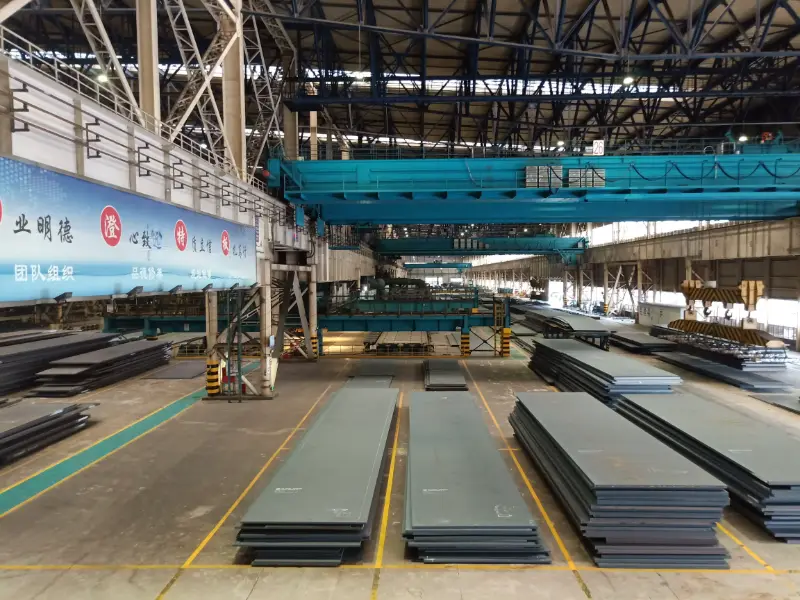
SUS430J1L Ferritic Stainless Steel Plate/Coil
SUS430J1L Ferritic Stainless Steel Plate/Coil: Low Carbon, Niobium-Stabilized Grade with Superior Formability
Comprehensive analysis of SUS430J1L stainless steel: chemical composition, mechanical and physical properties, international equivalents, and application guide for this low-carbon, niobium-stabilized ferritic stainless steel used in plates and coils.
Hot rolling, cold rolling, annealing, pickling, skin passing, slitting, cutting to length
- Phone : +8618037372205
- Email : [email protected]
- WhatsApp: Contact via Whtsapp
- WeChat: +8618037372205
SUS430J1L Ferritic Stainless Steel Plate/Coil Introduction
SUS430J1L is a low-carbon, niobium-stabilized ferritic stainless steel standardized under JIS G4305 (cold-rolled) and JIS G4304 (hot-rolled). It is an improved variant of standard SUS430, offering enhanced formability, superior resistance to intergranular corrosion after welding, and excellent oxidation resistance at elevated temperatures. The addition of niobium (Nb) binds carbon and nitrogen, preventing chromium carbide precipitation and thus preserving corrosion resistance. Its low carbon content (<0.025%) further improves toughness and weldability. The grade is non-hardenable by heat treatment and is typically supplied in the annealed and pickled condition. It is widely used in applications requiring good deep drawability and bright surface finish, such as automotive trim, kitchenware, and architectural panels. The material exhibits good resistance to stress corrosion cracking, unlike austenitic grades, and performs well in mildly corrosive environments.
SUS430J1L Ferritic Stainless Steel Plate/Coil Chemical Composition
The chemical composition of SUS430J1L is tightly controlled to ensure a fully ferritic microstructure and stabilization by niobium. The niobium content is specified as a minimum of 8×(C+N) up to a maximum of 0.80%. This guarantees that all carbon and nitrogen are bound as stable Nb(C,N) precipitates, preventing sensitization and intergranular corrosion during welding or high-temperature service. Phosphorus and sulfur are kept low for optimal formability and toughness. The absence of nickel (except as a residual) makes the grade cost-effective and resistant to stress corrosion cracking.
| Element | Content (%) | Remarks |
|---|---|---|
| Carbon (C) | ≤0.025 | Low carbon enhances formability and weldability |
| Silicon (Si) | ≤1.00 | Deoxidizer, improves oxidation resistance |
| Manganese (Mn) | ≤1.00 | Austenite suppressor, maintains ferritic structure |
| Phosphorus (P) | ≤0.040 | Kept low for toughness |
| Sulfur (S) | ≤0.030 | Improves machinability; low content required for formability |
| Chromium (Cr) | 17.00 – 20.00 | Primary ferrite stabilizer and key to corrosion resistance |
| Nickel (Ni) | ≤0.60 | Residual element; low content avoids austenite formation |
| Niobium (Nb) | 8×(C+N) to 0.80 | Stabilization against intergranular corrosion |
SUS430J1L Ferritic Stainless Steel Plate/Coil Thermal and Electrical Physical Properties
These physical properties are representative for ferritic stainless steel with 17% chromium, annealed condition. Values may slightly vary with temperature and exact composition. The combination of moderate thermal expansion and good thermal conductivity makes SUS430J1L suitable for applications requiring thermal cycling. Its electrical resistivity is higher than that of carbon steel, which is typical for stainless steels, providing some degree of electrical insulation.
| Property | Typical Value | Unit | Test Condition / Remarks |
|---|---|---|---|
| Density (ρ) | 7.70 | g/cm³ | 20°C |
| Elastic Modulus (E) | 200 | GPa | Annealed; slightly decreases with temperature |
| Shear Modulus (G) | 77 | GPa | Calculated from E and Poisson's ratio |
| Poisson's Ratio (ν) | 0.27 – 0.30 | - | Typical for ferritic grades |
| Thermal Expansion Coefficient (α) | 10.4 × 10⁻⁶ | /K | 20–100°C; linear mean coefficient |
| Thermal Expansion Coefficient (α) | 10.8 × 10⁻⁶ | /K | 20–200°C |
| Thermal Expansion Coefficient (α) | 11.3 × 10⁻⁶ | /K | 20–400°C |
| Thermal Conductivity (λ) | 26 | W/(m·K) | At 100°C |
| Thermal Conductivity (λ) | 25 | W/(m·K) | At 500°C |
| Specific Heat Capacity | 460 | J/(kg·K) | 0–100°C |
| Electrical Resistivity (ρ_e) | 0.60 | μΩ·m | At 20°C |
SUS430J1L Ferritic Stainless Steel Plate/Coil Mechanical Properties
Mechanical properties are determined on specimens taken in the transverse direction. The yield and tensile strengths ensure sufficient robustness for forming and service, while the high elongation values reflect excellent ductility for deep drawing operations. Hardness is controlled to guarantee soft formability. Bend tests demonstrate the material's ability to undergo cold forming without cracking. Actual values may vary slightly depending on thickness and processing conditions; the values below are minimum requirements unless stated otherwise.
| Property | Standard Requirement | Unit | Test Condition / Remarks |
|---|---|---|---|
| Yield Strength (0.2% proof) | ≥205 | MPa | Room temperature; applicable to all thicknesses |
| Tensile Strength | ≥360 | MPa | Room temperature; for sheet/plate ≤ 6 mm |
| Elongation (A) | ≥20 | % | Gauge length 50 mm; thickness 0.30 to <0.40 mm |
| Elongation (A) | ≥22 | % | Gauge length 50 mm; thickness 0.40 to <0.80 mm |
| Elongation (A) | ≥25 | % | Gauge length 50 mm; thickness ≥0.80 mm |
| Hardness | ≤88 | HRB | Rockwell B scale; typical for annealed condition |
| Hardness | ≤200 | HV | Vickers hardness; alternative measurement |
| Bend Test (180°) | Bend diameter = 1 × thickness | - | No cracking on outside of bend; thickness < 8 mm |
SUS430J1L Ferritic Stainless Steel Plate/Coil Fully Equivalent Material Standards and Alternative Grades
| Country/Region | Standard | Grade | Remarks |
|---|---|---|---|
| Japan | JIS G4305 / G4304 | SUS430J1L | Original standard; cold and hot rolled |
| Europe | EN 10088-2 | 1.4511 / X3CrNb17 | Equivalent; Cr range 16-18%, Nb stabilized, C ≤0.05% |
| International | ISO 15510 | X3CrNb17 | Conforms to same designation as EN |
| China | GB/T 3280 | 022Cr18Ti (similar) | Ti-stabilized variant with comparable properties; not identical |
SUS430J1L Ferritic Stainless Steel Plate/Coil Application Introduction
SUS430J1L is designed for applications that demand a combination of good corrosion resistance, high formability, and a stable, attractive surface finish. Its stabilized nature allows welding without significant loss of corrosion resistance, and its ferritic structure provides immunity to chloride stress corrosion cracking, making it preferable over austenitic grades in certain environments. The following industries, products, and components highlight its versatility.
Product Applications: Cold-rolled sheets and coils with 2B, BA, No.4, and hairline finishes, Hot-rolled plates for structural and industrial applications, Precision-rolled thin strip for electronics and spring applications, Welded tubes and pipes for low-pressure conveyance, Clad metal and laminated panels for decorative use
Processed into products: Automotive grilles and window surrounds, Kitchen sink bowls and drainboards, Architectural column covers and wall panels, Heat exchanger plates and fins, Storage tank shells and ends, Cookware lids and handles, Fasteners and brackets in mildly corrosive environments, Display stands and retail fixtures
Application industries: Automotive: exterior and interior trim, moldings, wiper blade holders, exhaust shrouds, Architecture and construction: elevator cabins, cladding, roofing, curtain wall panels, Home appliances: kitchen sinks, washing machine drums, refrigerator panels, dishwasher interiors, Food processing and catering: worktops, storage tanks, cutlery, mixing bowls, Chemical and petrochemical: tanks for mild chemicals, ductwork, heat exchangers, Consumer goods: watch cases, jewelry, writing instruments
SUS430J1L Ferritic Stainless Steel Plate/Coil Similar / Alternative Materials with Overlapping Properties
| Country/Region | Standard | Grade | Remarks |
|---|---|---|---|
| Japan | JIS G4305 | SUS430 | Basic 17%Cr ferritic grade; lower formability, prone to sensitization |
| Japan | JIS G4305 | SUS430LX | Low C, Ti-stabilized; similar formability, used for same applications |
| USA | ASTM A240 | Type 430 | UNS S43000; standard ferritic, not stabilized |
| USA | ASTM A240 | Type 430Ti | UNS S43030; Ti-stabilized, close to SUS430J1L but higher C |
| Europe | EN 10088-2 | 1.4016 / X6Cr17 | Standard ferritic 17%Cr; lower cost, less formable |
| Europe | EN 10088-2 | 1.4510 / X3CrTi17 | Ti-stabilized ferritic; excellent corrosion resistance after welding |
Notes:
Welding: SUS430J1L can be welded using common arc processes (TIG, MIG) with matching or slightly over-alloyed filler (e.g., 430Nb). Preheating to 150–200°C and post-weld annealing may be required for critical service to restore ductility. The material is magnetic in all conditions. Maximum service temperature in oxidizing environments is approximately 800°C. For severe corrosion conditions, molybdenum-containing grades (e.g., SUS444) should be considered.
- Share



