
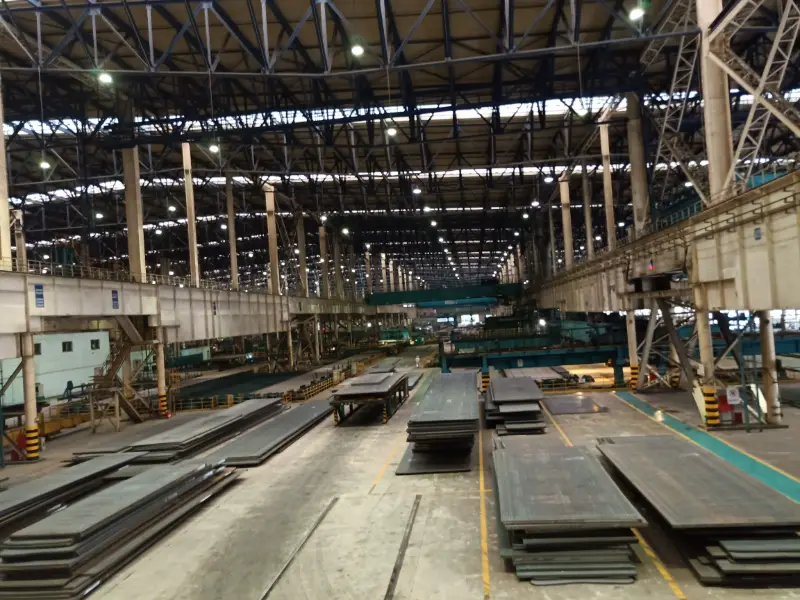
ASTM A533 Grade D Class 1 Pressure Vessel & Boiler Steel Plate
ASTM A533 Grade D Class 1 Pressure Vessel & Boiler Steel Plate
In-depth material data for ASTM A533 Grade D Class 1 (A533 Gr D Cl 1) manganese-molybdenum-nickel alloy steel plate used in boilers and pressure vessels, covering chemical composition, mechanical properties, thermal properties, equivalent grades, and application guidelines.
Hot rolling, quenching, tempering, welding, machining, cold forming, hot forming
- Phone : +8618037372205
- Email : [email protected]
- WhatsApp: Contact via Whtsapp
- WeChat: +8618037372205
ASTM A533 Grade D Class 1 Pressure Vessel & Boiler Steel Plate Introduction
ASTM A533 Grade D Class 1 is a quenched and tempered Mn-Mo-Ni alloy steel plate designed for welded pressure vessels and boilers operating at moderate to low temperatures. It offers excellent notch toughness, high strength, and good weldability, making it a standard choice for critical pressure-retaining components. The Class 1 designation indicates the lower strength level (tensile 550–690 MPa), providing an optimal balance between strength and ductility. Typical applications include nuclear reactor pressure vessels, boiler drums, and heavy-wall heat exchangers. The steel is delivered in the quenched and tempered condition to achieve uniform through-thickness properties.
ASTM A533 Grade D Class 1 Pressure Vessel & Boiler Steel Plate Chemical Composition
The chemical composition limits for ASTM A533 Grade D Class 1 are as specified in ASTM A533/A533M. The steel is a Mn-Mo-Ni alloy with controlled phosphorus and sulfur for improved toughness. Note: Values are maximum unless a range is given.
| Chemical Element | Standard Value (wt%) | Remarks |
|---|---|---|
| Carbon (C) | 0.25 max | Ladle analysis; product analysis tolerance per standard |
| Manganese (Mn) | 1.15 – 1.50 | Essential for strength and hardenability |
| Phosphorus (P) | 0.035 max | Controlled for toughness |
| Sulfur (S) | 0.035 max | Controlled for cleanliness |
| Silicon (Si) | 0.15 – 0.40 | Deoxidizer and strength contributor |
| Molybdenum (Mo) | 0.45 – 0.60 | Enhances hardenability and creep resistance |
| Nickel (Ni) | 0.20 – 0.40 | Improves low-temperature toughness |
ASTM A533 Grade D Class 1 Pressure Vessel & Boiler Steel Plate Thermal and Electrical Physical Properties
The values below are typical literature data for quenched and tempered Mn-Mo-Ni pressure vessel steel in the A533 family. These properties are not mandatory per ASTM A533 but are provided for engineering calculations. Caution: Actual values may vary with production route and plate thickness.
| Property | Standard Requirement | Unit | Test Condition / Remarks |
|---|---|---|---|
| Density (ρ) | 7.85 | g/cm³ | Room temperature |
| Elastic Modulus (E) | 205 | GPa | At 20 °C; decreases with temperature |
| Shear Modulus (G) | 80 | GPa | Approximate value |
| Poisson's Ratio (ν) | 0.3 | – | Typical for steel |
| Thermal Expansion Coefficient (α) | 11.7 | ×10⁻⁶/°C | 20–100 °C range |
| Thermal Expansion Coefficient (α) | 12.2 | ×10⁻⁶/°C | 20–200 °C range |
| Thermal Expansion Coefficient (α) | 12.7 | ×10⁻⁶/°C | 20–300 °C range |
| Thermal Expansion Coefficient (α) | 13.2 | ×10⁻⁶/°C | 20–400 °C range |
| Thermal Expansion Coefficient (α) | 13.7 | ×10⁻⁶/°C | 20–500 °C range |
| Thermal Conductivity (λ) | 40 | W/(m·K) | At 20 °C |
| Thermal Conductivity (λ) | 38 | W/(m·K) | At 100 °C |
| Thermal Conductivity (λ) | 36 | W/(m·K) | At 200 °C |
| Thermal Conductivity (λ) | 34 | W/(m·K) | At 300 °C |
| Thermal Conductivity (λ) | 32 | W/(m·K) | At 400 °C |
| Thermal Conductivity (λ) | 30 | W/(m·K) | At 500 °C |
| Specific Heat Capacity (cp) | 460 | J/(kg·K) | Approximate at 20 °C; rises with temperature |
| Electrical Resistivity (ρe) | 0.20 | µΩ·m | At 20 °C |
ASTM A533 Grade D Class 1 Pressure Vessel & Boiler Steel Plate Mechanical Properties
The following mechanical properties apply to plates in the quenched and tempered condition, tested in the transverse direction per ASTM A370. Charpy V-notch testing is mandatory; the temperature is normally specified by the purchaser (e.g., -40 °F/-40 °C). Requirements can vary with plate thickness; values shown are for common thickness ranges.
| Property | Standard Requirement | Unit | Test Condition / Remarks |
|---|---|---|---|
| Tensile Strength (Rm) | 550 – 690 | MPa | Room temperature, plate thickness ≤ 300 mm (12 in.); 80–100 ksi equivalent |
| Yield Strength (ReH, 0.2% offset) | 345 min | MPa | Minimum 50 ksi; valid for all thicknesses |
| Elongation (A) | 18 min | % | Gauge length 2 in. (50 mm) or 4D; thickness ≤ 2 in. (50 mm); for thicker plates the minimum elongation may be reduced (e.g., 16% for >2–4 in.) per standard |
| Charpy V-Notch Impact Energy | 27 min (average) | J | Test temperature as agreed (typically -40 °F/-40 °C); single minimum 20 J (15 ft·lbf) per ASTM A533 |
| Bend Test (180°) | No cracks | – | Diameter = 3 × specimen thickness for plates ≤ 1 in. (25 mm); for thicker plates see ASTM A533/A533M |
ASTM A533 Grade D Class 1 Pressure Vessel & Boiler Steel Plate Completely Equivalent Standards and Substitutable Grades
| Country/Region | Standard | Grade | Remarks |
|---|---|---|---|
| USA (ASME) | ASME SA-533/SA-533M | Grade D Class 1 | Identical chemistry and mechanical requirements; accepted by the ASME Boiler and Pressure Vessel Code Section II. Direct substitution permitted. |
| Japan | JIS G3120 | SQV2B | Corresponds to ASTM A533 Grade D Class 1 for pressure vessel plates; equivalent strength and toughness class; used in nuclear and thermal power equipment. |
| Germany / Europe | DIN EN 10028-2 | 20MnMoNi5-5 | Quenched and tempered Mn-Mo-Ni steel with similar strength and notch toughness; often used for reactor pressure vessels. Not a direct copy but functionally equivalent for many applications. |
ASTM A533 Grade D Class 1 Pressure Vessel & Boiler Steel Plate Application Introduction
ASTM A533 Grade D Class 1 is widely used for welded pressure vessels, boilers, and nuclear reactor components that demand high strength, good toughness, and homogeneous through‑thickness properties. Its quenched and tempered condition ensures reliable performance in thick sections subjected to moderate and low temperatures. Typical industries and products include:
Product Applications: Nuclear reactor pressure vessel shells and heads, Boiler drums and steam separators, High-pressure heat exchanger shells and channels, Ammonia converters and urea reactors, Hydrocracking and hydrotreating reactors
Processed into products: Cylindrical vessel shells and courses, Hemispherical and ellipsoidal heads, Forged nozzles and manways, Tube sheets for shell-and-tube heat exchangers, Flanges, reinforcing pads, and support skirts
Application industries: Nuclear power generation, Oil & gas processing and refining, Chemical and petrochemical manufacturing, Fossil fuel power plants, Heavy engineering and energy equipment
ASTM A533 Grade D Class 1 Pressure Vessel & Boiler Steel Plate Similar or Closely Related Substitute Materials
| Country/Region | Standard | Grade | Remarks |
|---|---|---|---|
| USA | ASTM A533/A533M | Grade B Class 1 | Mn-Mo steel (without Ni) with similar strength; lower low-temperature toughness. Suitable where Ni is not required. |
| USA | ASTM A533/A533M | Grade C Class 1 | Contains higher Ni (0.40–0.70 %) and similar Mn-Mo; offers better toughness and can be used as an alternative when enhanced low‑temperature performance is needed. |
| USA | ASTM A302/A302M | Grade D | Mn-Mo alloy steel plate for pressure vessels; typically supplied in normalized or as‑rolled condition; lower strength than quenched and tempered A533 but used in similar moderate‑temperature service. |
| Europe | DIN EN 10028-2 | 13CrMo4-5 | Cr-Mo creep‑resistant steel; different alloy design but often used in pressure vessels at elevated temperatures. Requires evaluation for substitution due to different hardenability and weldability. |
Notes:
Welding and PWHT: The steel has good weldability with low-hydrogen processes. Preheat (typically 150–200 °C) and post-weld heat treatment (PWHT) around 600–650 °C are recommended depending on thickness and applicable construction codes (ASME Section VIII, III).
Supplementary requirements: ASTM A533 allows additional testing such as ultrasonic examination, elevated temperature tensile tests, and simulated post-weld heat treated mechanical testing. These must be agreed upon at the time of order.
Thickness limitation: Grade D Class 1 plates are commonly available up to 12 in. (300 mm); greater thicknesses may be achievable but require prior qualification.
- Share



