
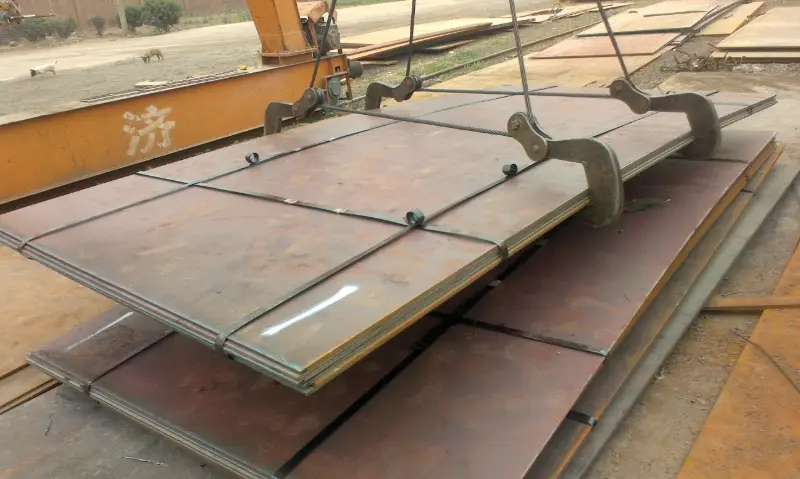
ASTM A533 Grade D Class 2 Pressure Vessel Steel Plate
ASTM A533 Grade D Class 2 Pressure Vessel Steel Plate - Properties, Equivalents & Applications
Comprehensive material data sheet for ASTM A533 Grade D Class 2 (Mn-Mo-Ni alloy steel plate), including chemical composition, mechanical and physical properties, international equivalents, and application guide.
Hot rolled, Quenched and Tempered, Welding, Machining, Forming
- Phone : +8618037372205
- Email : [email protected]
- WhatsApp: Contact via Whtsapp
- WeChat: +8618037372205
ASTM A533 Grade D Class 2 Pressure Vessel Steel Plate Introduction
ASTM A533 Grade D Class 2 is a manganese-molybdenum-nickel alloy steel plate intended for welded pressure vessels and boilers. Supplied in the quenched and tempered condition, it offers high strength and good toughness at low and moderate temperatures. The nominal composition includes controlled levels of Mn, Mo, and Ni to enhance hardenability and high-temperature performance. This grade belongs to the A533 Type D family and is designated as Class 2, indicating higher minimum tensile strength (80–100 ksi / 550–690 MPa) compared to Class 1. Typical thicknesses range from 2.5 to 6 inches (65–150 mm), with corresponding variations in yield strength. The material is widely used in the fabrication of thick-walled pressure vessels for the nuclear, petrochemical, and power generation industries.
ASTM A533 Grade D Class 2 Pressure Vessel Steel Plate Chemical Composition
The chemical composition of ASTM A533 Grade D Class 2 is specified to ensure hardenability, strength, and toughness.
- Carbon is limited to 0.25% max to maintain weldability.
- Manganese and molybdenum provide solid solution strengthening and hardenability.
- Nickel improves low-temperature toughness and reduces ductile-to-brittle transition temperature.
- Phosphorus and sulfur are tightly controlled to minimize embrittlement.
- Silicon is added for deoxidation.
| Chemical Element | Standard Value (wt%) | Remarks |
|---|---|---|
| Carbon (C) | 0.25 max | Ladle analysis |
| Manganese (Mn) | 1.15 – 1.50 | Plate thickness dependence applies for product analysis |
| Phosphorus (P) | 0.025 max | Product analysis may allow up to 0.035% |
| Sulfur (S) | 0.025 max | |
| Silicon (Si) | 0.15 – 0.40 | |
| Molybdenum (Mo) | 0.45 – 0.60 | |
| Nickel (Ni) | 0.40 – 0.70 |
ASTM A533 Grade D Class 2 Pressure Vessel Steel Plate Thermal and Electrical Physical Properties
The following physical properties are representative for Mn-Mo-Ni alloy steel in the quenched and tempered condition at room temperature unless otherwise noted. Values may vary slightly depending on exact composition and heat treatment.
- Density is typical for low-alloy steel.
- Elastic modulus decreases with increasing temperature.
- Thermal expansion and conductivity data are average values over the indicated temperature range.
| Property | Typical Value | Unit | Test Condition |
|---|---|---|---|
| Density (ρ) | 7.85 | g/cm³ | Room temperature |
| Elastic Modulus (E) | 200 – 210 | GPa | RT |
| Shear Modulus (G) | ~80 | GPa | RT |
| Poisson's Ratio (ν) | 0.29 – 0.30 | – | RT |
| Thermal Expansion Coefficient (α) | 12.0 – 13.5 | µm/m·°C | 20–400 °C |
| Thermal Conductivity (λ) | 38 – 42 | W/m·K | 100 °C |
| Thermal Conductivity (λ) | 36 – 40 | W/m·K | 200 °C |
| Thermal Conductivity (λ) | 33 – 37 | W/m·K | 300 °C |
| Specific Heat Capacity (cp) | 460 – 490 | J/kg·K | 100–300 °C |
| Electrical Resistivity (ρ_e) | 0.20 – 0.30 | µΩ·m | RT |
ASTM A533 Grade D Class 2 Pressure Vessel Steel Plate Mechanical Properties
Tensile properties are determined on transverse specimens from the plate. Yield strength and tensile strength requirements vary with plate thickness. Elongation is measured in 2 in. (50 mm) gauge length. Impact toughness is not a mandatory part of the base specification but is commonly specified via supplementary requirement S5 at a designated temperature (e.g., 27 J at −20 °C).
| Property | Standard Required Value | Unit | Test Condition / Thickness |
|---|---|---|---|
| Yield Strength (0.2% offset, ReH) | 485 min (70 ksi) | MPa (ksi) | t ≤ 65 mm (2.5 in) |
| Yield Strength (0.2% offset, ReH) | 450 min (65 ksi) | MPa (ksi) | 65 < t ≤ 100 mm (2.5–4 in) |
| Yield Strength (0.2% offset, ReH) | 415 min (60 ksi) | MPa (ksi) | 100 < t ≤ 150 mm (4–6 in) |
| Tensile Strength (Rm) | 550 – 690 (80 – 100 ksi) | MPa (ksi) | t ≤ 100 mm (4 in) |
| Tensile Strength (Rm) | 515 – 655 (75 – 95 ksi) | MPa (ksi) | 100 < t ≤ 150 mm (4–6 in) |
| Elongation (A) | 18 min | % in 2 in (50 mm) | t ≤ 65 mm (2.5 in) |
| Elongation (A) | 16 min | % in 2 in (50 mm) | t > 65 mm (>2.5 in) |
ASTM A533 Grade D Class 2 Pressure Vessel Steel Plate Fully Equivalent Standards and Grades
| Country / Region | Standard | Grade / Designation | Remarks |
|---|---|---|---|
| USA | ASME SA533 | SA533 Grade D Class 2 | Identical material accepted under ASME Boiler and Pressure Vessel Code (BPVC) |
| USA | ASTM A533/A533M | Grade D Class 2 | Original specification |
ASTM A533 Grade D Class 2 Pressure Vessel Steel Plate Application Introduction
ASTM A533 Grade D Class 2 is designed for heavy-duty pressure-retaining components. Its combination of high strength, toughness, and weldability makes it suitable for demanding environments.
- Typically used in plate thicknesses from 50 mm up to 150 mm.
- Requires careful welding practices (preheat, post-weld heat treatment) to avoid cold cracking.
- Charpy impact toughness is often specified at minimum design metal temperature.
- Compliant with ASME Section II and Section VIII for pressure vessel construction.
Product Applications: Pressure vessel shells and heads (hemispherical, ellipsoidal), Boiler drums and steam drums, Heat exchanger shells and channel barrels, Tube sheets and flanges for high-pressure service, Spherical gas storage vessels (LPG, LNG, hydrogen)
Processed into products: Cylindrical shell segments (rolled and welded), Forged or formed dished heads, Thick-walled nozzles and reinforcement pads, Support skirts and base rings, Tube sheets with drilled holes, Blind flanges and manway covers
Application industries: Nuclear power generation (reactor pressure vessels, steam generator shells), Petrochemical and refining (hydrocrackers, ammonia converters, heat exchangers), Chemical processing (reactors, autoclaves, high-pressure storage), Compressed gas storage (bullets, spherical vessels), Thermal power plants (boiler drums, headers)
ASTM A533 Grade D Class 2 Pressure Vessel Steel Plate Similar or Comparable Grades
| Country / Region | Standard | Grade / Designation | Remarks |
|---|---|---|---|
| European Union | EN 10028-2 | 18MnMoNi5-5 (1.6375) | Mn-Mo-Ni alloy; typical strength class 420–580 MPa yield; may require additional testing for substitution. |
| China | GB/T 6654 | 18MnMoNbR | Contains Nb; similar application in pressure vessels; not fully equivalent. |
| Japan | JIS G 3119 | SQV2B | Mn-Mo-Ni steel for boiler and pressure vessels; similar tensile properties. |
| International | ISO 9328-2 | 18MnMoNi5-5 | Identical to EN grade; often referenced together. |
Notes:
Supplementary Requirements: When specified, supplementary requirements such as Charpy V-notch impact testing (S5), ultrasonic examination (S8), or simulated post-weld heat treatment (S10) apply.
- For nuclear applications, additional requirements from ASME Section III may be imposed.
- Plates are normally ordered to ASTM A533/A533M in SI units (megapascals), but dual-unit marking is common.
- Product analysis tolerances are per ASTM A533; for high-stress areas, additional testing may be agreed upon.
- The steel is not intended for service above ~370°C (700°F) because of temper embrittlement risks.
- Share



