
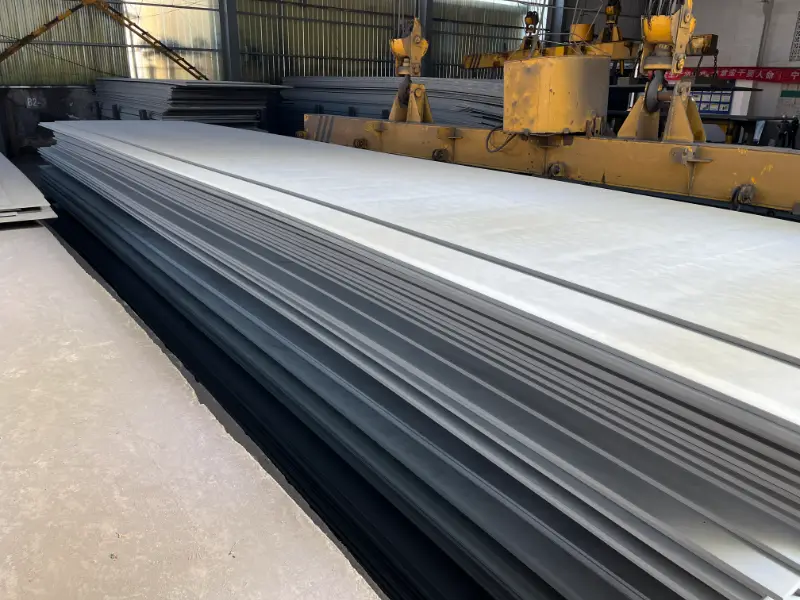
ASTM A533 Grade D Class 3 Pressure Vessel Steel Plate
ASTM A533 Grade D Class 3 Pressure Vessel Steel Plate: High-Strength Quenched & Tempered Mn-Mo-Ni Alloy
Detailed composition, mechanical properties, thermal/physical data, global equivalents, and application guidance for ASTM A533 Grade D Class 3 steel plate used in heavy-wall pressure vessels and boilers.
Hot rolling, austenitizing, water quenching, tempering
- Phone : +8618037372205
- Email : [email protected]
- WhatsApp: Contact via Whtsapp
- WeChat: +8618037372205
ASTM A533 Grade D Class 3 Pressure Vessel Steel Plate Introduction
ASTM A533 Grade D Class 3 is a quenched and tempered manganese‑molybdenum‑nickel alloy steel plate specifically designed for high‑temperature and high‑pressure service in welded boilers and pressure vessels. It offers exceptionally high tensile and yield strength (min YS 620 MPa, TS 690–860 MPa) combined with good toughness, making it suitable for thick‑section constructions. The controlled nickel addition (0.20–0.40%) enhances hardenability and low‑temperature toughness, while molybdenum (0.45–0.60%) provides creep resistance at elevated temperatures. Class 3 is the highest strength level of the A533 family, typically used for nuclear reactor pressure vessels, heavy chemical reactors, and large steam generators where design stresses demand superior mechanical properties. The material is supplied in the quenched and tempered condition and meets the rigorous requirements of ASTM A533/A533M, often supplemented by Charpy V‑notch impact tests per ASME SA‑20 or specification S5.
ASTM A533 Grade D Class 3 Pressure Vessel Steel Plate Chemical Composition
Typical ladle analysis limits according to ASTM A533/A533M for Grade D Class 3 plates. Elements not listed are typically residual (Cu ≤0.35%, etc.) with no specified control unless agreed. Values are in weight %.
| Chemical Element | Standard Value (wt%) | Remarks |
|---|---|---|
| Carbon (C) | ≤0.25 | Maximum allowable |
| Manganese (Mn) | 1.15–1.50 | For strength and hardenability |
| Phosphorus (P) | ≤0.025 | Maximum for cleanliness |
| Sulfur (S) | ≤0.025 | Maximum for cleanliness |
| Silicon (Si) | 0.15–0.40 | Deoxidizer and strength contributor |
| Nickel (Ni) | 0.20–0.40 | Improves toughness and hardenability |
| Molybdenum (Mo) | 0.45–0.60 | Creep resistance and strength |
ASTM A533 Grade D Class 3 Pressure Vessel Steel Plate Thermal and Electrical Physical Properties
These values are typical for a quenched and tempered Mn‑Mo‑Ni alloy steel and are not normative. They may vary slightly with exact composition and heat treatment.
| Property | Typical Value | Unit | Reference Condition |
|---|---|---|---|
| Density (ρ) | 7.85 | g/cm³ | At 20 °C |
| Elastic Modulus (E) | 205 | GPa | At room temperature |
| Shear Modulus (G) | 80 | GPa | At room temperature |
| Poisson's Ratio (ν) | 0.3 | – | At room temperature |
| Thermal Expansion Coefficient (α) | 11.7 | 10⁻⁶/K | Between 20 °C and 100 °C |
| Thermal Conductivity (λ) | 40 | W/(m·K) | At 20 °C |
| Specific Heat Capacity (cp) | 460 | J/(kg·K) | At 20 °C |
| Electrical Resistivity (ρₑ) | 0.15 | µΩ·m | At 20 °C |
ASTM A533 Grade D Class 3 Pressure Vessel Steel Plate Mechanical Properties
Mechanical properties for quenched and tempered ASTM A533 Grade D Class 3 plate as per specification. Values may vary with plate thickness. Charpy V‑notch impact requirements (longitudinal) are usually specified via supplementary requirement S5 and can be as low as −40°C at 27 J min transverse.
| Property | Standard Requirement | Unit | Test Condition |
|---|---|---|---|
| Yield Strength (ReH, min) | 620 (90) | MPa (ksi) | At room temperature, plate thickness ≤2.5 in. (63.5 mm) |
| Tensile Strength (Rm) | 690–860 (100–125) | MPa (ksi) | At room temperature |
| Elongation (A, min) | 18 | % | In 2 in. (50 mm) gauge, plate thickness ≤2 in. (50 mm) |
| Elongation (A, min) | 16 | % | In 2 in. (50 mm) gauge, plate thickness 2–4 in. (50–100 mm) |
| Charpy Impact (KV, typical) | 27 (20) at -40°C (-40°F) | J (ft·lbf) | Longitudinal, V‑notch; often required by supplemental S5 |
ASTM A533 Grade D Class 3 Pressure Vessel Steel Plate Completely Equivalent Material Standards and Replaceable Grades
| Country/Region | Standard | Grade | Remarks |
|---|---|---|---|
| USA | ASME SA533/SA533M | Grade D Class 3 | Identical material under the ASME Boiler and Pressure Vessel Code, Section II, Part A. |
ASTM A533 Grade D Class 3 Pressure Vessel Steel Plate Application Introduction
ASTM A533 Grade D Class 3 is a workhorse material for heavy, welded pressure‑retaining components that require high strength, good notch toughness, and reliable performance under static and cyclic loads. It is extensively used where design stresses approach 620 MPa yield and service temperatures may be from moderate to elevated (typically up to 370°C/700°F). The quenched and tempered microstructure provides a fine grain structure essential for resistance to brittle fracture.
Product Applications: Nuclear reactor pressure vessel shells and heads, Large steam generators and superheater drums, Petrochemical hydrotreating and hydrocracking reactors, High‑pressure process columns and ammonia converters, Pressure vessel sections for coal gasification and liquefaction plants
Processed into products: Cylindrical shell plates (rolled and welded rings), Dished and hemispherical heads (hot formed or spun), Tube sheets and flanges for high‑pressure heat exchangers, Transition rings and reinforcement pads for nozzles, Integrally forged vessel components (when fabricated from plate by welding)
Application industries: Nuclear power generation (reactor pressure vessels, steam generators), Petrochemical and refining (hydrocracking reactors, high‑pressure separators), Boiler and heat exchanger fabrication, Power plant engineering (steam drums, high‑energy piping supports), Offshore and heavy civil engineering (specialized high‑strength structural applications)
ASTM A533 Grade D Class 3 Pressure Vessel Steel Plate Similar/Comparable Substitute Materials
| Country/Region | Standard | Grade | Remarks |
|---|---|---|---|
| Europe | EN 10028-2 | 13MnNiMo5‑4 (1.6359) | Similar high‑strength pressure vessel steel with Ni 0.85‑1.15% (higher than A533 Gr.D), Tensile 610‑780 MPa, Yield min 460 MPa. Used for heavy‑wall vessels but not identical. |
| Japan | JIS G3120 | SQV2B | Quenched & tempered Mn‑Mo‑Ni steel for pressure vessels; Ni 0.60‑1.00%, higher than A533 Gr.D. Tensile 620‑790 MPa, Yield min 490 MPa. Suitable for similar applications but check exact design code equivalence. |
| China | GB 713 | 15MnNiDR | Low‑temperature pressure vessel steel with lower strength; not a direct substitute but used for similar vessel types at moderate temperatures. |
Notes:
Welding must follow qualified procedures using low‑hydrogen electrodes or submerged arc processes to avoid cold cracking. Post‑weld heat treatment (PWHT) is typically required according to code rules (e.g., ASME Section VIII or III) to relieve residual stresses. Impact testing at low temperature (‑40°C or lower) is frequently mandated via supplementary specification S5 for nuclear or critical service. Surface condition and ultrasonic testing per ASTM A578 may be specified to ensure internal soundness of heavy plates.
- Share



