
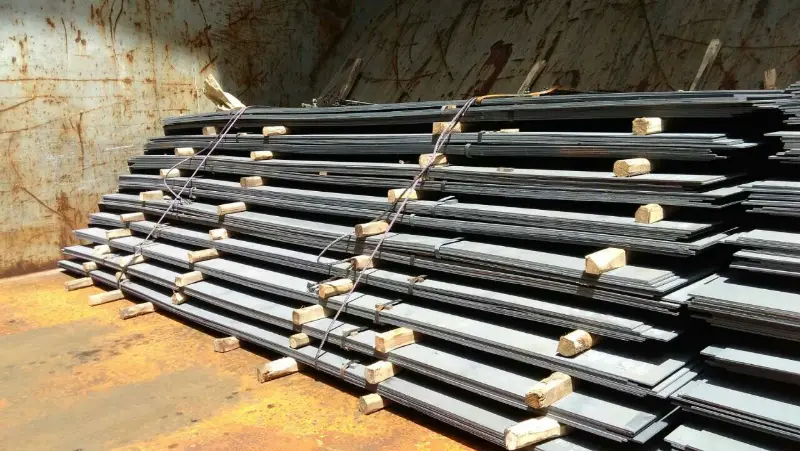
SUS429 Stainless Steel Plate/Coil
SUS429 Ferritic Stainless Steel Plate/Coil | JIS Standard Material Data
Complete material data sheet for SUS429 ferritic stainless steel plate/coil: chemical composition, mechanical properties, physical properties, international equivalents, and application guide.
Cold forming, deep drawing, bending, welding (with preheating and post-weld annealing recommended), machining
- Phone : +8618037372205
- Email : [email protected]
- WhatsApp: Contact via Whtsapp
- WeChat: +8618037372205
SUS429 Stainless Steel Plate/Coil Introduction
SUS429 is a standard ferritic stainless steel grade specified in JIS G4304 and G4305. It contains 14-16% chromium as the primary alloying element, offering good corrosion resistance and formability at a lower cost than austenitic grades. The material is magnetic, cannot be hardened by heat treatment, and is commonly supplied in annealed condition. Key characteristics:
- Moderate corrosion resistance in mild environments
- Good ductility and deep drawability
- Excellent resistance to stress corrosion cracking
- Suitable for welding with appropriate filler metals
Widely used for automotive exhaust components, kitchenware, and architectural trim.
SUS429 Stainless Steel Plate/Coil Chemical Composition
Chemical composition according to JIS G4304 for SUS429 stainless steel. Nickel is typically a residual element and is not intentionally added. All values are maximum unless a range is indicated.
| Chemical Element | Standard Value (wt%) | Remarks |
|---|---|---|
| Carbon (C) | ≤0.12 | |
| Silicon (Si) | ≤1.00 | |
| Manganese (Mn) | ≤1.00 | |
| Phosphorus (P) | ≤0.040 | |
| Sulfur (S) | ≤0.030 | |
| Chromium (Cr) | 14.00 - 16.00 | |
| Nickel (Ni) | ≤0.60 | Typically residual |
| Iron (Fe) | Balance |
SUS429 Stainless Steel Plate/Coil Thermal and Electrical Physical Properties
Typical physical properties for SUS429 stainless steel at room temperature unless specified otherwise. These values are representative for ferritic stainless steels in annealed condition.
| Property | Typical Value | Unit | Test Condition / Temperature |
|---|---|---|---|
| Density (ρ) | 7.70 | g/cm³ | 20°C |
| Modulus of Elasticity (E) | 200 | GPa | 20°C |
| Shear Modulus (G) | 77 | GPa | 20°C |
| Poisson's Ratio (ν) | 0.27 | - | 20°C |
| Thermal Expansion Coefficient (α) | 10.4 | 10⁻⁶/K | 20–100°C |
| Thermal Expansion Coefficient (α) | 11.1 | 10⁻⁶/K | 20–500°C |
| Thermal Conductivity (λ) | 25.0 | W/(m·K) | at 100°C |
| Specific Heat Capacity (Cp) | 460 | J/(kg·K) | 20°C |
| Electrical Resistivity (ρ_e) | 0.60 | μΩ·m | 20°C |
SUS429 Stainless Steel Plate/Coil Mechanical Properties
Mechanical properties as per JIS G4304 for annealed SUS429 stainless steel plate. Elongation values vary with thickness; the table shows the minimum elongation for sheet thickness ≤8 mm. Hardness values are for reference.
| Property | Standard Requirement (min/max) | Unit | Test Condition |
|---|---|---|---|
| Tensile Strength (Rm) | ≥450 | MPa | Room temperature, annealed |
| Yield Strength (ReH) | ≥205 | MPa | Room temperature, 0.2% offset |
| Elongation (A) | ≥22 | % | Thickness ≤8 mm, gauge length 50 mm |
| Hardness (HBW) | ≤183 | - | As annealed |
| Hardness (HRB) | ≤88 | - | As annealed |
SUS429 Stainless Steel Plate/Coil Direct Equivalent Standards and Substitutable Grades
| Country/Region | Standard | Grade | Remarks |
|---|---|---|---|
| Japan | JIS G4304 / JIS G4305 | SUS429 | Original specification |
| USA | ASTM A240/A240M | Type 429 (UNS S42900) | Chemically equivalent |
| International | ISO 15510 | X6Cr15 | Comparable ferritic grade |
SUS429 Stainless Steel Plate/Coil Application Introduction
SUS429 stainless steel is widely used in applications requiring moderate corrosion resistance and good formability. It is especially suitable for components that operate at elevated temperatures up to ~700°C and where austenitic grades would be too expensive or unnecessary. Processing considerations:
- Good deep drawing quality – ideal for sinks, pans, and kitchen equipment
- Welding: use low heat input; filler metal AWS E/ER430 or austenitic 309L for dissimilar joints
- Post-weld annealing at 760–820°C restores ductility and corrosion resistance
- Machinability is similar to other ferritic stainless steels; use sharp tools and adequate cooling
Product Applications: Welded exhaust pipes and mufflers, Domestic sinks and dishwashers, Stamped and deep-drawn kitchen utensils, Heat exchanger plates and tubes, Architectural cladding and flashings
Processed into products: Exhaust manifold components, Boiler baffles and combustion chambers, Deep-drawn pots and pans, Decorative trim and nameplates, Chemical mixing tanks and hoppers
Application industries: Automotive (exhaust systems, mufflers, catalytic converter shells), Food processing and kitchenware (sinks, countertops, cutlery), Architectural and construction (trim, decorative panels, roofing), Chemical and petrochemical (low-corrosion equipment, heat exchangers)
SUS429 Stainless Steel Plate/Coil Similar or Alternative Stainless Steels
| Country/Region | Standard | Grade | Remarks |
|---|---|---|---|
| Japan | JIS G4304 | SUS430 | Higher Cr (16–18%), better corrosion resistance, similar mechanical properties; most common ferritic grade. |
| USA | ASTM A240 | Type 430 (UNS S43000) | Equivalent to SUS430, widely available, better oxidation resistance than 429. |
| Japan | JIS G4304 | SUS409L | Lower Cr (10.5–11.7%), stabilized with Ti, used in automotive exhausts, lower cost but less corrosion resistance. |
| USA | ASTM A240 | Type 410S (UNS S41008) | 12% Cr martensitic-ferritic with low carbon, higher strength but lower ductility; modified for welding. |
Notes:
Note: SUS429 is often confused with SUS430. While similar, the lower chromium content of SUS429 provides slightly less corrosion resistance and may be preferred for cost-sensitive applications where the environment is less aggressive. The grade is not typically recommended for welding heavy sections without preheating and post-weld heat treatment to avoid embrittlement. Always refer to the latest JIS standards for exact tolerance and acceptance criteria.
- Share



