
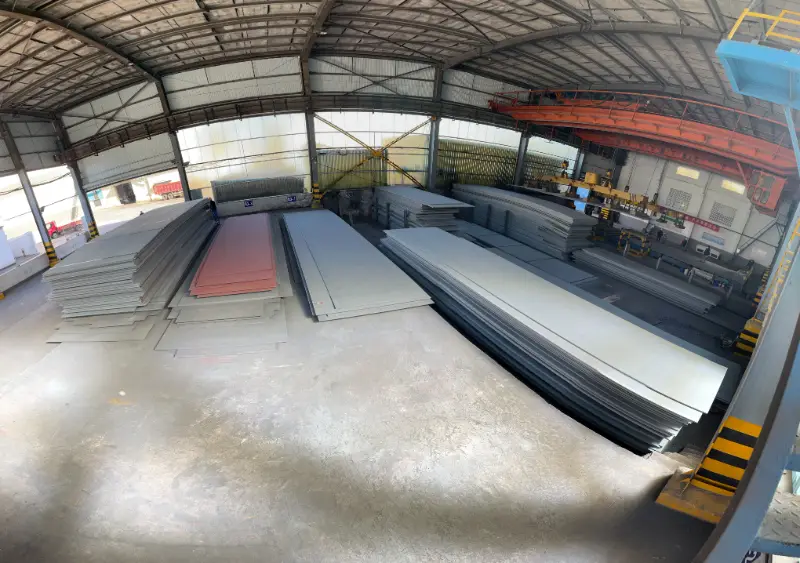
ASTM A533 Grade B Class 2 Pressure Vessel Steel Plate
ASTM A533 Grade B Class 2 Pressure Vessel Steel Plate - Properties, Equivalents & Applications
Complete material data for ASTM A533 Grade B Class 2 quenched and tempered Mn-Mo-Ni alloy steel plate for pressure vessels and boilers: chemical composition, mechanical and physical properties, international equivalents and similar grades.
Hot rolling, quenching and tempering, welding (with preheat and post-weld heat treatment as required), cutting, forming
- Phone : +8618037372205
- Email : [email protected]
- WhatsApp: Contact via Whtsapp
- WeChat: +8618037372205
ASTM A533 Grade B Class 2 Pressure Vessel Steel Plate Introduction
ASTM A533 Grade B Class 2 is a quenched and tempered manganese-molybdenum-nickel alloy steel plate intended for use in welded pressure vessels and boilers. It is covered by ASTM A533/A533M and is classified as a low-alloy steel with high strength and good notch toughness at low temperatures. The addition of nickel improves hardenability and low-temperature impact properties. Typical applications include nuclear reactor pressure vessels, thick-wall high-pressure separators, heat exchangers and large boiler drums. The material is commonly delivered in the quenched and tempered condition and can be readily welded with low-hydrogen processes. Its minimum yield strength is 485 MPa, and the tensile strength ranges from 620 to 795 MPa, making it suitable for heavy-walled structures in aggressive environments.
ASTM A533 Grade B Class 2 Pressure Vessel Steel Plate Chemical Composition
Chemical requirements for ASTM A533 Grade B Class 2 as per ASTM A533/A533M. All values are maximum unless a range is given. The specified elements control hardenability, toughness, and weldability. Residual elements are strictly limited to avoid temper embrittlement.
| Element | Content (%) | Notes |
|---|---|---|
| Carbon (C) | ≤ 0.25 | Max |
| Manganese (Mn) | 1.15 – 1.50 | Range |
| Phosphorus (P) | ≤ 0.025 | Max |
| Sulfur (S) | ≤ 0.025 | Max |
| Silicon (Si) | 0.15 – 0.40 | Range |
| Molybdenum (Mo) | 0.45 – 0.60 | Range |
| Nickel (Ni) | 0.40 – 0.70 | Range |
| Copper (Cu) | ≤ 0.35 (typical) | Residual |
| Chromium (Cr) | ≤ 0.25 (typical) | Residual |
| Vanadium (V) | ≤ 0.03 (typical) | Residual |
| Tin (Sn) | ≤ 0.020 (typical) | Residual; controlled for toughness |
| Antimony (Sb) | ≤ 0.003 (typical) | Residual |
ASTM A533 Grade B Class 2 Pressure Vessel Steel Plate Thermal and Electrical Physical Properties
Typical physical properties for A533 Grade B Class 2 steel in the quenched and tempered condition. These values are not specified in ASTM A533/A533M and are provided for engineering calculations. Density, modulus, and thermal expansion data are reliable for design. Thermal conductivity decreases with increasing temperature.
| Property | Typical Value | Unit | Test Condition |
|---|---|---|---|
| Density (ρ) | 7850 | kg/m³ | 20 °C |
| Modulus of Elasticity (E) | 205 | GPa | 20 °C |
| Shear Modulus (G) | 80 | GPa | 20 °C |
| Poisson's Ratio (ν) | 0.30 | — | 20 °C |
| Thermal Expansion Coefficient (α) | 11.5 | µm/m·K | 20 – 100 °C |
| Thermal Expansion Coefficient (α) | 12.2 | µm/m·K | 20 – 200 °C |
| Thermal Expansion Coefficient (α) | 13.0 | µm/m·K | 20 – 400 °C |
| Thermal Conductivity (λ) | 45 | W/m·K | 20 °C |
| Thermal Conductivity (λ) | 42 | W/m·K | 200 °C |
| Thermal Conductivity (λ) | 38 | W/m·K | 400 °C |
| Specific Heat Capacity (cₚ) | 460 | J/kg·K | 20 °C |
| Electrical Resistivity (ρₑ) | 0.23 | µΩ·m | 20 °C |
ASTM A533 Grade B Class 2 Pressure Vessel Steel Plate Mechanical Properties
Minimum specified tensile and impact properties for ASTM A533 Grade B Class 2 plates in the quenched and tempered condition. Values apply to plates up to 50 mm thickness unless otherwise noted. For thicker plates, slight derating may apply per ASTM A533/A533M. Impact testing is usually required per supplementary requirement S5 at a temperature agreed upon; typical temperature is -18 °C.
| Property | Specification Value | Unit | Test Condition |
|---|---|---|---|
| Yield Strength (ReH) | ≥ 485 | MPa | Room temperature, 0.2% offset |
| Tensile Strength (Rm) | 620 – 795 | MPa | Room temperature |
| Elongation (A50) | ≥ 16 | % | Gauge length 50 mm (2 in), transverse |
| Elongation (A200) | ≥ 18 | % | Gauge length 200 mm (8 in), transverse |
| Reduction of Area (Z) | ≥ 35 (typical) | % | Room temperature |
| Bend Test | 180° bend, d = 3a, no cracks | — | Bend diameter 3 × thickness; specimen width ≥ 38 mm |
| Charpy Impact (KV) | ≥ 27 | J | Transverse, at -18 °C (0 °F) or as agreed |
| Hardness | ≤ 235 HBW (typical) | HBW | Reference after tempering |
ASTM A533 Grade B Class 2 Pressure Vessel Steel Plate Fully Equivalent Standards and Replaceable Grades
| Country / Region | Standard | Grade | Notes |
|---|---|---|---|
| USA | ASME SA-533 / SA-533M | SA-533 Grade B Class 2 | Identical adoption of ASTM A533 under ASME BPVC |
| Europe | EN 10028-2 | 13MnNiMo5-4 | Chemical and mechanical equivalents; minor differences in Mn range |
| Japan | JIS G3118 | SQV2B Class 2 | Designed to match ASTM A533 Gr.B Cl.2 properties |
| China | GB/T 150.2 | 13MnNiMoR | Approximate equivalent; similar target strength and toughness |
ASTM A533 Grade B Class 2 Pressure Vessel Steel Plate Application Introduction
ASTM A533 Grade B Class 2 steel is widely used in critical pressure-containing equipment requiring high strength and good toughness at subzero temperatures. Its excellent weldability and heat-treatment response make it a standard choice for heavy-wall pressure vessels in energy and process industries. Below are typical application areas:
Product Applications: Reactor pressure vessels for PWR/BWR nuclear plants, Ammonia synthesis converters, Hydrocracking reactors, High-pressure heat exchanger shells, Boiler drums and superheater headers, Liquefied gas storage tanks (heavy walls)
Processed into products: Cylindrical shells and hemispherical heads of pressure vessels, Thick-wall nozzles and manways, Tube sheets for heat exchangers, Forged flanges when matched with plate material, Support skirts and structural attachments
Application industries: Nuclear power generation (reactor pressure vessels, steam generators), Petrochemical and refinery (hydrocrackers, heavy-wall reactors, high-pressure separators), Power generation (boiler drums, steam drums, headers), Chemical processing (ammonia converters, urea reactors), Oil & gas (high-pressure storage spheres, thick-wall pipelines)
ASTM A533 Grade B Class 2 Pressure Vessel Steel Plate Comparable/Similar Alternative Materials
| Country / Region | Standard | Grade | Notes |
|---|---|---|---|
| USA | ASTM A533/A533M | Grade A Class 2 | Same strength level but without nickel; lower low-temperature toughness |
| USA | ASTM A533/A533M | Grade C Class 2 | Higher nickel (0.70–1.00%) for improved toughness, suitable for thicker sections |
| USA | ASTM A533/A533M | Grade D Class 2 | Contains Ni (0.20–0.40%) and higher Mn; different balance of properties |
| USA | ASTM A302/A302M | Grade B | Lower strength class (Mn-Mo-Ni), yield 345 MPa, used in moderate pressure vessels |
| Europe | EN 10028-2 | 15NiCuMoNb5-6-4 | Higher Ni and Cu, similar heat resistance, often used in boiler construction |
Notes:
ASME Adoption: ASME SA-533 Grade B Class 2 is identical to ASTM A533 Gr. B Cl.2 and meets the requirements of the ASME Boiler and Pressure Vessel Code, Section II, Part A.
Welding: Low-hydrogen welding processes are recommended. Preheat (typically 150–200°C) and post-weld heat treatment (PWHT) are required for thicknesses above a certain limit to avoid cold cracking and stress relief.
Notch Toughness: Supplementary requirement S5 (Charpy V-notch test) is almost always specified. Typical test temperature is -18°C (0°F) or -12°C (10°F), but the user may specify lower values. The steel can maintain adequate toughness down to -40°C if properly controlled.
Ultrasonic Examination: Often required per ASTM A435 or A578 for internal soundness in thicker plates.
- Share



