
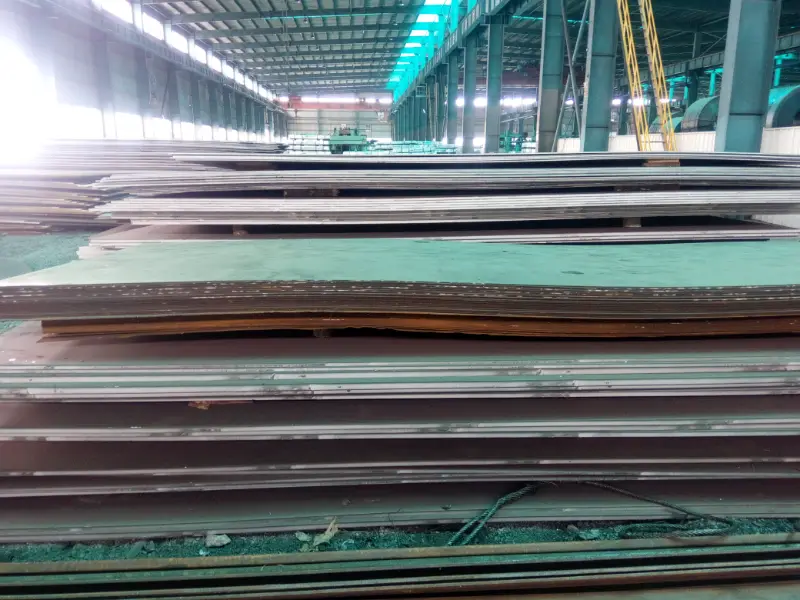
ASTM A533 GRBCL3 Pressure Vessel Steel Plate
ASTM A533 GRBCL3 Pressure Vessel Steel Plate - High Strength Mn-Mo-Ni Alloy for Low Temperature Service
Comprehensive data sheet for ASTM A533 Grade B Class 3 pressure vessel steel plate, including chemical composition, mechanical properties, thermal and electrical properties, international equivalents, and application guidelines.
Hot rolling, quenching, tempering, cutting, welding, forming (cold or hot), machining
- Phone : +8618037372205
- Email : [email protected]
- WhatsApp: Contact via Whtsapp
- WeChat: +8618037372205
ASTM A533 GRBCL3 Pressure Vessel Steel Plate Introduction
ASTM A533 Grade B Class 3 is a quenched and tempered manganese-molybdenum-nickel alloy steel plate designed for welded pressure vessels and boilers operating at low to moderate temperatures. It belongs to the ASTM A533/A533M standard and offers high tensile strength (550–690 MPa) combined with excellent notch toughness at sub-zero temperatures. The Class 3 designation indicates the highest strength level within the grade, achieved through a proprietary heat treatment. Typical applications include thick-walled reactor vessels, steam drums, and industrial columns in petrochemical, chemical, and power generation plants. The steel exhibits good weldability and resistance to brittle fracture, making it suitable for critical service conditions where safety and reliability are paramount.
ASTM A533 GRBCL3 Pressure Vessel Steel Plate Chemical Composition
The chemical composition of ASTM A533 Grade B Class 3 is carefully controlled to ensure deep hardenability and toughness at low temperatures. The alloy design relies on manganese, nickel, and molybdenum additions to achieve the required strength level after quenching and tempering. Residual elements are kept at minimum levels to maintain ductility and weldability.
| Element | Specified Value (wt%) | Remarks |
|---|---|---|
| Carbon (C) | ≤ 0.25 | maximum for base metal; for product analysis, max 0.27 |
| Manganese (Mn) | 1.15 – 1.50 | for plates up to 65 mm; contributes to strength and hardenability |
| Phosphorus (P) | ≤ 0.025 | maximum to avoid temper embrittlement |
| Sulfur (S) | ≤ 0.025 | maximum to ensure cleanliness and toughness |
| Silicon (Si) | 0.15 – 0.40 | deoxidizer and strength contributor |
| Nickel (Ni) | 0.40 – 0.70 | improves low-temperature toughness |
| Molybdenum (Mo) | 0.45 – 0.60 | enhances hardenability and creep resistance |
ASTM A533 GRBCL3 Pressure Vessel Steel Plate Thermal and Electrical Physical Properties
The following data are representative for ASTM A533 Grade B Class 3 steel in the quenched and tempered condition. Actual values may vary slightly depending on the exact heat composition and tempering temperature. These properties are useful for design calculations involving heat transfer, expansion, and electrical resistance.
| Property | Typical Value | Unit | Test Condition / Remarks |
|---|---|---|---|
| Density (ρ) | 7850 | kg/m³ | At 20 °C |
| Elastic Modulus (E) | 205 | GPa | At 20 °C, dynamic method |
| Shear Modulus (G) | 80 | GPa | At 20 °C, estimated from E and Poisson's ratio |
| Poisson's Ratio (ν) | 0.3 | – | At 20 °C, typical for ferritic steels |
| Thermal Expansion Coefficient (α) | 11.7 | 10⁻⁶ /K | Between 20 °C and 100 °C |
| Thermal Conductivity (λ) | 40 | W/(m·K) | At 20 °C |
| Specific Heat Capacity (cp) | 460 | J/(kg·K) | At 20 °C |
| Electrical Resistivity (ρe) | 0.20 | 10⁻⁶ Ω·m | At 20 °C |
ASTM A533 GRBCL3 Pressure Vessel Steel Plate Mechanical Properties
Mechanical testing is conducted on specimens taken from the quenched and tempered condition. Values represent minimum requirements unless a range is specified. Impact tests are optional and performed only when specified by the purchaser (e.g., per Supplementary Requirement S5).
| Property | Specified Value | Unit | Test Condition |
|---|---|---|---|
| Tensile Strength (Rm) | 550 – 690 | MPa | Room temperature, transverse direction |
| Yield Strength (ReH, 0.2% offset) | ≥ 415 | MPa | Room temperature, transverse |
| Elongation (A50) | ≥ 18 | % | Gauge length 50 mm (2 in.), transverse |
| Bend Test (thickness ≤ 20 mm) | No cracks, d = 2t | – | 180° cold bend, mandrel diameter = 2 × thickness |
| Bend Test (thickness 20 – 65 mm) | No cracks, d = 2.5t | – | 180° cold bend, mandrel diameter = 2.5 × thickness |
| Charpy V-Notch Impact (if required by S5) | ≥ 27 (average of 3) | J | At -46 °C (-50 °F), transverse specimens |
ASTM A533 GRBCL3 Pressure Vessel Steel Plate Completely Equivalent Material Standards and Replaceable Grades
| Country/Region | Standard | Grade | Remarks |
|---|---|---|---|
| USA | ASME SA533/SA533M | SA533 Grade B Class 3 | Technically identical to ASTM A533 Gr.B Cl.3; used for ASME pressure vessel construction |
ASTM A533 GRBCL3 Pressure Vessel Steel Plate Application Introduction
ASTM A533 Grade B Class 3 is the material of choice for critical pressure-retaining components in industries that demand high strength, good low-temperature toughness, and reliability. The quenched and tempered condition provides a balanced microstructure of tempered bainite/martensite, ensuring a combination of mechanical properties that withstands static and dynamic loads.
- Design Codes: ASME Boiler and Pressure Vessel Code, Section VIII, Division 1 and 2; AWS D1.1 for welding.
- Welding: Requires preheat (typically 150–200°C) and low-hydrogen electrodes; post-weld heat treatment (PWHT) may be necessary depending on thickness and service conditions.
Product Applications: Reactor pressure vessels for hydrotreating and hydrocracking, High-pressure steam drums for thermal power plants, Nuclear reactor primary containment components (subject to additional qualification), Heat exchanger shells and channels for high-temperature, high-pressure service, LPG and LNG storage vessels (when design temperature requires notch toughness)
Processed into products: Shell plates and formed heads for pressure vessels, Tube sheets for heat exchangers, Forged flanges and nozzles (by subsequent forming and welding), Reinforcing pads and support structures, Welded process piping (thick-wall) for high-pressure systems
Application industries: Oil and gas (refinery reactors, hydrocrackers, separators), Chemical processing (ammonia converters, urea reactors, high-pressure autoclaves), Power generation (steam drums, boiler shells, nuclear reactor pressure vessels), Petrochemical (ethylene cracking furnaces, heat exchangers), Heavy machinery (thick-walled cylinders, hydraulic accumulators)
ASTM A533 GRBCL3 Pressure Vessel Steel Plate Similar or Approximate Substitute Materials
| Country/Region | Standard | Grade | Remarks |
|---|---|---|---|
| European Union | EN 10028-2 | 13MnNiMo5-4 (1.6311) | Similar Mn-Mo-Ni alloy; tensile strength 570–740 MPa, YS ≥400 MPa (≤60 mm); often used as a substitute with careful design review |
| Japan | JIS G3119 | SBV2 | Manganese-molybdenum-nickel steel for boilers and pressure vessels; strength range comparable but requires verification of Class designation |
| China | GB 713 | Q345R (maybe Q370R) | Lower strength unless specified as quenched and tempered variant; not a direct substitute |
| USA | ASTM A533/A533M | A533 Grade A Class 3 | Lower nickel content (~0.15–0.35%) but otherwise similar properties; may be acceptable in some applications |
| USA | ASTM A533/A533M | A533 Grade C Class 3 | Higher manganese (1.35–1.70) and slightly different nickel (0.55–0.85); comparable mechanical properties |
| International | ISO 9328-2 | 13MnNiMo5-4 | Similar to EN designation; for thickness up to 60 mm, strength and toughness close to A533 Gr.B Cl.3 |
Notes:
Supplementary Requirements: The standard ASTM A533/A533M includes several optional supplementary requirements that may be invoked at the time of order. Common ones include: S1 (Vacuum Treatment), S2 (Product Analysis), S5 (Charpy V-Notch Impact Test), S8 (Ultrasonic Examination), S17 (Bend Test). The impact test temperature and acceptance criteria can be modified by agreement.
Fabrication: Hot forming should be followed by a new quenching and tempering treatment to restore properties. Cold forming limits should be assessed per applicable code. Post-weld heat treatment is typically performed at 595–675°C.
Certification: Material is normally supplied with EN 10204 Type 3.1 inspection certificate (or equivalent). Mill test reports include chemical composition, tensile properties, and, when requested, impact and ultrasonic test results.
- Share



