
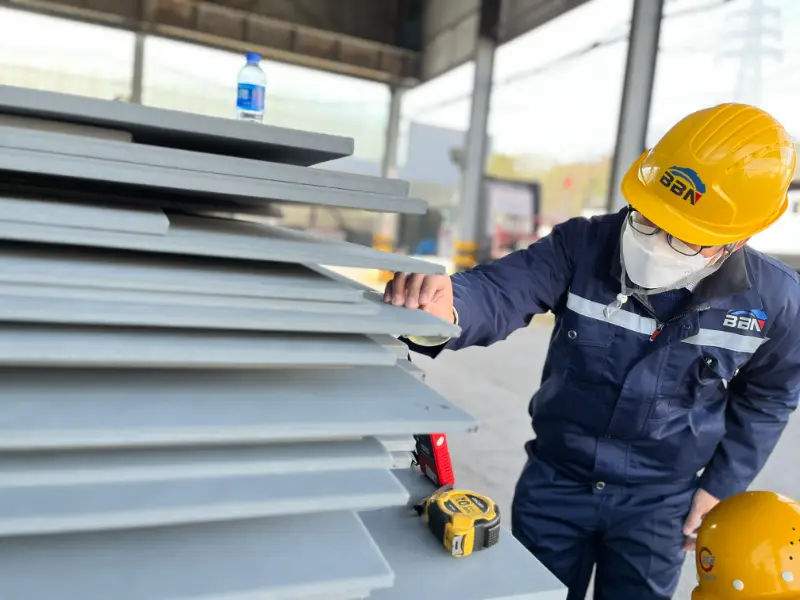
SUS329J3L Ferritic & Austenitic Stainless Steel Plate/Coil
SUS329J3L Ferritic & Austenitic Stainless Steel Plate/Coil - Complete Material Data & Equivalents
Comprehensive technical data for SUS329J3L ferritic-austenitic (duplex) stainless steel plate and coil, including chemical composition, mechanical properties, thermophysical values, international equivalents, and application guidance.
Hot rolling, cold rolling, solution annealing, welding, forming, machining, pickling
- Phone : +8618037372205
- Email : [email protected]
- WhatsApp: Contact via Whtsapp
- WeChat: +8618037372205
SUS329J3L Ferritic & Austenitic Stainless Steel Plate/Coil Introduction
SUS329J3L is a ferritic-austenitic (duplex) stainless steel standardized under JIS G4304 and G4305. It features a balanced microstructure of approximately equal amounts of ferrite and austenite, providing a unique combination of high strength, excellent corrosion resistance—particularly to chloride stress corrosion cracking and pitting—and good weldability. The low carbon content (L-grade) minimizes intergranular corrosion susceptibility after welding. Compared to standard austenitic grades like 304/316, SUS329J3L offers roughly twice the yield strength, enabling thinner wall designs and weight reduction in structural applications. Its corrosion resistance is superior to 316L in many chloride-containing environments, making it suitable for aggressive media such as seawater, acids, and chemical process streams. Typical delivery condition is solution annealed, ensuring optimum mechanical and corrosion properties. The material is widely available as hot- and cold-rolled plate, coil, sheet, and strip, and can be formed, machined, and welded with standard procedures adjusted for duplex alloys.
SUS329J3L Ferritic & Austenitic Stainless Steel Plate/Coil Chemical Composition
Heat analysis according to JIS G4304 standard for SUS329J3L. The alloy is a low-carbon duplex stainless steel with additions of chromium, nickel, molybdenum, and nitrogen. Low carbon (<0.030%) enhances resistance to sensitization during welding. Nitrogen acts as both an austenite stabilizer and a strengthening agent, while also improving pitting resistance. Molybdenum contributes to localized corrosion resistance in chloride environments.
| Chemical Element | Standard Value (%) | Remarks |
|---|---|---|
| Carbon (C) | ≤0.030 | Max limit ensures low intergranular corrosion tendency |
| Silicon (Si) | ≤1.00 | Residual element, typical for duplex grades |
| Manganese (Mn) | ≤2.00 | Austenite former; can be used to adjust phase balance |
| Phosphorus (P) | ≤0.040 | Impurity |
| Sulfur (S) | ≤0.030 | Impurity; low sulfur beneficial for hot workability |
| Nickel (Ni) | 4.50 – 6.50 | Primary austenite former; range ensures approximately 50 vol% austenite |
| Chromium (Cr) | 22.00 – 24.00 | Essential for corrosion resistance and ferrite formation |
| Molybdenum (Mo) | 2.50 – 3.50 | Significantly improves pitting and crevice corrosion resistance |
| Nitrogen (N) | 0.08 – 0.20 | Strengthens austenite and increases pitting resistance equivalent (PREN) |
SUS329J3L Ferritic & Austenitic Stainless Steel Plate/Coil Thermophysical & Electrical Properties
Physical properties of SUS329J3L duplex stainless steel at room temperature and elevated temperatures. These values are typical for fully solution-annealed material and may vary slightly depending on exact composition and processing. The thermal expansion coefficient is lower than that of austenitic grades, reducing thermal stresses in welded structures. Thermal conductivity is higher, aiding heat transfer applications.
| Property | Typical Value | Unit | Test Condition |
|---|---|---|---|
| Density (ρ) | 7.8 | g/cm³ | At 20 °C |
| Elastic Modulus (E) | 200 | GPa | At 20 °C |
| Shear Modulus (G) | 77 | GPa | At 20 °C, calculated |
| Poisson's Ratio (ν) | 0.30 | — | At 20 °C |
| Mean Coefficient of Thermal Expansion (α) | 13.0 | 10⁻⁶/K | 20–100 °C |
| Mean Coefficient of Thermal Expansion | 13.5 | 10⁻⁶/K | 20–200 °C |
| Mean Coefficient of Thermal Expansion | 14.0 | 10⁻⁶/K | 20–300 °C |
| Thermal Conductivity (λ) | 15.0 | W/(m·K) | At 20 °C |
| Thermal Conductivity | 16.0 | W/(m·K) | At 100 °C |
| Thermal Conductivity | 19.0 | W/(m·K) | At 300 °C |
| Specific Heat Capacity | 500 | J/(kg·K) | 20–100 °C |
| Electrical Resistivity (ρₑ) | 0.80 | μΩ·m | At 20 °C |
SUS329J3L Ferritic & Austenitic Stainless Steel Plate/Coil Mechanical Properties
Minimum mechanical properties at room temperature in the solution-annealed condition per JIS G4304 for plate/coil. Actual values may exceed the specified minima and are influenced by thickness and processing. The duplex structure provides high yield strength, typically twice that of austenitic grades, and good elongation. Hardness values are indicative; HRB or HV may be used alternatively.
| Property | Standard Requirement | Unit | Test Condition |
|---|---|---|---|
| 0.2% Yield Strength (Rp0.2) | ≥450 | MPa | Room temperature, transverse specimen (thickness ≤75 mm) |
| Tensile Strength (Rm) | ≥620 | MPa | Room temperature, transverse specimen |
| Elongation (A) | ≥25 | % | Gauge length 50 mm, thickness ≤6 mm |
| Elongation (A) | ≥25 | % | Gauge length 50 mm, thickness 6–12.5 mm |
| Elongation (A) | ≥20 | % | Gauge length 50 mm, thickness 12.5–75 mm |
| Brinell Hardness (HBW) | ≤270 | — | Typical as-annealed |
| Rockwell Hardness (HRC) | ≤28 | — | For reference |
| Bending Test | 180°, d = 2a | — | Bend diameter = 2× thickness (a), no cracks |
SUS329J3L Ferritic & Austenitic Stainless Steel Plate/Coil Fully Equivalent Standards & Substitutable Grades
| Country/Region | Standard | Grade | Remarks |
|---|---|---|---|
| Japan | JIS G4304 | SUS329J3L | Original designation |
| USA | ASTM A240/A240M | UNS S32906 | Equivalent duplex stainless steel |
| EU (Germany, etc.) | EN 10088-2 / EN 10088-3 | 1.4477, X2CrNiMoN22-5-3 | Ferritic-austenitic, similar chemistry |
| China | GB/T 3280 / GB/T 4237 | S22253, 022Cr22Ni5Mo3N | Equivalent grade |
| International | ISO 15510 | X2CrNiMoN22-5-3 | Same composition range |
SUS329J3L Ferritic & Austenitic Stainless Steel Plate/Coil Application Introduction
SUS329J3L / UNS S32906 duplex stainless steel is chosen for applications demanding high strength combined with excellent corrosion resistance, especially in chloride-containing environments. Its higher yield strength allows for weight savings and thinner gauge construction compared to austenitic grades. Proper fabrication practices, including controlled heat input during welding and post-weld heat treatment if necessary, are essential to maintain the balanced microstructure and corrosion resistance.
Product Applications: Pressure vessels and reactors, Shell-and-tube heat exchangers, Storage tanks and process vessels, Piping systems (seamless and welded tubes), Centrifuges, separators, and rotating equipment, Structural components for corrosive atmospheres (bridges, architectural panels), Marine hardware (propellers, rudders, shafting), Desalination evaporators and flash chambers
Processed into products: Tube sheets and baffles in heat exchangers, Welded pipe spools and flanges, Pump impellers, casings, and shafts, Valve bodies and trim, Fasteners (bolts, nuts, studs) when corrosion resistance needed, Machined fittings and connectors, Structural weldments (frames, supports), Manway covers and nozzles
Application industries: Chemical and petrochemical processing, Marine and offshore engineering (seawater systems, platforms), Oil and gas extraction and refining, Pulp and paper industry (digesters, bleaching equipment), Water treatment and desalination plants, Food and beverage equipment, Pharmaceutical manufacturing, Nuclear and conventional power generation
SUS329J3L Ferritic & Austenitic Stainless Steel Plate/Coil Similar / Alternative Material Recommendations
| Country/Region | Standard | Grade | Remarks |
|---|---|---|---|
| USA / EU | ASTM A240 / EN 10088-2 | S32205 (2205), 1.4462 | Slightly lower Mo (~3.0% vs ~3.0% but actually 2205 has 3.0–3.5%), broader use, very similar corrosion resistance. Often interchangeable with S32906; check mechanicals. |
| USA | ASTM A240 | S32550 (Alloy 255), UNS S32550 | Higher alloyed duplex with Cu, superior to S32906 in seawater and strong acids. Good upgrade option. |
| USA / EU | ASTM A240 / EN 10088-2 | S32750 (2507), 1.4410 | Super duplex stainless steel, higher PREN, excellent for aggressive chloride environments. Replacement when higher pitting resistance needed. |
| USA | ASTM A240 | S32900 (329) | Older duplex grade with lower Mo (1.0–2.0%), still used but inferior corrosion performance. Can substitute in less demanding media. |
| Japan | JIS G4304 | SUS329J1 | Lower Mo and N variant; suitable for less severe conditions, but not full corrosion equivalent. |
Notes:
- Heat treatment: Solution annealing must be performed in the range 1020–1100 °C, followed by rapid cooling to avoid sigma and other brittle phases. Slow cooling or service in the 300–550 °C range may cause 475 °C embrittlement.
- Welding: Use matching or over-alloyed filler metals (ER2209, E2209). Control interpass temperature below 150 °C and maintain heat input of 0.5–2.5 kJ/mm. Post-weld solution annealing may be required for severe corrosion service.
- Forming: Due to higher strength, forming requires greater force than austenitic stainless steels. Hot forming should be done in the range 1100–950 °C with final cooling in still air. Cold forming may necessitate intermediate annealing.
- Machining: The material's high strength and work hardening require rigid setups, sharp tools, and lower speeds compared to austenitics. Use carbide tooling and adequate cooling.
- Corrosion resistance: PREN (Pitting Resistance Equivalent Number) ≈ 33–35, indicating good resistance to pitting in chlorides. However, it may not replace super duplex grades in very hot, concentrated chloride solutions.
- Share



