
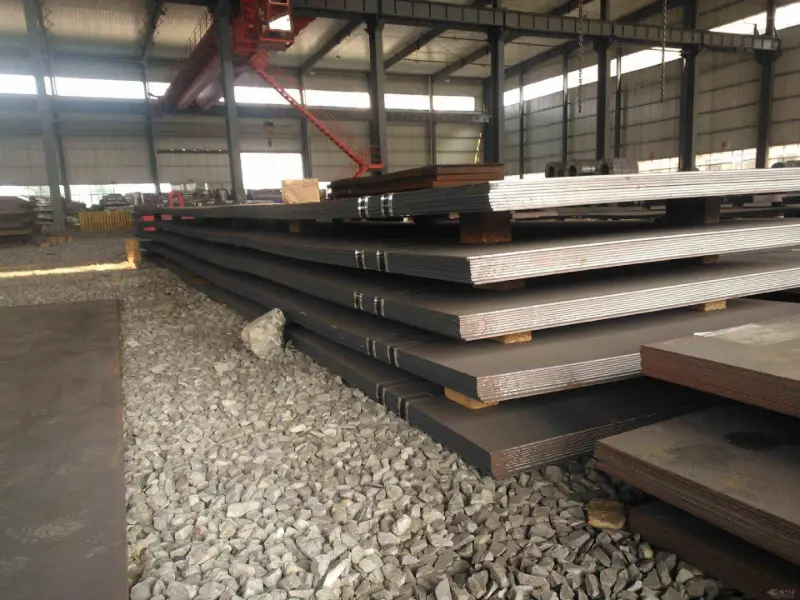
SUS329J1 Ferritic-Austenitic Duplex Stainless Steel Plate/Coil
SUS329J1 Ferritic-Austenitic Duplex Stainless Steel Plate/Coil - Full Material Data & Equivalents
Complete material data for SUS329J1 duplex stainless steel: chemical composition, mechanical & physical properties, international equivalents, and application guidelines. Ideal for chemical, marine, and heat exchanger industries.
Hot-rolling, Cold-rolling, Solution Annealing
- Phone : +8618037372205
- Email : [email protected]
- WhatsApp: Contact via Whtsapp
- WeChat: +8618037372205
SUS329J1 Ferritic-Austenitic Duplex Stainless Steel Plate/Coil Introduction
SUS329J1 is a ferritic-austenitic (duplex) stainless steel standardized in JIS G4304. Its duplex microstructure provides an excellent combination of high mechanical strength and outstanding corrosion resistance, especially in chloride-containing environments. The alloy contains high chromium (23–28%) and molybdenum (1–3%) for superior pitting and crevice corrosion resistance. Key characteristics include:
- Tensile strength ≥ 588 MPa and yield strength ≥ 392 MPa
- Good weldability with proper filler metals
- Resistance to stress corrosion cracking
- Supplied in solution-treated condition for optimal properties
SUS329J1 Ferritic-Austenitic Duplex Stainless Steel Plate/Coil Chemical Composition
The chemical composition of SUS329J1 as specified in JIS G4304. The balanced levels of chromium, nickel, and molybdenum ensure a duplex structure with approximately 50% ferrite and 50% austenite. Carbon is restricted to a maximum of 0.08% to maintain weldability and corrosion resistance. Nitrogen is not a requirement but may be present as a residual element.
| Chemical Element | Standard Value (wt%) | Remarks |
|---|---|---|
| C | ≤ 0.08 | |
| Si | ≤ 1.00 | |
| Mn | ≤ 1.50 | |
| P | ≤ 0.040 | |
| S | ≤ 0.030 | |
| Ni | 3.00 – 6.00 | |
| Cr | 23.00 – 28.00 | |
| Mo | 1.00 – 3.00 | |
| N | Not specified (typically ≤ 0.10) | Residual element; may be present |
SUS329J1 Ferritic-Austenitic Duplex Stainless Steel Plate/Coil Thermal & Electrical Physical Properties
Typical physical properties for SUS329J1 duplex stainless steel. Data are based on published values for UNS S32900 and similar grades. These values are indicative and may vary with exact composition and heat treatment. Density, modulus, and thermal expansion are important for design calculations.
| Property | Typical Value | Unit | Condition / Test Method |
|---|---|---|---|
| Density (ρ) | 7.8 | g/cm³ | 20°C |
| Modulus of Elasticity (E) | 200 | GPa | 20°C |
| Shear Modulus (G) | 77 | GPa | 20°C |
| Poisson's Ratio (ν) | 0.3 | 20°C | |
| Thermal Expansion Coefficient (α) | 10.5 | 10⁻⁶/K | 20–100°C |
| Thermal Expansion Coefficient (α) | 11.0 | 10⁻⁶/K | 20–200°C |
| Thermal Expansion Coefficient (α) | 11.5 | 10⁻⁶/K | 20–300°C |
| Thermal Conductivity (λ) | 15 | W/m·K | 20°C |
| Thermal Conductivity (λ) | 16 | W/m·K | 100°C |
| Thermal Conductivity (λ) | 19 | W/m·K | 300°C |
| Specific Heat Capacity (cp) | 460 | J/kg·K | 20°C |
| Specific Heat Capacity (cp) | 500 | J/kg·K | 100°C |
| Electrical Resistivity (ρe) | 0.80 | µΩ·m | 20°C |
SUS329J1 Ferritic-Austenitic Duplex Stainless Steel Plate/Coil Mechanical Properties
Room temperature mechanical properties for SUS329J1 in the solution-treated condition, per JIS G4304. Yield strength (0.2% offset) and tensile strength are minimum requirements. Elongation is thickness dependent; the values below apply to standard hot-rolled plates. Hardness values are typical maxima.
| Property | Standard Requirement | Unit | Test Condition |
|---|---|---|---|
| Yield Strength (0.2% offset) | ≥ 392 | MPa | Solution-treated, at room temperature |
| Tensile Strength | ≥ 588 | MPa | Solution-treated, at room temperature |
| Elongation (A) | ≥ 18 | % | Thickness ≤ 13 mm |
| Elongation (A) | ≥ 15 | % | Thickness > 13 mm |
| Brinell Hardness | ≤ 277 | HBW | Solution-treated |
| Rockwell Hardness | ≤ 29 | HRB | Solution-treated |
SUS329J1 Ferritic-Austenitic Duplex Stainless Steel Plate/Coil Direct Equivalent Materials & Substitute Grade Recommendations
| Country/Region | Standard | Grade/Designation | Remarks |
|---|---|---|---|
| Japan | JIS G4304 | SUS329J1 | Original grade; solution-treated duplex stainless steel |
| USA | ASTM A240 | UNS S32900 | Chemically equivalent; same duplex structure |
| Europe | EN 10088-2 | 1.4460 (X3CrNiMoN27-5-2) | Closest European counterpart; contains intentionally added nitrogen (0.05–0.20%), which may refine mechanical properties |
SUS329J1 Ferritic-Austenitic Duplex Stainless Steel Plate/Coil Application Introduction
SUS329J1 is engineered for aggressive environments where high strength and resistance to chloride stress corrosion cracking are critical. Its high chromium and molybdenum content makes it suitable for:
- Seawater and brackish water systems
- Chemical process reactors and storage systems
- Heat exchangers operating with chloride‑containing media
It is commonly supplied as plates and coils for fabrication.
Product Applications: Pressure vessels, Storage tanks, Piping systems, Structural components in corrosive atmospheres, Heat exchanger shells and tube sheets
Processed into products: Flanges and fittings, Valve bodies, Pump shafts and impellers, Heat exchanger plates and baffles, Welded pipes and headers
Application industries: Chemical processing, Oil & gas (offshore/onshore), Marine engineering, Pulp & paper, Desalination plants, Heat exchanger manufacturing
SUS329J1 Ferritic-Austenitic Duplex Stainless Steel Plate/Coil Similar / Comparable Duplex Stainless Steels
| Country/Region | Standard | Grade/Designation | Remarks |
|---|---|---|---|
| International | ASTM A240 / EN 10088-2 | S32205 / 1.4462 (2205) | Lower Cr (~22%) and Mo (~3.2%); the most widely used duplex grade with excellent balance of properties |
| Japan | JIS G4304 | SUS329J3L | Low‑carbon variant (≤0.030%) with nitrogen; superior weldability and toughness, close to S31803 |
| USA | ASTM A240 | S31803 | Standard 22Cr‑5Ni‑3Mo duplex; often used as a general‑purpose duplex |
Notes:
Heat treatment: Solution annealing at 950–1100°C followed by rapid cooling (water or air) is essential. Avoid prolonged exposure in the 475°C embrittlement range and the 600–950°C sigma phase formation range to maintain toughness and corrosion resistance. Welding: Use matching filler metals (e.g., AWS ER329, E329) and control interpass temperature. Post‑weld solution treatment is recommended for optimum corrosion performance.
- Share



