
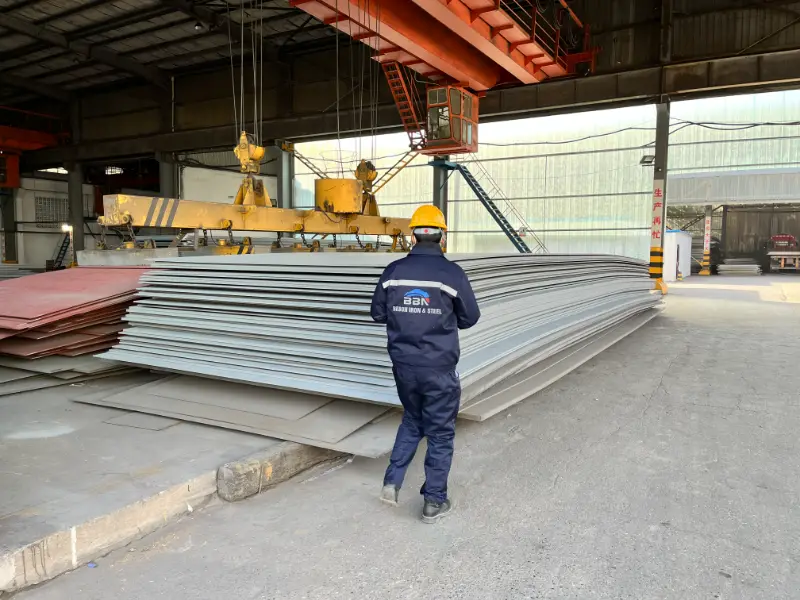
Leading Duplex Stainless Steel 2205 Plate & Coil
Leading Duplex Stainless Steel 2205 Plate & Coil - Superior Strength & Corrosion Resistance
Explore comprehensive material data for 2205 duplex stainless steel plate/coil per ASTM A240. Get chemical, mechanical, thermal properties, equivalents, and application guide.
Hot rolling, cold rolling, forming, welding, machining
- Phone : +8618037372205
- Email : [email protected]
- WhatsApp: Contact via Whtsapp
- WeChat: +8618037372205
Leading Duplex Stainless Steel 2205 Plate & Coil Introduction
UNS S32205 (commonly known as 2205) is a nitrogen-enhanced duplex stainless steel with a balanced microstructure of approximately equal parts ferrite and austenite. Key features include:
- Excellent resistance to stress corrosion cracking, pitting, and crevice corrosion.
- High yield strength – roughly double that of conventional austenitic stainless steels.
- Good weldability and formability.
- Operating temperatures from -50°C to 300°C in most applications.
It bridges the gap between standard austenitic grades and higher-alloy super duplex steels, offering an optimal cost-performance ratio.
Leading Duplex Stainless Steel 2205 Plate & Coil Chemical Composition
Heat analysis as per ASTM A240 for grade 2205 (S32205). All values are maximum unless a range or minimum is indicated. The balanced composition ensures the desired ferrite-austenite ratio and corrosion resistance.
| Element | Standard Value | Remarks |
|---|---|---|
| Carbon (C) | 0.030 max. | |
| Manganese (Mn) | 2.00 max. | |
| Phosphorus (P) | 0.030 max. | |
| Sulfur (S) | 0.020 max. | |
| Silicon (Si) | 1.00 max. | |
| Chromium (Cr) | 22.0 - 23.0 | Key for pitting resistance |
| Nickel (Ni) | 4.5 - 6.5 | Stabilizes austenite |
| Molybdenum (Mo) | 3.0 - 3.5 | Enhances corrosion resistance |
| Nitrogen (N) | 0.14 - 0.20 | Increases strength and pitting resistance |
Leading Duplex Stainless Steel 2205 Plate & Coil Thermal and Electrical Physical Properties
Values are typical for solution-annealed 2205 at 20°C unless stated otherwise. These properties may vary slightly depending on product form and exact composition. The duplex structure results in lower thermal expansion than austenitic grades.
| Property | Typical Value | Unit | Test Condition / Remarks |
|---|---|---|---|
| Density (ρ) | 7.80 | g/cm³ | At 20°C |
| Modulus of Elasticity (E) | 200 | GPa | Tension, at 20°C |
| Shear Modulus (G) | 77 | GPa | Calculated |
| Poisson's Ratio (ν) | 0.30 | - | At 20°C |
| Thermal Expansion Coefficient (α) | 13.0 | 10⁻⁶/K | 20–100°C |
| Thermal Expansion Coefficient (α) | 14.0 | 10⁻⁶/K | 20–300°C |
| Thermal Conductivity (λ) | 19.0 | W/(m·K) | At 20°C |
| Thermal Conductivity (λ) | 21.0 | W/(m·K) | At 300°C |
| Specific Heat Capacity (cₚ) | 500 | J/(kg·K) | At 20°C |
| Electrical Resistivity (ρe) | 0.80 | Ω·mm²/m | At 20°C |
Leading Duplex Stainless Steel 2205 Plate & Coil Mechanical Properties
Tensile testing at room temperature in accordance with ASTM A240/A240M. Values represent minimum requirements for plate and sheet; actual properties may exceed these. 2205 exhibits significantly higher yield strength than 304/316L.
| Property | Standard Value | Unit | Condition / Remarks |
|---|---|---|---|
| Yield Strength (0.2% offset, Rp0.2) | 450 min. | MPa | Transverse direction, annealed |
| Tensile Strength (Rm) | 655 min. | MPa | Transverse direction, annealed |
| Elongation (A) in 50mm (2 in.) | 25 min. | % | Transverse direction, annealed |
| Hardness (Brinell) | 293 max. | HB | For plate |
| Hardness (Rockwell C) | 31 max. | HRC | For plate |
Leading Duplex Stainless Steel 2205 Plate & Coil Complete Equivalent Material Standards & Replaceable Grades
| Country/Region | Standard | Grade / Designation | Notes |
|---|---|---|---|
| Europe | EN 10088-2 / EN 10088-3 | 1.4462 (X2CrNiMoN22-5-3) | Identical chemistry within tolerance |
| International | ISO 15510 | X2CrNiMoN22-5-3 (4462-2205) | Directly based on EN 1.4462 |
| Japan | JIS G4304 / G4305 | SUS 329J3L | Close equivalent; minor Si/Mn differences possible |
| China | GB/T 3280 / GB/T 4237 | 022Cr23Ni5Mo3N (S22053) | Equivalent to UNS S32205 |
| USA (alternate) | ASTM A240 | UNS S31803 (Type 2205) | Older version with slightly lower N; S32205 is preferred for better corrosion resistance |
Leading Duplex Stainless Steel 2205 Plate & Coil Application Introduction
UNS S32205 duplex stainless steel combines high mechanical strength with outstanding corrosion resistance, making it ideal for demanding environments. Its applications span multiple sectors where reliability and longevity are critical. Typical end-use products and components include:
Product Applications: Pressure vessels and storage tanks, Heat exchangers and condensers, Seawater handling piping systems, Welded structural hollow sections, Plate for various fabrication projects
Processed into products: Pump shafts and impellers, Valve bodies and fittings, Flanges and forgings, Welded tube and pipe assemblies, Offshore structural nodes and braces
Application industries: Oil & Gas (offshore platforms, pipelines, subsea equipment), Chemical Process Industry (reactors, storage tanks, heat exchangers), Marine & Shipbuilding (rudder systems, propeller shafts, desalination), Pulp & Paper (digesters, bleaching equipment, stock handling), Power Generation (flue gas desulfurization, cooling water pipes), Architecture & Construction (coastal bridges, rebar, structural supports)
Leading Duplex Stainless Steel 2205 Plate & Coil Similar Alternative Materials with Comparable Properties
| Country/Region | Standard | Grade / Designation | Similarity Analysis |
|---|---|---|---|
| Global | ASTM A240 / EN 10088 | UNS S32750 (Super Duplex 2507) | Higher strength and PREN; used for more aggressive chloride environments, but more expensive. |
| Global | ASTM A240 / EN 10088 | UNS S32304 (Lean Duplex 2304) | Lower alloy content, lower strength, good for less severe corrosion; more cost-effective alternative. |
| USA | ASTM A240 | UNS S32101 (Lean Duplex) | Economical duplex with lower Ni/Mo; suitable for structural applications without high chloride exposure. |
| Europe | EN 10088 | 1.4362 (X2CrNiN23-4) | Lean duplex with similar corrosion resistance to 316L but higher strength; cannot replace 2205 in harsh conditions. |
| Japan | JIS G4304 | SUS 316L | Austenitic; lower strength and similar pitting resistance but more susceptible to SCC; use where duplex may suffer embrittlement at high temperatures. |
Notes:
For welded applications, use matching filler metal (e.g., ER2209) to maintain corrosion resistance. Avoid prolonged exposure between 300°C and 550°C to prevent 475°C embrittlement. Post-weld heat treatment is usually not required but may be performed for stress relief. For pressure vessel design, refer to ASME BPVC Section II Part D for allowable stress values.
- Share



