
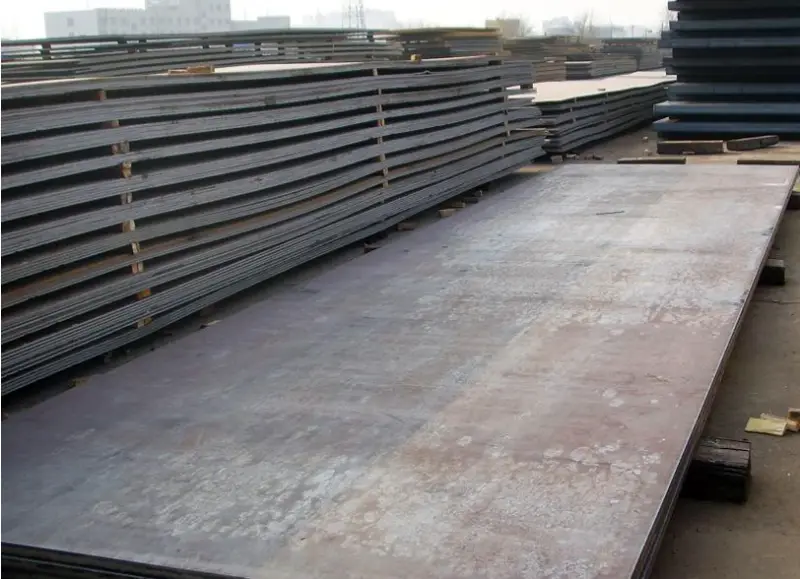
SUS317 Stainless Steel per JIS G4304/G4305
SUS317 Stainless Steel: JIS G4304/G4305 Plate & Coil – Full Properties & Equivalents
Detailed material data for SUS317 austenitic stainless steel plate and coil per JIS G4304 and JIS G4305. Includes chemical composition, mechanical and physical properties, international equivalents ASTM 317 and GB 06Cr19Ni13Mo3, plus applications in chemical and food equipment.
Hot rolling, cold rolling, forming, welding, machining
- Phone : +8618037372205
- Email : [email protected]
- WhatsApp: Contact via Whtsapp
- WeChat: +8618037372205
SUS317 Stainless Steel per JIS G4304/G4305 Introduction
SUS317 is a molybdenum-bearing austenitic stainless steel specified in JIS G4304 (hot-rolled plates/sheets) and JIS G4305 (cold-rolled plates/sheets/strips). With a nominal composition of 18Cr-12Ni-3.5Mo, it offers significantly improved resistance to pitting and crevice corrosion compared to standard 304/316 grades, particularly in chloride-containing environments. The alloy exhibits excellent toughness, ductility, and weldability in the solution-annealed condition. It is non-magnetic in the annealed state and can be easily formed. Typical applications include chemical processing vessels, flue gas desulfurization systems, pulp bleaching equipment, and food processing machinery where higher corrosion resistance than SUS316 is required. The steel is delivered in solution-annealed and pickled condition with guaranteed minimum mechanical properties as per JIS standards.
SUS317 Stainless Steel per JIS G4304/G4305 Chemical Composition
Chemical composition as specified in JIS G4304/G4305 for SUS317. The alloy is an austenitic stainless steel with controlled carbon, chromium, nickel, and molybdenum to achieve high corrosion resistance. The addition of 3–4% molybdenum provides superior pitting resistance compared to SUS316.
| Element | Content (%) | Remarks |
|---|---|---|
| Carbon (C) | ≤ 0.08 | Highest value |
| Silicon (Si) | ≤ 1.00 | Highest value |
| Manganese (Mn) | ≤ 2.00 | Highest value |
| Phosphorus (P) | ≤ 0.045 | Highest value |
| Sulfur (S) | ≤ 0.030 | Highest value |
| Nickel (Ni) | 11.00 – 15.00 | Range |
| Chromium (Cr) | 18.00 – 20.00 | Range |
| Molybdenum (Mo) | 3.00 – 4.00 | Range |
| Nitrogen (N) | ≤ 0.10 | Optional element, typical residual |
| Iron (Fe) | Balance | Remaining content |
SUS317 Stainless Steel per JIS G4304/G4305 Thermal and Electrical Physical Properties
Typical physical properties of SUS317 austenitic stainless steel at ambient and elevated temperatures. Values are for the solution-annealed condition and may vary with actual processing. Data sources: typical published values for 18Cr-12Ni-3Mo grade.
| Property | Standard Required Value | Unit | Test Condition |
|---|---|---|---|
| Density (ρ) | 7.98 | g/cm³ | At 20°C |
| Modulus of Elasticity (E) | 200 | GPa | At 20°C, longitudinal |
| Shear Modulus (G) | 77 | GPa | Calculated from E and Poisson's ratio |
| Poisson's Ratio (ν) | 0.30 | - | At 20°C |
| Thermal Expansion Coefficient (α) | 16.0 | ×10⁻⁶ /°C | 20–100°C |
| Thermal Expansion Coefficient (α) | 16.5 | ×10⁻⁶ /°C | 20–200°C |
| Thermal Expansion Coefficient (α) | 17.0 | ×10⁻⁶ /°C | 20–400°C |
| Thermal Expansion Coefficient (α) | 17.5 | ×10⁻⁶ /°C | 20–600°C |
| Thermal Conductivity (λ) | 14.0 | W/m·K | At 100°C |
| Thermal Conductivity (λ) | 15.0 | W/m·K | At 300°C |
| Thermal Conductivity (λ) | 17.0 | W/m·K | At 500°C |
| Specific Heat Capacity (cp) | 500 | J/kg·K | 0–100°C |
| Electrical Resistivity (ρe) | 0.74 | μΩ·m | At 20°C |
SUS317 Stainless Steel per JIS G4304/G4305 Mechanical Properties
Minimum required mechanical properties at room temperature for SUS317 plate and coil in solution-annealed condition, in accordance with JIS G4304 and JIS G4305. Elongation values vary with product thickness. Hardness values are typical and not part of mandatory requirements.
| Property | Standard Required Value | Unit | Test Condition |
|---|---|---|---|
| Yield Strength (0.2% offset) | ≥ 205 | N/mm² (MPa) | Room temperature, longitudinal direction |
| Tensile Strength | ≥ 520 | N/mm² (MPa) | Room temperature, longitudinal direction |
| Elongation (thickness ≤ 8 mm) | ≥ 40 | % | Gauge length: 50 mm (JIS Z2241) or 5.65√S0 |
| Elongation (8 mm < thickness ≤ 25 mm) | ≥ 40 | % | Gauge length: 50 mm |
| Elongation (25 mm < thickness ≤ 50 mm) | ≥ 35 | % | Gauge length: 50 mm |
| Elongation (thickness > 50 mm) | ≥ 35 | % | For reference only (JIS G4304); cold-rolled plate/coil usually ≤6 mm |
| Brinell Hardness (HB) | ≤ 187 (Typical) | - | As solution annealed, 3000 kg load (typical value) |
| Rockwell Hardness (HRB) | ≤ 90 (Typical) | - | As solution annealed (typical value) |
SUS317 Stainless Steel per JIS G4304/G4305 Fully Equivalent Material Standards and Replaceable Grade Recommendations
| Country/Region | Standard | Grade | Remarks |
|---|---|---|---|
| Japan | JIS G4304 / JIS G4305 | SUS317 | Original grade, hot/cold rolled plate and coil |
| USA | ASTM A240 / A240M | 317 (UNS S31700) | Full equivalent for plate, sheet, and strip |
| China | GB/T 3280 (cold-rolled), GB/T 4237 (hot-rolled) | 06Cr19Ni13Mo3 (new designation); 0Cr19Ni13Mo3 (old) | Chemical composition and properties identical; commonly used in Chinese projects |
| ISO | ISO 15510 | X5CrNiMo17-12-3 (approximate) | The ISO grade has a Mo range of 2.5–3.0%, slightly lower than SUS317. Verify substitution with design requirements. |
| European Union | EN 10088-2 | 1.4449 (X5CrNiMo17-13-3) – approximate | EN 1.4449 has Mo 2.5–3.0%; full Mo 3–4% match is absent in EN. Use only after engineering assessment. |
SUS317 Stainless Steel per JIS G4304/G4305 Application Introduction
SUS317 is widely used in aggressive environments where standard 304/316 grades are insufficient. Its enhanced pitting and crevice corrosion resistance, combined with good formability and weldability, make it a preferred material for chemical reactors, tanks, and piping systems handling acids and chlorides. It is also used in food processing equipment, flue gas desulfurization (FGD) scrubbers, and pulp & paper bleaching equipment. Below are typical industries, products, and components fabricated from this grade.
Product Applications: Chemical storage tanks, Reactor vessels and columns, Shell-and-tube heat exchangers, Piping systems for corrosive fluids, Pressure vessels (ASME/EN code), Scrubber and absorber towers, Pasteurizers and evaporators
Processed into products: Flanges, fittings and valves, Pump shafts and impellers, Agitator blades and shafts, Fasteners (bolts, nuts) – when high corrosion resistance is required, Expansion joints and bellows, Instrument tubing and fittings, Welded pipe spools and headers
Application industries: Chemical & Petrochemical Processing, Pulp & Paper (especially bleach plants), Food & Beverage Processing, Pharmaceutical & Biotechnology, Marine & Offshore Engineering, Flue Gas Desulfurization (FGD) Systems, Textile Dyeing Equipment
SUS317 Stainless Steel per JIS G4304/G4305 Similar / Near-Equivalent Substitute Material Recommendations
| Country/Region | Standard | Grade | Remarks |
|---|---|---|---|
| USA / International | ASTM A240 / A240M | 317L (UNS S31703) | Low-carbon version (C ≤0.03) of SUS317; improved sensitization resistance during welding, suitable for as-welded parts. Slightly lower strength but comparable corrosion resistance. |
| Japan | JIS G4304 / G4305 | SUS316 (AISI 316, UNS S31600) | Standard Mo-alloyed austenitic stainless with 2–3% Mo. Lower pitting resistance than SUS317 but more economical. Suitable for less aggressive chloride environments. |
| China | GB/T 3280 | 06Cr17Ni12Mo2 (316) | Similar composition to SUS316; commonly used as a lower-cost substitute when molybdenum requirement is moderate. |
| European Union | EN 10088-2 | 1.4438 (X2CrNiMo18-15-4) | A low-carbon, high-Mo (3–4%) austenitic stainless steel with 17.5-19.5% Cr, 13-16% Ni, 3-4% Mo. Very similar corrosion resistance, slightly stronger Ni content. Can replace SUS317 in many applications. |
Notes:
Welding: SUS317 can be welded by common methods (TIG, MIG, SMAW, SAW). Filler metal recommendation: AWS E317/ER317. No preheating is required. Post-weld heat treatment is generally not needed for maximum service corrosion resistance, but solution annealing may be applied to restore full corrosion properties if sensitization is a concern. Corrosion note: The alloy is susceptible to intergranular corrosion in the sensitized condition (425–850°C). For applications involving welding of heavy sections or long-term exposure in this temperature range, consider the low-carbon variant SUS317L. Forming: Excellent cold forming characteristics; the work hardening rate is higher than that of plain chromium grades but can be accommodated. Standards reference: Data tables above are based on JIS G4304:2012 and JIS G4305:2012. Always refer to the latest edition of the standard for certified material properties.
- Share



