
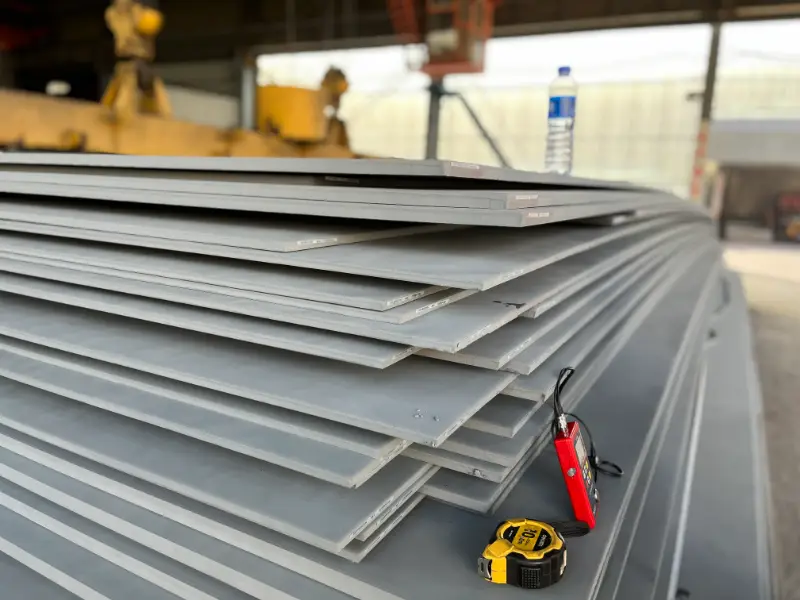
SUS316L Austenitic Stainless Steel Plate/Coil
SUS316L Austenitic Stainless Steel Plate/Coil - Low Carbon Mo-Bearing Cr-Ni Alloy for Superior Corrosion Resistance
Explore the complete data sheet of SUS316L stainless steel plate and coil under JIS G4304/G4305, including chemical composition, mechanical, thermal and electrical properties, global equivalents, and application guidance for demanding environments.
Hot rolling, cold rolling, annealing, pickling, descaling, welding, bending, deep drawing, machining, laser cutting
- Phone : +8618037372205
- Email : [email protected]
- WhatsApp: Contact via Whtsapp
- WeChat: +8618037372205
SUS316L Austenitic Stainless Steel Plate/Coil Introduction
SUS316L is a low-carbon, molybdenum-bearing austenitic stainless steel standardized in Japan under JIS G4304 (hot-rolled) and JIS G4305 (cold-rolled). The alloy contains approximately 16-18% chromium, 12-15% nickel, and 2-3% molybdenum, with a maximum carbon content of 0.030%. This low carbon level minimizes carbide precipitation during welding, enabling good intergranular corrosion resistance in the as-welded condition. SUS316L offers excellent resistance to pitting and crevice corrosion in chloride environments, superior to standard 304/304L. It exhibits high tensile strength and excellent formability at ambient and elevated temperatures. Typical applications include chemical processing equipment, marine components, medical devices, and food handling systems where both corrosion resistance and weldability are critical.
SUS316L Austenitic Stainless Steel Plate/Coil Chemical Composition
Chemical composition according to JIS G4304:2012 and JIS G4305:2012. Analysis is performed on ladle samples. Unless otherwise stated, all values are maximum values.
| Element | Standard Value (%) | Remarks |
|---|---|---|
| Carbon (C) | ≤ 0.030 | Low carbon for improved weldability |
| Silicon (Si) | ≤ 1.00 | |
| Manganese (Mn) | ≤ 2.00 | |
| Phosphorus (P) | ≤ 0.045 | |
| Sulfur (S) | ≤ 0.030 | |
| Nickel (Ni) | 12.00 – 15.00 | Stabilizes austenitic structure |
| Chromium (Cr) | 16.00 – 18.00 | Primary corrosion resistance element |
| Molybdenum (Mo) | 2.00 – 3.00 | Enhances pitting and crevice corrosion resistance |
SUS316L Austenitic Stainless Steel Plate/Coil Thermal and Electrical Physical Properties
Physical properties in the solution annealed condition. Density and elastic modulus at 20°C. Thermal expansion coefficients from 20°C to indicated temperature. Thermal conductivity and specific heat at 20°C, electrical resistivity at 20°C. Data are representative for this grade.
| Property | Typical Value | Unit | Test Condition |
|---|---|---|---|
| Density (ρ) | 7.98 | g/cm³ | at 20 °C |
| Elastic Modulus (E) | 193 | GPa | at 20 °C |
| Shear Modulus (G) | 77 | GPa | at 20 °C |
| Poisson's Ratio (ν) | 0.3 | - | at 20 °C |
| Coefficient of Thermal Expansion (α) | 16.0 × 10⁻⁶ | K-1 | 20 to 100 °C |
| Coefficient of Thermal Expansion (α) | 16.5 × 10⁻⁶ | K-1 | 20 to 200 °C |
| Coefficient of Thermal Expansion (α) | 17.0 × 10⁻⁶ | K-1 | 20 to 300 °C |
| Coefficient of Thermal Expansion (α) | 17.5 × 10⁻⁶ | K-1 | 20 to 400 °C |
| Coefficient of Thermal Expansion (α) | 18.0 × 10⁻⁶ | K-1 | 20 to 500 °C |
| Thermal Conductivity (λ) | 15 | W/(m·K) | at 20 °C |
| Specific Heat Capacity | 500 | J/(kg·K) | at 20 °C |
| Electrical Resistivity (ρ_e) | 0.74 | μΩ·m | at 20 °C |
SUS316L Austenitic Stainless Steel Plate/Coil Mechanical Properties
Mechanical properties at room temperature for solution annealed condition as specified in JIS G4304 (hot-rolled plate) and JIS G4305 (cold-rolled sheet/coil). Values depend on thickness range. The standard provides minimum requirements; actual values may exceed these.
| Property | Standard Requirement | Unit | Test Condition |
|---|---|---|---|
| Tensile Strength (Rm) | ≥ 480 | MPa | Room temperature |
| Yield Strength (ReH/ ReL, 0.2% offset) | ≥ 175 | MPa | Room temperature |
| Elongation (A) | ≥ 40 (for thickness ≤ 8 mm) | % | Gauge length: 50 mm |
| Elongation (A) | ≥ 40 (for thickness 8 < t ≤ 14 mm) | % | Gauge length: 50 mm |
| Elongation (A) | ≥ 40 (for thickness > 14 mm) | % | Gauge length: 50 mm |
| Hardness | ≤ 200 | HV | Vickers hardness, typical for annealed |
| Hardness | ≤ 187 | HBW | Brinell hardness |
| Hardness | ≤ 90 | HRB | Rockwell B hardness |
| Bend Test (180°) | No cracks on bent surface | - | Bend radius = plate thickness (for plates ≤ 25 mm) |
SUS316L Austenitic Stainless Steel Plate/Coil Identical Equivalent Material Standards and Substitute Grades
| Country/Region | Standard | Grade | Remarks |
|---|---|---|---|
| International (ISO) | ISO 15510 | X2CrNiMo17-12-2 | Equivalent to 1.4404/316L |
| European Union | EN 10088-2 (sheet/plate) | X2CrNiMo17-12-2 (1.4404) | Low carbon Mo-alloyed austenitic |
| USA | ASTM A240 / A240M | UNS S31603 (Grade 316L) | Identical chemical and mechanical limits |
| USA | ASME SA240 | UNS S31603 | For pressure vessel applications |
| China | GB/T 3280 (cold-rolled) / GB/T 4237 (hot-rolled) | 022Cr17Ni12Mo2 | Formerly 00Cr17Ni14Mo2, equivalent to SUS316L |
| South Korea | KS D 3698 (cold-rolled) / KS D 3705 (hot-rolled) | STS316L | JIS-based Korean standard |
| Germany (historical) | DIN EN 10088-2 | 1.4404 | Replaced older DIN 1.4404 |
SUS316L Austenitic Stainless Steel Plate/Coil Application Introduction
Key Features:
- Excellent general corrosion resistance in atmospheric and mildly aggressive media
- Better resistance to pitting and crevice corrosion than 304/304L due to molybdenum addition
- Low carbon content prevents intergranular corrosion after welding without post-weld heat treatment
- Good mechanical properties from cryogenic to moderately elevated temperatures
- Non-magnetic in annealed condition (may become slightly magnetic after cold working)
Product Applications: Chemical storage tanks and pressure vessels, Heat exchangers and condensers, Piping systems, valves and fittings, Kitchen equipment and sinks, Brewery and dairy equipment, Surgical instruments and implants, Offshore platform components, Pharmaceutical vessels and tubing, Flue gas desulfurization components, Compensators and expansion joints
Processed into products: Welded pipe fittings (elbows, tees, reducers), Bolting and fasteners (when corrosion resistance needed), Springs and wire mesh (cold-worked condition), Deep drawn cups and housings, Laser-cut gaskets and shims, Stamped brackets and clips, Fabricated frames for cleanrooms, Impellers and pump shafts, Spiral wound heat exchanger plates, Surgical implants (only with certification)
Application industries: Chemical and petrochemical processing, Marine and coastal engineering, Food and beverage processing, Pharmaceutical and biotechnology, Medical device manufacturing, Pulp and paper industry, Water treatment and desalination, Nuclear power (non-pressure boundary components), Automotive (exhaust systems, trim), Architecture and construction (coastal areas)
SUS316L Austenitic Stainless Steel Plate/Coil Similar or Near-Equivalent Material Recommendations
| Country/Region | Standard | Grade | Remarks / Analysis |
|---|---|---|---|
| Japan | JIS G4304/G4305 | SUS316 | Higher carbon (≤0.08%), susceptible to sensitization during welding; use SUS316L for welded structures. |
| Japan | JIS G4304/G4305 | SUS316J1L (1.4435) | Similar Mo content, slightly higher Ni (13-16%), lower C (≤0.030); improved corrosion resistance in some media. |
| EU | EN 10088-2 | X2CrNiMo18-14-3 (1.4435) | Higher Mo (2.5-3.5%) and Ni (13.0-16.0%); enhanced pitting resistance compared to 316L. |
| USA | ASTM A240 | 316Ti (UNS S31635) | Titanium stabilized variant; better high temperature or long-term sensitization resistance, but lower toughness. |
| Global | Proprietary alloys | 904L (UNS N08904) | Higher Ni, Cr, Mo, Cu for extreme chloride resistance; significantly more expensive than 316L. |
Notes:
SUS316L welding: Use filler metal matching the base metal (e.g., ER316L or E316L-16) for optimum corrosion resistance. Post-weld cleaning and passivation recommended. Maximum service temperature in air: ~870°C intermittent, ~925°C continuous. For applications requiring high strength, cold-worked tempers (1/4 hard, 1/2 hard) are available. In extreme chloride environments, consider upgrading to 2205 duplex or 6% Mo super austenitic. Magnetic permeability: <1.02 after annealing. All data are based on JIS standards and typical producer data sheets and are believed accurate at time of compilation. Users should verify specific product certifications for actual values.
- Share



