
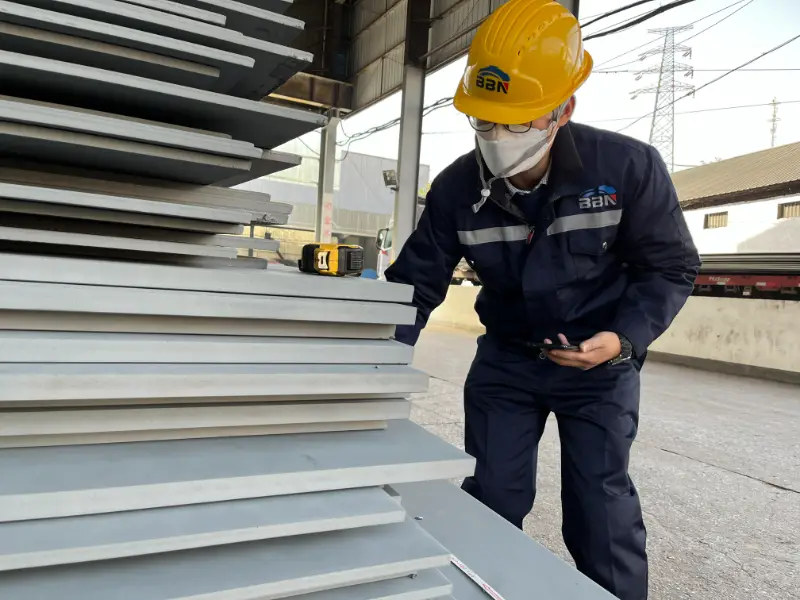
SUS316 Austenitic Stainless Steel Plate/Coil per JIS G4304/G4305
SUS316 Austenitic Stainless Steel Plate/Coil per JIS G4304/G4305: Composition, Properties & Equivalents
Detailed technical data for SUS316 stainless steel plate and coil according to JIS G4304 and JIS G4305, including chemical composition, mechanical and physical performance tables, international equivalents, similar materials, and application guidance.
Hot rolling, cold rolling, solution annealing, pickling, cutting, bending, deep drawing, welding, machining
- Phone : +8618037372205
- Email : [email protected]
- WhatsApp: Contact via Whtsapp
- WeChat: +8618037372205
SUS316 Austenitic Stainless Steel Plate/Coil per JIS G4304/G4305 Introduction
SUS316 is a molybdenum-bearing austenitic chromium–nickel stainless steel standardized under JIS G4304 (hot-rolled) and JIS G4305 (cold-rolled). The addition of 2–3% molybdenum significantly enhances resistance to pitting and crevice corrosion in chloride-containing environments, making it superior to SUS304 in marine and chemical applications.
- Excellent corrosion resistance in acidic, marine, and mild chemical media
- Good high-temperature strength and oxidation resistance up to approx. 800°C
- Non-magnetic in annealed condition, with slight magnetism after cold working
- Excellent formability and weldability by common fusion methods
It is widely used for fabrication of process equipment, architectural panels, food and medical appliances.
SUS316 Austenitic Stainless Steel Plate/Coil per JIS G4304/G4305 Chemical Composition
The following chemical composition is specified in JIS G4304:2005 and JIS G4305:2005 for SUS316. Controlled additions of chromium, nickel and molybdenum provide the corrosion resistance typical of this grade.
| Element | Standard Value (%) | Remarks |
|---|---|---|
| Carbon (C) | ≤0.08 | Maximum |
| Silicon (Si) | ≤1.00 | Maximum |
| Manganese (Mn) | ≤2.00 | Maximum |
| Phosphorus (P) | ≤0.045 | Maximum |
| Sulfur (S) | ≤0.030 | Maximum |
| Nickel (Ni) | 10.00–14.00 | Range |
| Chromium (Cr) | 16.00–18.00 | Range |
| Molybdenum (Mo) | 2.00–3.00 | Range |
SUS316 Austenitic Stainless Steel Plate/Coil per JIS G4304/G4305 Thermal and Electrical Physical Properties
Typical physical properties for SUS316 at room and elevated temperatures. These data are representative of the grade and are not specified in JIS G4304/G4305. Values may vary slightly depending on exact composition and processing.
| Property | Typical Value | Unit | Temperature / Remarks |
|---|---|---|---|
| Density (ρ) | 8.0 | g/cm³ | 20°C |
| Modulus of Elasticity (E) | 193 | GPa | 20°C |
| Shear Modulus (G) | 77 | GPa | 20°C |
| Poisson's Ratio (ν) | 0.28 | – | 20°C |
| Coefficient of Thermal Expansion (α) | 16.0 | 10⁻⁶/K | 20–100°C |
| Coefficient of Thermal Expansion (α) | 17.0 | 10⁻⁶/K | 20–300°C |
| Coefficient of Thermal Expansion (α) | 18.5 | 10⁻⁶/K | 20–500°C |
| Thermal Conductivity (λ) | 16.3 | W/(m·K) | at 100°C |
| Thermal Conductivity (λ) | 21.5 | W/(m·K) | at 500°C |
| Specific Heat Capacity (cp) | 500 | J/(kg·K) | 20–100°C |
| Electrical Resistivity (ρe) | 0.74 | µΩ·m | 20°C |
SUS316 Austenitic Stainless Steel Plate/Coil per JIS G4304/G4305 Mechanical Properties
Tensile testing is performed at room temperature according to JIS Z 2241. Requirements depend on product thickness and test piece geometry. The values below are the minimum guaranteed values for plate, sheet and coil under JIS G4304/G4305.
| Property | Standard Minimum Value | Unit | Test Condition / Thickness |
|---|---|---|---|
| 0.2% Proof Strength (ReH) | ≥205 | MPa | All thicknesses |
| Tensile Strength (Rm) | ≥520 | MPa | All thicknesses |
| Elongation (A) | ≥40 | % | Thickness ≤8 mm; gauge length 50 mm, specimen No.14A |
| Elongation (A) | ≥30 | % | Thickness >8 mm to ≤75 mm; gauge length 50 mm, specimen No.14A |
| Brinell Hardness | ≤187 | HBW | Solution annealed; alternative Rockwell HRB ≤90 |
SUS316 Austenitic Stainless Steel Plate/Coil per JIS G4304/G4305 Internationally Equivalent Standards and Grades
| Country / Region | Standard | Grade / Designation | Remarks |
|---|---|---|---|
| Japan | JIS G4304 / G4305 | SUS316 | Original specification |
| USA | ASTM A240/A240M | 316 (UNS S31600) | Hot/cold rolled plate, sheet, strip |
| Europe | EN 10088-2 | X5CrNiMo17-12-2 (1.4401) | Stainless steel sheet/plate for general purposes |
| International | ISO 15510 | X5CrNiMo17-12-2 | Chemical composition identical |
| UK | BS 1449 Pt.2 (obs.) | 316S31 | Historically equivalent |
| Germany | DIN 17440 (obs.) | X5CrNiMo17-12-2 | Historically equivalent |
| China | GB/T 3280 | 06Cr17Ni12Mo2 (new) / 0Cr17Ni12Mo2 (old) | Cold-rolled stainless steel strip |
SUS316 Austenitic Stainless Steel Plate/Coil per JIS G4304/G4305 Application Introduction
Because of its superior chloride pitting resistance and good mechanical properties, SUS316 is the material of choice for applications involving mild to moderate corrosive environments. It can be easily formed into complex shapes and welded, making it suitable for a wide variety of industrial and consumer products.
Product Applications: Storage tanks and process vessels, Heat exchangers and condensers, Pipelines and tubing systems, Commercial kitchen worktops and sinks, Surgical and dental instruments, Architectural panels and curtain walls
Processed into products: Valve bodies, balls and seats, Flanges, elbows, tees and reducers, Pump shafts and impeller housings, Fasteners (bolts, nuts, washers), Welded stainless steel pipes and tubes, Fabricated structural supports and frames
Application industries: Chemical and petrochemical processing, Marine and offshore engineering, Food and beverage processing, Pharmaceutical and medical equipment, Architectural and construction cladding, Pulp and paper industry
SUS316 Austenitic Stainless Steel Plate/Coil per JIS G4304/G4305 Similar or Alternative Stainless Steel Grades
| Country / Region | Standard | Grade | Remarks |
|---|---|---|---|
| Japan | JIS G4304 / G4305 | SUS316L | Low carbon (≤0.030%) variant; better weldability and resistance to intergranular attack |
| Europe | EN 10088-2 | 1.4404 (X2CrNiMo17-12-2) | Ultra-low carbon version of 1.4401; similar to 316L |
| Japan | JIS G4304 / G4305 | SUS316Ti | Titanium stabilized; improved high-temperature strength and sensitisation resistance |
| Europe | EN 10088-2 | 1.4571 (X6CrNiMoTi17-12-2) | Titanium stabilized equivalent to 316Ti |
| Japan | JIS G4304 / G4305 | SUS317 | Higher molybdenum (3.0‑4.0%); greater pitting and crevice corrosion resistance |
| Europe | EN 10088-2 | 1.4449 (X5CrNiMo17‑13‑3) | Increased Mo content for aggressive chloride media |
Notes:
Solution annealing is mandatory to achieve the required mechanical properties and to dissolve chromium carbides. It should be performed at 1010–1150°C with rapid water quenching. Weldability is excellent by all common methods (TIG, MIG, SAW). No preheating is required, but post-weld solution annealing may be needed for optimum corrosion resistance unless low‑carbon (316L) filler is used. Machining is more difficult compared to carbon steels due to work hardening; sharp tools, rigid setups and appropriate cutting fluids are required. Stress corrosion cracking may occur in environments containing chlorides above approximately 60°C; for such conditions, low‑carbon 316L or duplex stainless steels should be considered. Intergranular corrosion after welding can be mitigated by using the low‑carbon version (SUS316L) or by applying a post‑weld solution treatment.
- Share



