
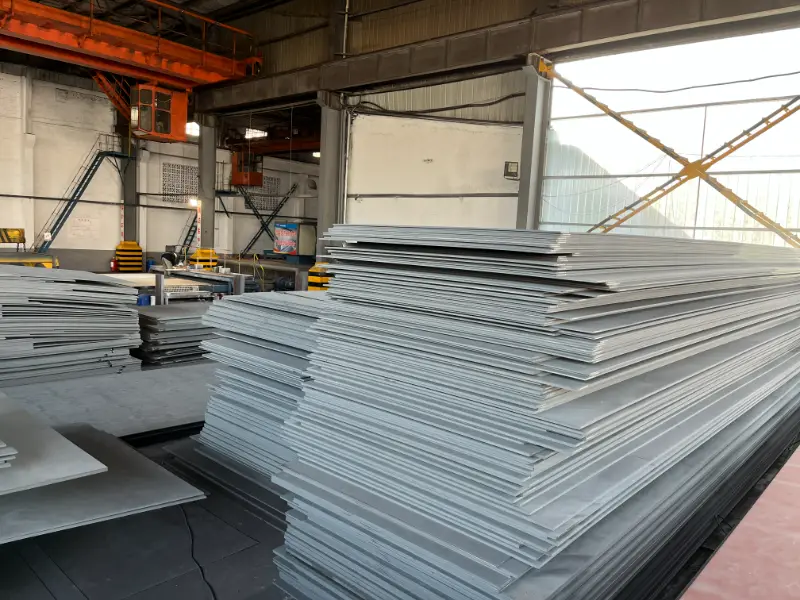
SUS315J2 Austenitic Stainless Steel
SUS315J2 Austenitic Stainless Steel - JIS G4304/G4305 Plate & Coil, Cu-Mo Enhanced Corrosion Resistance
Detailed material data sheet for SUS315J2 stainless steel to JIS G4304 (hot-rolled) and JIS G4305 (cold-rolled). Covers chemical composition, mechanical properties, physical properties, international equivalents, similar grades, and application guidance for chemical and power plant equipment.
Hot rolling, cold rolling, solution annealing, pickling, cutting, welding, forming, machining
- Phone : +8618037372205
- Email : [email protected]
- WhatsApp: Contact via Whtsapp
- WeChat: +8618037372205
SUS315J2 Austenitic Stainless Steel Introduction
SUS315J2 is an austenitic stainless steel specified in JIS G4304 (hot-rolled plates, sheets and strips) and JIS G4305 (cold-rolled plates, sheets and strips). It is a copper-molybdenum bearing grade developed to resist sulfuric acid dew-point corrosion, typically encountered in flue gas desulfurization systems and chemical processing. The alloy contains 17–19% Cr, 11–14% Ni, 1–2% Mo, and 1–2% Cu, providing improved resistance to reducing acid environments compared to standard 304/304L grades. It offers good weldability and formability, and is supplied in solution-annealed condition. Common product forms include hot-rolled and cold-rolled plates, sheets, coils, and strips for fabricating pressure vessels, heat exchangers, and ductwork.
SUS315J2 Austenitic Stainless Steel Chemical Composition
Chemical composition limits as specified in JIS G4304 and JIS G4305 for SUS315J2. The alloy is austenitic with deliberate additions of copper and molybdenum to enhance resistance to sulfuric acid and chloride environments. Nitrogen is not intentionally added but may be present as a residual.
| Element | Standard Value (min - max or max) | Remarks |
|---|---|---|
| C | ≤ 0.08 | Maximum |
| Si | ≤ 1.00 | Maximum |
| Mn | ≤ 2.00 | Maximum |
| P | ≤ 0.045 | Maximum |
| S | ≤ 0.030 | Maximum |
| Ni | 11.00 – 14.00 | |
| Cr | 17.00 – 19.00 | |
| Mo | 1.00 – 2.00 | |
| Cu | 1.00 – 2.00 |
SUS315J2 Austenitic Stainless Steel Physical Properties
Typical physical properties for SUS315J2 austenitic stainless steel in the solution-annealed condition. These values are representative and may vary slightly with exact composition and processing. Thermal expansion, thermal conductivity, and electrical resistivity are similar to other chromium-nickel austenitic grades with molybdenum.
| Property | Typical Value | Unit | Test Condition |
|---|---|---|---|
| Density (ρ) | 7.93 | g/cm³ | 20 °C |
| Modulus of Elasticity (E) | 193 | GPa | Tension, room temperature |
| Shear Modulus (G) | 74 | GPa | Calculated, room temperature |
| Poisson's Ratio (ν) | 0.30 | — | 20 °C |
| Thermal Expansion Coefficient (α) | 16.0 | 10⁻⁶/K | 20–100 °C |
| Thermal Expansion Coefficient (α) | 17.0 | 10⁻⁶/K | 20–300 °C |
| Thermal Conductivity (λ) | 16.2 | W/(m·K) | At 100 °C |
| Thermal Conductivity (λ) | 19.5 | W/(m·K) | At 300 °C |
| Specific Heat Capacity (cp) | 500 | J/(kg·K) | 20 °C |
| Electrical Resistivity (ρ_e) | 0.73 | μΩ·m | 20 °C |
SUS315J2 Austenitic Stainless Steel Mechanical Properties
Minimum mechanical property requirements for SUS315J2 according to JIS G4304 (hot-rolled) and JIS G4305 (cold-rolled). Yield strength (0.2% offset) and tensile strength values apply to all thicknesses. Elongation varies with product thickness. Hardness values are typical and not mandated by the standard but often used for reference.
| Property | Standard Requirement (min.) | Unit | Test Condition |
|---|---|---|---|
| Yield Strength (0.2% offset, ReH) | 205 | MPa | Room temperature, all thicknesses |
| Tensile Strength (Rm) | 520 | MPa | Room temperature, all thicknesses |
| Elongation (A) | 40 | % | Thickness ≤ 5 mm, gauge length 50 mm |
| Elongation (A) | 35 | % | Thickness > 5 mm to ≤ 8 mm, gauge length 50 mm |
| Elongation (A) | 30 | % | Thickness > 8 mm, gauge length 50 mm (hot-rolled plates) |
| Hardness (HBW) – typical | ≤ 187 (typical) | HBW | Solution annealed, for reference |
SUS315J2 Austenitic Stainless Steel Completely Equivalent Material Standards and Substitutable Grades
SUS315J2 has no identical full equivalent outside the JIS system. The ISO 15510 grade X5CrNiCuMo18-12-4 matches closely in chemistry but with slight differences in chromium range. It is not an exact one-to-one substitute and should be verified for each application.
| Country/Region | Standard | Grade | Remarks |
|---|---|---|---|
| Japan | JIS G4304 / G4305 | SUS315J2 | Original specification |
| International | ISO 15510 | X5CrNiCuMo18-12-4 | Close chemical match; Cr 16.5–18.5% vs. 17–19% in SUS315J2; may substitute with engineering approval |
SUS315J2 Austenitic Stainless Steel Application Introduction
SUS315J2 is designed for service in mildly reducing acidic environments where sulfuric acid condensation can occur. Its copper and molybdenum additions provide improved resistance to sulfuric acid dew-point corrosion over conventional 304/304L, making it a preferred choice for flue gas treatment, chemical processing, and marine applications. The material can be fabricated by common methods including welding (with matching filler), forming, and machining.
Product Applications: FGD absorbers, inlet and outlet ducts, chimneys, Ammonium sulfate crystallizers, Heat exchanger tubes and plates, Condenser shells and tube sheets, Pressure vessels and storage tanks, Piping systems for chemical transport, Scrubbers and scrubber components, Evaporators and crystallizers
Processed into products: Tube sheets and baffle plates for shell-and-tube heat exchangers, Flanges, fittings, and gaskets for chemical piping, Expansion joints and bellows, Welded plate heat exchanger cores, Internals of absorption towers (trays, packings, supports), Welded ducts and casings, Fasteners (bolts, nuts) when cold heading is used, Spray nozzles and mist eliminator supports
Application industries: Power generation (flue gas desulfurization – FGD), Chemical and petrochemical processing, Pollution control equipment, Pulp and paper (digesters, bleach plants), Marine engineering and coastal structures, Oil refining (overhead condensers, crude distillation)
SUS315J2 Austenitic Stainless Steel Similar or Approximate Alternative Materials
The following grades share similar corrosion-resistant characteristics (Cu-Mo austenitics) or offer comparable pitting and acid resistance. They are not direct equivalents but can be considered as substitutes depending on service conditions.
| Country/Region | Standard | Grade | Remarks |
|---|---|---|---|
| Japan | JIS G4304/G4305 | SUS315J1 | Lower Ni (8.5–11.5%), higher Cu (1.5–3.0%); similar corrosion resistance with slightly different strength |
| Japan | JIS G4304/G4305 | SUS316J1 | Contains Ni 10–14%, Cr 16–18%, Mo 2–3%, Cu 1–3%; higher Mo improves pitting resistance |
| USA | ASTM A240/A240M | 316L (UNS S31603) | Mo bearing but no Cu; widely used for general corrosion; less effective against sulfuric acid dew-point corrosion |
| Europe | EN 10088-2 | 1.4404 (X2CrNiMo17-12-2) | Similar to 316L; no Cu, lower corrosion resistance in reducing sulfuric acid media |
| International | ASTM/EN | 904L (UNS N08904 / 1.4539) | High Ni-Cu-Mo; superior corrosion resistance but more costly; often used for severe FGD environments |
Notes:
Welding: SUS315J2 can be welded using conventional methods (GTAW, SMAW, GMAW) with filler metals such as ER315J2 or ER316Cu that match the composition. Post-weld heat treatment is not required for most applications, but solution annealing may be performed to restore corrosion resistance. Forming: Excellent cold formability; hot working should be performed between 1150–900 °C followed by rapid cooling and solution annealing. Pickling and passivation: Standard procedures for austenitic stainless steels are applicable to remove heat tint and enhance surface corrosion resistance. Ordering information: Specify JIS designation, appropriate standard (G4304 or G4305), surface finish, dimensions, and optional supplementary requirements (e.g., ultrasonic testing, intergranular corrosion test per JIS G0575).
- Share



