
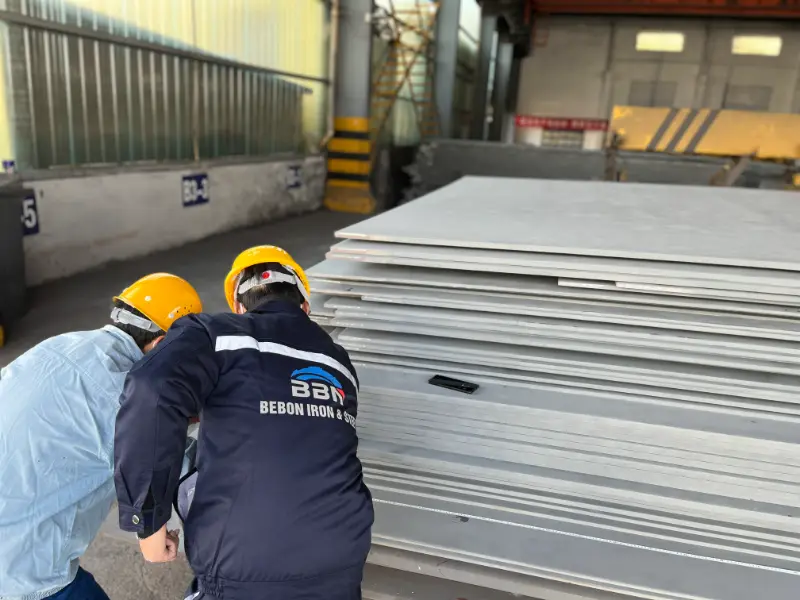
SUS316N Austenitic Stainless Steel
SUS316N Austenitic Stainless Steel: High-Nitrogen Enhanced Strength for Demanding Applications
Detailed technical data of JIS G4304/G4305 SUS316N austenitic stainless steel plate/coil, including chemical composition, mechanical properties, physical properties, international equivalents, and typical applications.
Hot rolling, cold rolling, welding, machining, forming, bending
- Phone : +8618037372205
- Email : [email protected]
- WhatsApp: Contact via Whtsapp
- WeChat: +8618037372205
SUS316N Austenitic Stainless Steel Introduction
SUS316N is a nitrogen-strengthened austenitic stainless steel specified in JIS G4304/G4305. With controlled nitrogen addition (0.10–0.22%), it offers significantly higher yield and tensile strength compared to standard SUS316, while maintaining excellent corrosion resistance comparable to 316 grades.
- Improved mechanical strength at room and elevated temperatures
- Excellent resistance to pitting and crevice corrosion in chloride environments
- Good weldability and formability
- Non-magnetic in annealed condition
Commonly supplied as hot-rolled or cold-rolled plate, sheet, and coil, and widely used in chemical processing, marine engineering, and heat exchanger manufacturing.
SUS316N Austenitic Stainless Steel Chemical Composition
Chemical composition according to JIS G4304:2012 for SUS316N. The nitrogen content is intentionally increased between 0.10% and 0.22% to enhance mechanical strength without compromising corrosion resistance. All values represent ladle analysis limits.
| Element | Standard Value (wt%) | Remarks |
|---|---|---|
| Carbon (C) | ≤0.08 | Maximum |
| Silicon (Si) | ≤1.00 | Maximum |
| Manganese (Mn) | ≤2.00 | Maximum |
| Phosphorus (P) | ≤0.045 | Maximum |
| Sulfur (S) | ≤0.030 | Maximum |
| Nickel (Ni) | 10.00–14.00 | |
| Chromium (Cr) | 16.00–18.00 | |
| Molybdenum (Mo) | 2.00–3.00 | |
| Nitrogen (N) | 0.10–0.22 | Key strengthening element |
SUS316N Austenitic Stainless Steel Thermal and Electrical Physical Properties
Representative physical properties for SUS316N austenitic stainless steel at ambient temperature, unless otherwise specified. These values are typical for standard solution-annealed material and can vary slightly depending on exact composition and processing history.
| Property | Typical Value | Unit | Test Conditions |
|---|---|---|---|
| Density (ρ) | 8.0 | g/cm³ | 20°C |
| Modulus of Elasticity (E) | 193 | GPa | 20°C |
| Shear Modulus (G) | 77 | GPa | 20°C (estimated) |
| Poisson's Ratio (ν) | 0.25 | – | 20°C |
| Thermal Expansion Coefficient (α) | 16.0 | 10⁻⁶/K | 20–100°C |
| Thermal Expansion Coefficient (α) | 17.5 | 10⁻⁶/K | 20–300°C |
| Thermal Conductivity (λ) | 14.6 | W/(m·K) | 100°C |
| Thermal Conductivity (λ) | 21.5 | W/(m·K) | 500°C |
| Specific Heat Capacity (c) | 500 | J/(kg·K) | 20°C |
| Electrical Resistivity (ρₑ) | 0.74 | μΩ·m | 20°C |
SUS316N Austenitic Stainless Steel Mechanical Properties
Mechanical properties per JIS G4304:2012. Values are obtained from tensile tests on standard specimens in solution-annealed condition. Hardness is measured by Brinell or Rockwell methods and serves as a supplementary requirement.
- Yield Strength (ReH): 0.2% offset proof stress
- Tensile Strength (Rm)
- Elongation (A): gauge length 50 mm for thickness ≤8 mm, 4√S0 ratio for thicker sections
| Property | Specification Value | Unit | Test Conditions |
|---|---|---|---|
| Tensile Strength (Rm) | ≥550 | MPa | Thickness ≤8 mm, solution annealed |
| Tensile Strength (Rm) | ≥520 | MPa | Thickness >8 mm to 100 mm, solution annealed |
| Yield Strength (ReH, 0.2%) | ≥275 | MPa | All thicknesses up to 100 mm |
| Elongation (A) | ≥35 | % | Thickness ≤8 mm |
| Elongation (A) | ≥35 | % | Thickness >8 mm to 100 mm (4√S0) |
| Hardness | ≤217 | HBW | All thicknesses |
| Hardness | ≤95 | HRB | Alternative |
SUS316N Austenitic Stainless Steel Direct Equivalent Material Standards and Designations
| Country/Region | Standard | Designation | Remarks |
|---|---|---|---|
| Japan | JIS G4304/G4305 | SUS316N | Original standard grade |
| USA | ASTM A240/A240M | 316N (UNS S31651) | Nitrogen-strengthened 316 |
| China | GB/T 3280 | 06Cr17Ni12Mo2N (S31651) | New designation, N: 0.10–0.22 |
SUS316N Austenitic Stainless Steel Application Introduction
SUS316N is chosen when the corrosion resistance of standard 316 stainless steel is required but higher mechanical strength is necessary. The added nitrogen raises the yield strength by approximately 30–40% over SUS316 without sacrificing ductility or weldability.
- Use in welded structures where post-weld annealing is impractical
- Ideal for pressure vessels and piping operating at moderate temperatures
- Suitable for components exposed to chloride-containing environments such as seawater, chemical brines, and food processing fluids
- Replaces 316 in spring and fastener applications where higher strength prevents deformation
Product Applications: Heat exchangers and condensers, Pressure vessels and reactors, Storage tanks for corrosive chemicals, Piping and tubing systems, Marine hardware and propeller shafts, Food processing equipment
Processed into products: Flanges and pipe fittings, Valve bodies and stems, Pump shafts and impellers, High-strength fasteners (bolts, nuts, studs), Springs and spring washers, Welded fabrications and structural supports
Application industries: Chemical Processing, Marine and Shipbuilding, Oil and Gas, Food and Beverage, Pharmaceutical, Heat Exchanger Manufacturing, Pulp and Paper
SUS316N Austenitic Stainless Steel Similar or Equivalent Material Recommendations
| Country/Region | Standard | Designation | Remarks |
|---|---|---|---|
| Japan | JIS G4304 | SUS316 | Standard 316 without intentional nitrogen addition; lower strength |
| Japan | JIS G4304 | SUS316L | Low-carbon variant; even lower strength than 316 |
| USA | ASTM A240 | 316/316L | 316 lacks nitrogen, 316L is low carbon; both have lower yield strength |
| Europe | EN 10088-2 | X5CrNiMo17-12-2 (1.4401) | Standard 316, N ≤ 0.11; slightly lower strength |
| Europe | EN 10088-2 | X2CrNiMo17-12-2 (1.4404) | 316L, low carbon, <0.1 N; lowest strength |
| International | ISO 15510 | X5CrNiMo17-12-2 | Similar to 1.4401 |
Notes:
SUS316N maintains full austenitic microstructure in the solution-annealed condition and is non-magnetic. The increased nitrogen content may slightly reduce cold formability compared to SUS316, but the material still exhibits good forming characteristics. Welding should follow standard procedures for austenitic stainless steels; filler metal with matching chemical composition (e.g., AWS E316N) is recommended to maintain strength in the weld joint. Intergranular corrosion resistance in the welded condition is ensured by the low carbon level combined with nitrogen stabilization. The typical service temperature range is from cryogenic (-196°C) up to 550°C for load-bearing applications.
- Share



