
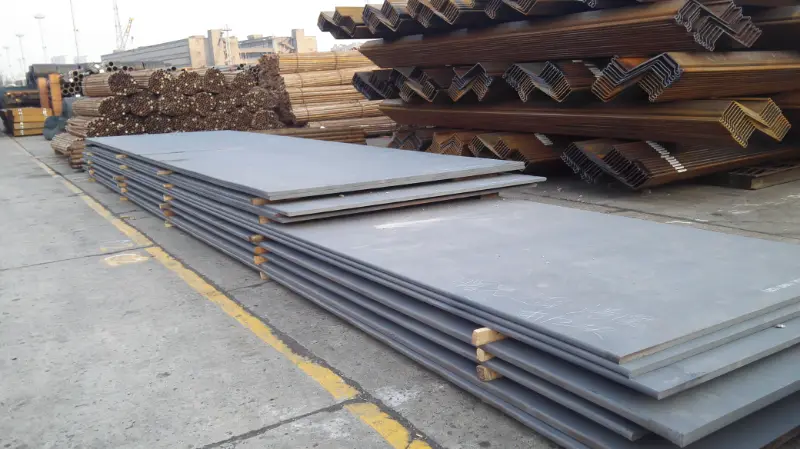
SUS301L Stainless Steel Plate/Coil
SUS301L Stainless Steel Plate/Coil: JIS G4304/G4305 Austenitic Grade for High Strength Structural Applications
Complete material data for SUS301L stainless steel according to JIS G4304 and JIS G4305, including chemical composition, mechanical properties, physical properties, international equivalents, and application guidance.
Cold forming, bending, punching, deep drawing, welding, brazing, machining (limited in high-strength tempers)
- Phone : +8618037372205
- Email : [email protected]
- WhatsApp: Contact via Whtsapp
- WeChat: +8618037372205
SUS301L Stainless Steel Plate/Coil Introduction
SUS301L is a low-carbon austenitic stainless steel specified in JIS G4304 (hot-rolled plates) and JIS G4305 (cold-rolled plates and coils). As a modification of SUS301 (grade 301), the reduced carbon content (<0.03%) improves intergranular corrosion resistance after welding and makes it suitable for applications that require both high strength and good formability. Through controlled cold working, SUS301L can achieve various strength levels (1/4H, 1/2H, 3/4H, FH) while retaining its non-magnetic austenitic structure in the annealed condition. The material exhibits excellent fatigue resistance, moderate corrosion resistance, and is widely used in railway vehicle bodies, automotive structural parts, and spring components. It is typically supplied in solution-treated (annealed) condition and can be further cold worked to increase strength.
SUS301L Stainless Steel Plate/Coil Chemical Composition
The chemical composition of SUS301L is according to JIS G4304:2015 and JIS G4305:2015. The low carbon content ensures resistance to sensitization during welding. Nitrogen up to 0.20% may be intentionally added to increase strength but is not required. All values are maximum unless a range is indicated.
| Chemical Element | Standard Value (wt.%) | Remarks |
|---|---|---|
| Carbon (C) | ≤ 0.030 | Low carbon for improved weldability |
| Silicon (Si) | ≤ 1.00 | Deoxidizer and strength enhancer |
| Manganese (Mn) | ≤ 2.00 | Austenite stabilizer |
| Phosphorus (P) | ≤ 0.045 | Residual element |
| Sulfur (S) | ≤ 0.030 | Residual element, limited for machinability |
| Nickel (Ni) | 6.00 – 8.00 | Promotes austenitic structure |
| Chromium (Cr) | 16.00 – 18.00 | Provides corrosion resistance |
| Nitrogen (N) | ≤ 0.20 | May be added to enhance strength |
SUS301L Stainless Steel Plate/Coil Thermal and Electrical Physical Properties
Physical properties of SUS301L are typical for 17Cr-7Ni austenitic stainless steel. Slight variations may occur due to manufacturing tolerances and composition. Data provided for room temperature unless otherwise specified.
| Property | Standard Value | Unit | Test Condition |
|---|---|---|---|
| Density (ρ) | 7.93 | g/cm³ | At 20 °C |
| Modulus of Elasticity (E) | 193 | GPa | At 20 °C |
| Shear Modulus (G) | 74 | GPa | At 20 °C |
| Poisson's Ratio (ν) | 0.30 | — | At 20 °C |
| Thermal Expansion Coefficient (α) | 16.0 | 10⁻⁶/K | 20 – 100 °C |
| Thermal Expansion Coefficient (α) | 16.8 | 10⁻⁶/K | 20 – 200 °C |
| Thermal Expansion Coefficient (α) | 17.5 | 10⁻⁶/K | 20 – 400 °C |
| Thermal Conductivity (λ) | 16.3 | W/(m·K) | At 100 °C |
| Specific Heat Capacity | 500 | J/(kg·K) | At 20 °C |
| Electrical Resistivity (ρ_e) | 0.73 | Ω·mm²/m | At 20 °C |
SUS301L Stainless Steel Plate/Coil Mechanical Properties
Mechanical properties for SUS301L in the solution-annealed condition according to JIS G4304 (for plate) and JIS G4305 (for sheet/coil). For cold-worked tempers, significantly higher strengths and reduced elongations are achieved. Values apply to room temperature testing. HBW is for reference only and not a mandatory requirement in some thicknesses.
| Property | Standard Requirement | Unit | Test Condition |
|---|---|---|---|
| Yield Strength (ReH, 0.2% offset) | ≥ 205 | MPa | Room temperature, annealed, thickness ≤ 75 mm |
| Tensile Strength (Rm) | ≥ 520 | MPa | Room temperature, annealed, thickness ≤ 75 mm |
| Elongation (A) | ≥ 40 | % | Thickness ≤ 3 mm, gauge length 50 mm |
| Elongation (A) | ≥ 40 | % | Thickness 3 – 8 mm, gauge length 50 mm |
| Elongation (A) | ≥ 40 | % | Thickness 8 – 75 mm, gauge length 50 mm |
| Hardness | ≤ 207 | HBW | Annealed condition (for reference) |
SUS301L Stainless Steel Plate/Coil Completely Equivalent Material Standards and Substitutable Grades
| Country/Region | Standard | Grade | Remarks |
|---|---|---|---|
| China | GB/T 3280-2015 | 022Cr17Ni7 | Low-carbon 17Cr-7Ni, identical chemical requirements |
| USA | ASTM A240/A240M | UNS S30103 | Carbon ≤0.03%, otherwise similar 301 chemistry |
| International | ISO 15510:2014 | X2CrNiN18-7* | Nitrogen allowed up to 0.20%, matches SUS301L when nitrogen is present. Without N, 301L may be designated as X2CrNi18-7. |
SUS301L Stainless Steel Plate/Coil Application Introduction
SUS301L is specifically designed for applications demanding a combination of high strength, moderate corrosion resistance, and good formability. Its low carbon content permits welded structures where intergranular corrosion resistance is needed. The material is frequently used in:
Product Applications: Shinkansen and other EMU car bodies, Passenger car door beams and bumpers, Flat springs and wave washers, Welded conveyor chains, Solar panel support frames
Processed into products: Roll-formed structural sections (hat channels, Z-profiles), Press-formed brackets and reinforcements, Precision stamped spring contacts, Deep-drawn housings for electronic devices, Welded frames and trusses
Application industries: Railway and high-speed train manufacturing (body shells, underframes), Automotive (structural reinforcements, clips, seat frames), Industrial equipment (springs, fasteners, clamps), Architectural and civil engineering (facade panels, handrails), Aerospace (secondary structural brackets, non-critical components)
SUS301L Stainless Steel Plate/Coil Similar / Alternative Materials Recommendation
| Country/Region | Standard | Grade | Remarks |
|---|---|---|---|
| Japan | JIS G4304/G4305 | SUS301 | Higher carbon (≤0.15%), lower weldability, similar strength after cold work |
| Japan | JIS G4304/G4305 | SUS304 | 18Cr-8Ni, better corrosion resistance, lower cold-work strength potential |
| Europe | EN 10088-2 | 1.4310 (X10CrNi18-8) | Spring grade, higher carbon, used for high-strength cold-worked parts |
| Europe | EN 10088-2 | 1.4318 (X2CrNiN18-7) | Nitrogen-alloyed 301LN, strength similar to cold-worked SUS301L |
| China | GB/T 3280 | 12Cr17Ni7 (301) | Equivalent to JIS SUS301, higher carbon, less weldable |
| USA | ASTM A240 | 301 (S30100) | Full carbon version, high work-hardening rate |
Notes:
SUS301L may undergo a martensitic transformation during severe cold forming, leading to increased magnetism. In the fully annealed condition, it is essentially non-magnetic (μ ≤ 1.02). Cold-worked tempers (e.g., 1/2H) can achieve tensile strengths above 930 MPa with reduced elongation. Welding consumables should be selected to match the low carbon base metal; AWS ER308L is typically used. Pickling and passivation are recommended after welding to restore corrosion resistance.
- Share



