
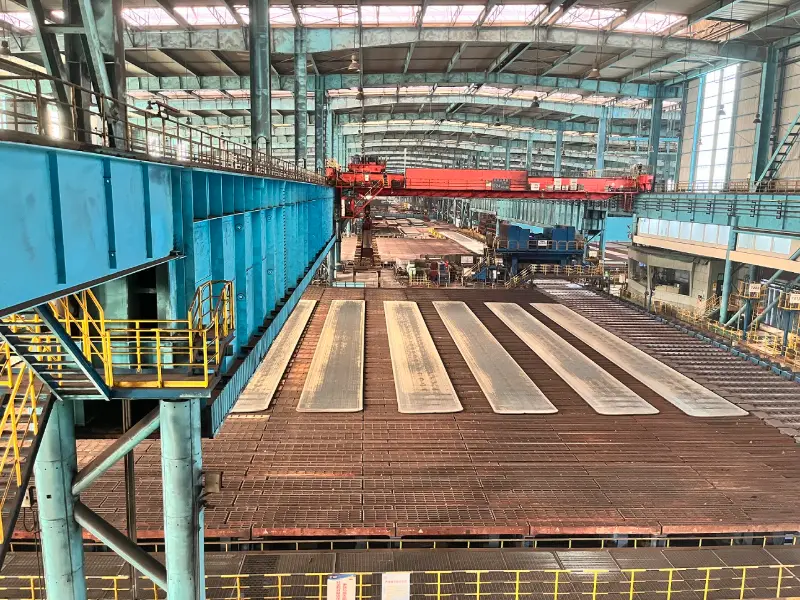
SUS301J1 Austenitic Stainless Steel
SUS301J1 Austenitic Stainless Steel: High-Strength Cold-Worked Plate/Coil per JIS G4304/G4305
Technical data and equivalent grades for SUS301J1, an austenitic stainless steel with enhanced work-hardening capacity for springs and precision components, supplied as plate or coil.
Hot rolling, cold rolling, annealing, pickling, temper rolling, slitting
- Phone : +8618037372205
- Email : [email protected]
- WhatsApp: Contact via Whtsapp
- WeChat: +8618037372205
SUS301J1 Austenitic Stainless Steel Introduction
SUS301J1 is a modified austenitic stainless steel derived from SUS301, designed to achieve superior strength through cold deformation while maintaining good ductility and corrosion resistance. It is specified under JIS G4304 (hot-rolled stainless steel plates) and JIS G4305 (cold-rolled stainless steel plates and coils). The alloy features a carefully balanced composition with lower carbon and slightly adjusted nickel content to promote a highly stable austenite that transforms to martensite during cold working, resulting in a dramatic increase in tensile strength and hardness. Typical delivery conditions include solution-annealed or various cold-worked tempers (1/4H, 1/2H, 3/4H, H). This grade is widely used in electronic connectors, spring clips, flat springs, and automotive sensor components where high fatigue strength and elastic limit are required.
SUS301J1 Austenitic Stainless Steel Chemical Composition
The chemical composition of SUS301J1 is tailored to provide an optimal balance between formability and work-hardening potential. Chromium ensures corrosion resistance, while nickel stabilizes the austenitic structure. The controlled carbon content and adjusted nickel level promote martensitic transformation during cold deformation, which is the key to achieving high strength.
| Element | Standard Value (wt%) | Remarks |
|---|---|---|
| Carbon (C) | ≤ 0.08 | Lower than standard SUS301 to enhance ductility and reduce sensitization |
| Silicon (Si) | ≤ 1.00 | Deoxidizer, improves oxidation resistance |
| Manganese (Mn) | ≤ 2.00 | Austenite stabilizer, counteracts hot shortness |
| Phosphorus (P) | ≤ 0.045 | Residual element, kept low for ductility |
| Sulfur (S) | ≤ 0.030 | Residual element, improves machinability but may reduce toughness |
| Nickel (Ni) | 6.50 – 8.00 | Primary austenite stabilizer |
| Chromium (Cr) | 16.00 – 18.00 | Provides corrosion and oxidation resistance |
| Nitrogen (N) | ≤ 0.10 | Stabilizes austenite and increases strength; usually present as residual |
SUS301J1 Austenitic Stainless Steel Thermal and Electrical Physical Properties
Physical properties are given for the solution-annealed condition at room temperature unless otherwise noted. Thermal expansion and conductivity values are comparable to standard Type 301 stainless steel. These data are provided for design calculations and may vary slightly with actual processing history.
| Property | Typical Value | Unit | Test Condition |
|---|---|---|---|
| Density (ρ) | 7.93 | g/cm³ | Ambient temperature |
| Elastic Modulus (E) | 193 | GPa | Tension |
| Shear Modulus (G) | 76 | GPa | Torsion |
| Poisson's Ratio (ν) | 0.27 – 0.30 | — | Room temperature |
| Thermal Expansion Coefficient (α) | 16.0 | µm/m·°C | 20 – 100 °C |
| Thermal Expansion Coefficient (α) | 16.6 | µm/m·°C | 20 – 200 °C |
| Thermal Expansion Coefficient (α) | 17.2 | µm/m·°C | 20 – 300 °C |
| Thermal Expansion Coefficient (α) | 17.7 | µm/m·°C | 20 – 400 °C |
| Thermal Conductivity (λ) | 16.3 | W/m·K | at 100 °C |
| Thermal Conductivity (λ) | 21.5 | W/m·K | at 500 °C |
| Specific Heat Capacity | 500 | J/kg·K | at 20 °C |
| Electrical Resistivity (ρ_e) | 0.72 | µΩ·m | at 20 °C |
SUS301J1 Austenitic Stainless Steel Mechanical Properties
Mechanical properties strongly depend on the cold-working temper. In the solution-annealed condition the steel is soft and highly formable. After cold rolling (1/4H, 1/2H, 3/4H, H) the tensile strength and hardness increase significantly due to strain-induced martensitic transformation. The values listed below are typical and may be referenced from JIS G4313 for similar spring strip grades (SUS301-CSP). No impact test data is required for thin strip products, and bending properties are evaluated by formability.
| Property | Typical Requirement | Unit | Test Condition |
|---|---|---|---|
| Tensile Strength (Rm) – Solution annealed | ≥ 520 | MPa | JIS G4305, at room temperature |
| Yield Strength (ReH) – Solution annealed | ≥ 205 | MPa | JIS G4305, at room temperature |
| Elongation (A) – Solution annealed | ≥ 40 | % | Gauge length 50 mm |
| Hardness – Solution annealed | ≤ 218 | HV | Vickers hardness |
| Tensile Strength (Rm) – Temper 1/4H | ≥ 860 | MPa | Typical for cold-rolled strip |
| Yield Strength (ReH) – Temper 1/4H | ≥ 515 | MPa | at room temperature |
| Elongation (A) – Temper 1/4H | ≥ 25 | % | Gauge length 50 mm |
| Tensile Strength (Rm) – Temper 1/2H | ≥ 1030 | MPa | Typical for cold-rolled strip |
| Yield Strength (ReH) – Temper 1/2H | ≥ 760 | MPa | at room temperature |
| Elongation (A) – Temper 1/2H | ≥ 10 | % | Gauge length 50 mm |
| Tensile Strength (Rm) – Temper 3/4H | ≥ 1210 | MPa | Typical for cold-rolled strip |
| Yield Strength (ReH) – Temper 3/4H | ≥ 930 | MPa | at room temperature |
| Elongation (A) – Temper 3/4H | ≥ 7 | % | Gauge length 50 mm |
| Tensile Strength (Rm) – Temper H | ≥ 1280 | MPa | Typical for cold-rolled strip |
| Yield Strength (ReH) – Temper H | ≥ 970 | MPa | at room temperature |
| Elongation (A) – Temper H | ≥ 5 | % | Gauge length 50 mm |
| Hardness – Temper H | 420 – 490 | HV | Vickers hardness |
SUS301J1 Austenitic Stainless Steel Fully Equivalent Material Standards and Substitute Grades
| Country/Region | Standard | Grade | Remarks |
|---|---|---|---|
| Japan | JIS G4304/G4305 | SUS301 | Base grade; SUS301J1 is a low‑carbon variant with improved cold‑work hardening |
| USA | ASTM A666 | AISI 301 (UNS S30100) | Similar chemical composition; mechanical properties may differ slightly |
| Europe | EN 10088‑2 | 1.4310 (X10CrNi18‑8) | Widely used spring stainless steel; composition envelope includes SUS301J1 |
| China | GB/T 20878 | 12Cr17Ni7 (old: 1Cr17Ni7) | Corresponds to original 301; check carbon level for exact equivalence |
SUS301J1 Austenitic Stainless Steel Application Introduction
SUS301J1 excels in applications that demand a combination of high elastic limit, fatigue resistance, and moderate corrosion protection. The material is delivered in strip or coil form and is typically processed by blanking, bending, coining, or forming in the annealed or lightly tempered condition, then finally shaped or heat‑set. Its high work‑hardening rate allows progressive stamping tools to produce parts with locally increased strength.
Product Applications: Electronic connectors and contact springs, Flat‑spring washers (DIN 2093 compliant when hardened), Spring clips and retaining rings, Metal domes and tactile switches, Automotive sensor return springs, Surgical clip cartridges, Constant‑force springs
Processed into products: Stamped precision springs (e.g., SIM card tray springs), Formed wire springs and clips, Coined contact points, Roll‑formed sections and channels, Deep‑drawn cups and housings (from annealed stock, followed by tempering), Etched precision parts (e.g., fine‐line springs for micro‑motors)
Application industries: Electronics & Electrical: connectors, USB ports, battery springs, EMI shielding clips, Automotive: sensor contact springs, hose clamps, seat belt retractor springs, wiper blade springs, Medical Devices: surgical staples, endoscopic springs, orthodontic wires and brackets (low nickel variant may be required), Industrial Equipment: flat springs for valves, bimetallic strips, metal belts, power transmission clips, Consumer Goods: snap domes for keyboards, retractable badge holders, watch components
SUS301J1 Austenitic Stainless Steel Similar / Alternative Materials
| Country/Region | Standard | Grade | Remarks |
|---|---|---|---|
| Japan | JIS G4313 | SUS301‑CSP | Spring strip version; mechanical properties align closely with SUS301J1 tempers |
| Japan | JIS G4304/G4305 | SUS304 | Higher nickel, lower work‑hardening rate; lower strength in cold‑worked tempers |
| Europe | EN 10088‑2 | 1.4318 (X2CrNiN18‑7) | Low‑carbon, nitrogen‑alloyed; comparable strength but better corrosion resistance |
| USA | ASTM A666 | AISI 301 1/4‑H to H | Same cold‑worked strength levels; verify availability in exact temper |
| Global | ISO 15510 | X5CrNi17‑7 (approximate) | Precipitation‑hardening alternative (17‑7PH) for very high strength applications |
Notes:
SUS301J1 may be specified in accordance with JIS G4313 for spring‑tempered strip, even though the original standard for plate and coil is JIS G4304/G4305. The designation "J1" is often a producer's suffix indicating a controlled chemistry for high and consistent work‑hardening behaviour. Where optimum fatigue life is essential, parts should be formed before the final hardening treatment, and sharp internal corners should be avoided. Electro‑polishing or passivation is recommended to restore full corrosion resistance after forming. For applications requiring magnetic properties, note that cold‑worked SUS301J1 becomes ferromagnetic due to martensite formation.
- Share



