
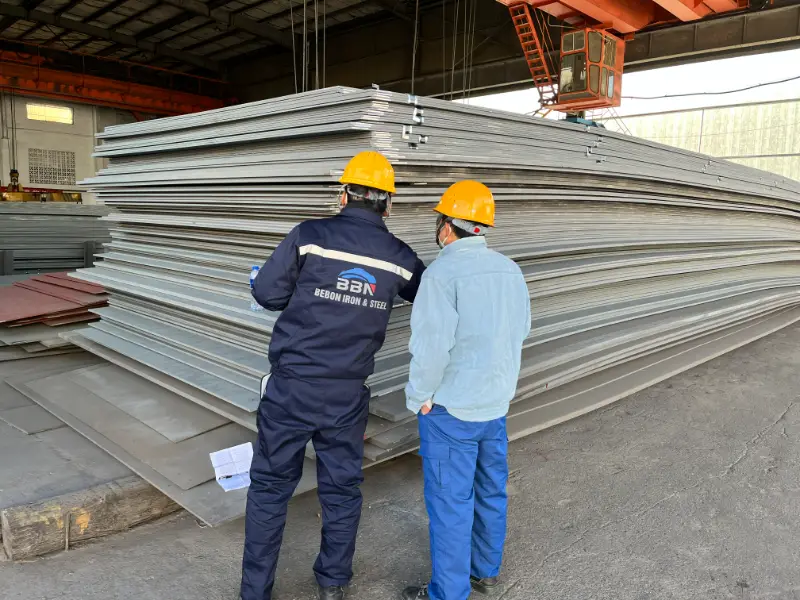
SUS302B Stainless Steel
SUS302B Stainless Steel: High-Carbon Austenitic Grade for Elevated Temperature Strength
Comprehensive data sheet for SUS302B austenitic stainless steel under JIS G4304/G4305. Includes chemical composition, mechanical and physical properties, international equivalents, and application guide.
Hot Rolling, Cold Rolling, Welding, Bending, Deep Drawing, Spinning
- Phone : +8618037372205
- Email : [email protected]
- WhatsApp: Contact via Whtsapp
- WeChat: +8618037372205
SUS302B Stainless Steel Introduction
JIS SUS302B is an austenitic stainless steel with a controlled high carbon content in the range of 0.10-0.15%, enhanced by a silicon addition of up to 3.00%. Governed by standards JIS G4304 (Hot-rolled stainless steel plate, sheet and strip) and JIS G4305 (Cold-rolled stainless steel plate, sheet and strip), this grade is designed for applications requiring superior strength at moderately elevated temperatures compared to standard SUS304. The higher carbon provides greater creep and stress-rupture properties, while the high chromium-nickel base ensures excellent oxidation resistance. Typical characteristics include non-magnetic behavior in the annealed condition (though may become slightly magnetic after cold working), good formability, and weldability. It is commonly supplied in plate and coil form for heat exchangers, furnace components, and chemical processing equipment.
SUS302B Stainless Steel Chemical Composition of SUS302B
The chemical composition adheres to the JIS G4304 and JIS G4305 standards, confirmed by ladle analysis. The alloying design combines high chromium for passivation with elevated carbon and silicon to improve heat resistance and strength. Manganese assists in stabilizing the austenite structure, while phosphorus and sulfur are strictly controlled to maintain corrosion resistance and hot workability.
| Chemical Element | Standard Value | Remarks |
|---|---|---|
| Carbon (C) | 0.10 ~ 0.15 | Increased for high-temperature strength; max 0.15% to limit sensitization |
| Silicon (Si) | 2.00 ~ 3.00 | Added to enhance oxidation resistance at high temperatures |
| Manganese (Mn) | Max 2.00 | Austenite stabilizer |
| Phosphorus (P) | Max 0.045 | Controlled to maintain hot workability |
| Sulfur (S) | Max 0.030 | Controlled to maintain corrosion resistance |
| Nickel (Ni) | 8.00 ~ 10.00 | Primary austenite former |
| Chromium (Cr) | 17.00 ~ 19.00 | Primary element for oxidation and corrosion resistance |
SUS302B Stainless Steel Thermophysical and Electrical Properties of SUS302B
Thermophysical and electrical properties are sensitive to temperature and thermal history. These values are based on published data for this alloy type in the annealed condition and provide essential information for design engineers, particularly for applications involving thermal cycling, heat transfer, or electromagnetic fields. Density and specific heat capacity are critical for weight and thermal mass calculations, while the thermal expansion rate must be considered when joining with other materials.
| Property | Standard Required Value | Unit | Test Condition |
|---|---|---|---|
| Density (ρ) | 8.0 | g/cm³ | At Room Temperature |
| Elastic Modulus (E) | 193 | GPa | At Room Temperature |
| Shear Modulus (G) | 76 | GPa | At Room Temperature |
| Poisson's Ratio (ν) | 0.25 | - | At Room Temperature |
| Thermal Expansion Coefficient (α) | 17.3 | 10⁻⁶/K | Mean Coefficient 0-100°C |
| Thermal Expansion Coefficient (α) | 17.8 | 10⁻⁶/K | Mean Coefficient 0-315°C |
| Thermal Expansion Coefficient (α) | 18.4 | 10⁻⁶/K | Mean Coefficient 0-540°C |
| Thermal Conductivity (λ) | 15.9 | W/(m·K) | At 100°C |
| Thermal Conductivity (λ) | 21.5 | W/(m·K) | At 500°C |
| Specific Heat Capacity (c) | 500 | J/(kg·K) | At 0-100°C |
| Electrical Resistivity (ρ_e) | 720 | nΩ·m | At Room Temperature |
| Melting Range | 1400 ~ 1450 | °C | Approximate Solidus to Liquidus |
| Magnetic Permeability | ≤ 1.02 (Non-magnetic) | μ | Annealed; slightly magnetic after cold work |
SUS302B Stainless Steel Mechanical Properties of SUS302B
Mechanical properties are defined in JIS G4304 (Hot-rolled) and JIS G4305 (Cold-rolled). Properties are specified for solution-annealed condition unless noted for cold-rolled tempers. The high carbon content results in a higher yield and tensile strength compared to SUS302. Elongation and hardness values reflect the balance between strength and ductility. Bend test requirements ensure suitable formability for fabrication.
| Property | Standard Required Value | Unit | Test Condition |
|---|---|---|---|
| Yield Strength (Proof Stress, 0.2%) | ≥ 205 | MPa | Solution Annealed (Hot-rolled/Cold-rolled Plate/Strip) |
| Tensile Strength (Rm) | ≥ 520 | MPa | Solution Annealed (Hot-rolled/Cold-rolled Plate/Strip) |
| Elongation (A) | ≥ 40 | % | Solution Annealed (Hot-rolled Plate, thickness ≤ 8mm) |
| Elongation (A) | ≥ 50 | % | Solution Annealed (Hot-rolled Plate, thickness > 8mm) |
| Elongation (A) | ≥ 50 | % | Solution Annealed (Cold-rolled Sheet, thickness ≤ 0.3mm) |
| Elongation (A) | ≥ 55 | % | Solution Annealed (Cold-rolled Sheet, thickness > 0.3mm) |
| Bend Test (Bend Angle/Center Diameter) | 180° (d=0.4t) | - | Solution Annealed Strip, thickness ≤ 10mm (No cracking) |
| Impact Charpy V-notch (KV) | Not Specified | J | Typically not a requirement for this standard |
| Hardness | ≤ 207 | HBW | Solution Annealed |
| Hardness | ≤ 95 | HRB | Solution Annealed |
| Hardness | ≤ 217 | HV | Solution Annealed |
SUS302B Stainless Steel Completely Equivalent Material Standards and Substitutable Grade Recommendations
| Country/Region | Standard | Grade/Designation | Remarks |
|---|---|---|---|
| International / Europe | EN 10088-2 / EN 10095 | X15CrNiSi25-21 (1.4841) | Chemical and physical equivalent; primary European heat-resisting grade |
| USA | ASTM A240/A240M / SAE | 302B (UNS S30215) | Functionally identical for pressure vessel and general applications |
| Japan | JIS G4304 / JIS G4305 | SUS302B | Reference standard for this inquiry |
| China | GB/T 4237 / GB/T 1220 | 1Cr25Ni20Si2 (Old GB) / 16Cr25Ni20Si2 | Closest match in Chinese standard, minor element tolerances may differ |
| International | ISO 15510 | X15CrNiSi25-21 | International standard mirroring the chemical requirements |
SUS302B Stainless Steel Application Introduction
SUS302B is utilized where elevated temperature mechanical properties are critical and the operating environment involves dry heat or mild oxidizing conditions up to approximately 870°C. Its higher carbon content provides enhanced creep resistance, making it superior to SUS304 for furnace components. Its stable austenitic structure also allows for deep drawing and complex forming in sheet metal applications before service. It is not recommended for heavy wet corrosion acidic environments where L-grade or stabilized grades would be more appropriate.
Product Applications: Hot-rolled and Cold-rolled Annealed Plates, Cold-rolled Stainless Steel Coils and Strips, Welded and Seamless Tubes (Per complementary specs), Fabricated Pressure Vessels, Heat Treatment Baskets, Trays, and Fixtures
Processed into products: Furnace retorts and muffles, Annealing boxes and quenching racks, Heat exchanger baffles and tube supports, High-temperature conveyor belts and wire mesh, Exhaust gas recirculation (EGR) coolers, Burner nozzles and flame tubes, Cement kiln nose rings, Steam boiler superheater tube hangers
Application industries: Industrial Furnace Manufacturing, Thermal Processing and Heat Treatment Facilities, Petrochemical Processing Equipment, Automotive Exhaust Systems (High-Performance), Power Generation (Boiler and Superheater internals), Gas Burner Components
SUS302B Stainless Steel Similar or Nearby Substitute Material Recommendations
| Country/Region | Standard | Grade/Designation | Remarks |
|---|---|---|---|
| Japan | JIS G4304/G4305 | SUS304 | Lower carbon (≤0.08%), no Si addition. Lower high-temperature strength but superior corrosion resistance. Most common alternative for non-creep applications. |
| Japan | JIS G4304/G4305 | SUS302 | Similar high carbon (≤0.15%), but lower silicon (≤1.00%). Lower oxidation resistance; suitable where high strength is needed but the environment is less aggressive. |
| Japan | JIS G4312 | SUH309 | Heat-resisting steel with higher Cr (22.00-24.00%) and Ni (12.00-15.00%). Better scaling resistance up to 980°C, excellent substitute for higher temperature oxidation environments. |
| Europe | EN 10088-2 | X9CrNiSiNCe21-11-2 (1.4835) | High nitrogen and cerium micro-alloyed grade. Offers superior oxidation resistance and creep strength at temperatures up to 1100°C, with similar formability. |
| USA | ASTM A240 | 309S (UNS S30908) | Low carbon version with higher Cr & Ni (22-24% Cr, 12-15% Ni). Excellent oxidation resistance at high temperature, often used as an upgrade for SUS302B. |
Notes:
For optimal properties, solution annealing should be performed by heating to a range of 1010°C to 1150°C, followed by rapid water quenching. Air cooling is possible but must be sufficiently rapid through the sensitization range of 550°C–850°C to avoid precipitating detrimental chromium carbides. Slow cooling is not recommended as it can reduce the intergranular corrosion resistance. While the alloy has good weldability through standard processes (TIG, MIG, resistance welding), the welding heat-affected zone may show slightly reduced corrosion resistance due to carbide precipitation, though the higher carbon level compared to L-grades is intentional for strength. Stress relief heat treatment post-welding is often unnecessary unless for dimensional stability. This grade can exhibit slight magnetism after cold working due to the partial transformation of austenite to martensite, which does not significantly affect its corrosion performance.
- Share



