
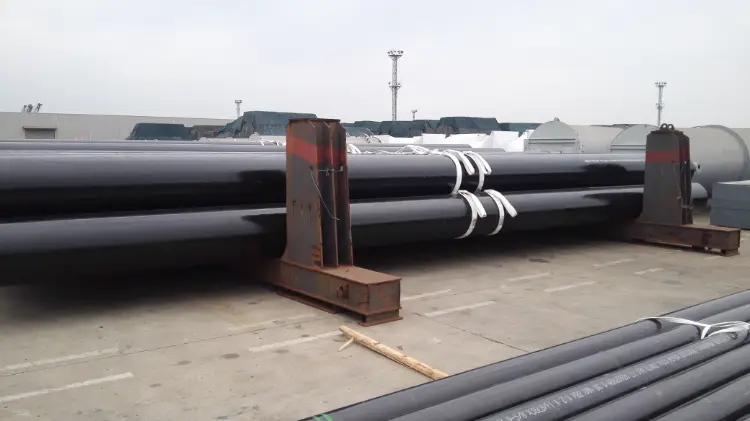
St37-2 Steel (DIN 17100) Properties & SSAW Pipe Guide
St37-2 Steel (DIN 17100) Properties & SSAW Pipe Guide - Complete Material Analysis
Detailed material data for St37-2 structural steel per DIN 17100, used in SSAW pipes. Includes chemical composition, mechanical and thermal properties, international equivalents, and application guidance.
Hot rolling, normalizing rolling, cold forming, welding (SAW, ERW), machining, cutting
- Phone : +8618037372205
- Email : [email protected]
- WhatsApp: Contact via Whtsapp
- WeChat: +8618037372205
St37-2 Steel Properties & SSAW Pipe Guide Introduction
St37-2 is a German carbon structural steel regulated by the historical standard DIN 17100. It is a non-alloy mild steel widely used for general welded structures, including spiral submerged arc welded (SSAW) pipes. The grade offers a good balance of moderate strength, excellent weldability, and formability, making it suitable for a variety of fabrication processes. In SSAW pipe manufacturing, hot-rolled coils of St37-2 are spirally formed and welded, creating large-diameter pipes primarily for fluid transportation and structural applications.
- Typical yield strength of ≥235 MPa for thicknesses ≤16 mm
- Tensile strength range 360–510 MPa
- Good cold bending performance with specified bend radii
- Supplied in hot-rolled or normalizing-rolled condition, often without impact requirements
- Replaced in modern European standards by S235JR (1.0038) per EN 10025-2
St37-2 remains a reference grade in many global markets, particularly for pipelines, construction, and mechanical engineering.
St37-2 Steel Properties & SSAW Pipe Guide Chemical Composition
The chemical composition limits for St37-2 are specified in DIN 17100. The steel is non-alloyed, with restricted phosphorus and sulfur to ensure good weldability. Nitrogen is controlled to minimize strain aging effects. Silicon and aluminum may be present as deoxidizers but are not regulated by the standard. The values below represent maximum permissible contents unless otherwise noted.
| Element | Standard Value (%) | Remarks |
|---|---|---|
| Carbon (C) | ≤ 0.17 | max |
| Manganese (Mn) | ≤ 1.40 | max |
| Phosphorus (P) | ≤ 0.045 | max |
| Sulfur (S) | ≤ 0.045 | max |
| Nitrogen (N) | ≤ 0.009 | max; applies to non-alloy steel without nitrogen-binding elements |
St37-2 Steel Properties & SSAW Pipe Guide Thermal and Electrical Physical Properties
The following physical properties are typical for a non-alloy carbon steel like St37-2 at room temperature unless another condition is specified. These data are not mandatory requirements of DIN 17100 but are representative of the grade for design and thermal calculations. Properties are similar to those of EN S235JR.
| Property | Value | Unit | Test Condition / Temperature |
|---|---|---|---|
| Density (ρ) | 7.85 | g/cm³ | 20 °C |
| Elastic Modulus (E) | 210 | GPa | 20 °C |
| Shear Modulus (G) | ≈ 80 | GPa | 20 °C |
| Poisson's Ratio (ν) | 0.3 | – | 20 °C |
| Thermal Expansion Coefficient (α) | 11.7 12.5 | x10⁻⁶/K | 20 – 100 °C 20 – 200 °C |
| Thermal Conductivity (λ) | 53 | W/(m·K) | 20 °C |
| Specific Heat Capacity (cp) | 480 | J/(kg·K) | 20 °C |
| Electrical Resistivity (ρe) | 0.15 | Ω·mm²/m | 20 °C |
St37-2 Steel Properties & SSAW Pipe Guide Mechanical Properties
The mechanical properties of St37-2 depend on the product thickness. For SSAW pipes, the base metal (hot-rolled coil) must meet these tensile requirements when tested in the longitudinal or transverse direction according to the standard. The bending test is mandatory for sheets and strips; the recommended bend diameters ensure cold formability without cracking.
| Property | Value | Unit | Condition / Thickness |
|---|---|---|---|
| Yield Strength (ReH) | ≥ 235 ≥ 225 ≥ 215 ≥ 205 | MPa | t ≤ 16 mm 16 < t ≤ 40 mm 40 < t ≤ 63 mm 63 < t ≤ 80 mm |
| Tensile Strength (Rm) | 360 – 510 | MPa | All thicknesses ≤ 100 mm |
| Elongation (A) – longitudinal | ≥ 26 ≥ 25 ≥ 24 | % | t ≤ 40 mm (A5) 40 < t ≤ 63 mm 63 < t ≤ 100 mm |
| Elongation (A) – transverse | ≥ 24 ≥ 23 ≥ 22 | % | t ≤ 40 mm 40 < t ≤ 63 mm 63 < t ≤ 100 mm |
| Bend Test (180°) – mandrel diameter | 0.5 a 1.0 a 2.0 a | – | t ≤ 16 mm 16 < t ≤ 100 mm > 100 mm (informative) |
St37-2 Steel Properties & SSAW Pipe Guide Complete Equivalent Standards and Substitute Grades
| Country / Region | Standard | Grade | Remarks |
|---|---|---|---|
| Germany / Europe | EN 10025-2 | S235JR (1.0038) | Direct successor to St37-2; slightly tighter P and S limits, modern designation |
| European Union | EN 10025-2 | S235JRC (1.0122) | Variant with guaranteed suitability for cold forming |
| International | ISO 630-2 | S235B | Similar chemical and mechanical requirements; globally recognized |
| China | GB/T 700 | Q235B | Equivalent carbon structural steel, widely used in welded pipes and structures |
| USA | ASTM A283/A283M | Grade C | Comparable tensile strength; used for general structural purposes, including pipe |
| Japan | JIS G 3101 | SS400 | Similar strength level and application range; slightly wider composition limits |
| Russia | GOST 380 | St3sp / St3ps | Close match in strength and chemical composition; used for welded structures |
St37-2 Steel Properties & SSAW Pipe Guide Application Introduction
St37-2 is predominantly used for SSAW (spiral submerged arc welded) pipes due to its excellent weldability, good formability, and adequate strength. The pipes are manufactured from hot-rolled coils formed into a spiral and welded under flux, producing large-diameter, long-length pipes efficiently. These pipes serve both fluid transport and structural functions and are widely employed in infrastructure projects. Beyond SSAW, the grade is also used to produce various structural components through cutting, bending, and welding processes.
Product Applications: SSAW (spiral submerged arc welded) steel pipes, LSAW (longitudinal submerged arc welded) pipes, ERW (electric resistance welded) pipes, Structural hollow sections (square, rectangular, round), Steel frames and support structures, Storage tanks and pressure vessels (non-critical service)
Processed into products: Cross-country oil and gas transmission pipelines, Water mains and penstock pipes, Piling pipes and foundation casings, Wind turbine tower flanges and internal platforms, Structural columns, beams, and trusses, Welded brackets, supports, and machinery bases, General fabricated parts for civil works
Application industries: Oil & Gas (transmission and distribution pipelines), Water Supply & Sewage Systems, Construction & Civil Engineering, Offshore & Marine (non-critical structural members), Mechanical & General Engineering, Renewable Energy (e.g., wind turbine tower internals)
St37-2 Steel Properties & SSAW Pipe Guide Similar / Alternative Material Recommendations
| Country / Region | Standard | Grade | Remarks |
|---|---|---|---|
| Germany | DIN 17100 | St37-3 (1.0116) | Same strength as St37-2 but with guaranteed notch toughness (optional for St37-2) |
| Europe | EN 10025-2 | S235J0 (1.0114) | Impact energy 27 J at 0°C; suitable for structures with moderate toughness needs |
| Europe | EN 10025-2 | S235J2 (1.0117) | Impact energy 27 J at -20°C; preferred for low-temperature applications |
| USA | ASTM A36/A36M | A36 | Minimum yield strength 250 MPa; widely used structural steel, higher strength than St37-2 |
| China | GB/T 700 | Q235A | Lower toughness assurance (no impact requirement); suitable for non-critical welded parts |
Notes:
St37-2 was officially withdrawn and replaced by S235JR (1.0038) under EN 10025-2. In modern SSAW pipe procurement, the coil material is usually specified as S235JR or similar dual-certified grades. The welding consumables and procedure must be compatible to maintain seam toughness and corrosion resistance. For pipe applications, relevant product standards such as API 5L PSL1 (e.g., Grade B) or EN 10219 (S235JRH) may be applied, often requiring additional testing like hydrostatic tests, NDT of welds, and dimensional tolerances. When replacing St37-2 with a modern grade, ensure that the phosphorus and sulfur content meets the tighter limits of S235JR to guarantee equivalent weldability.
- Share



