
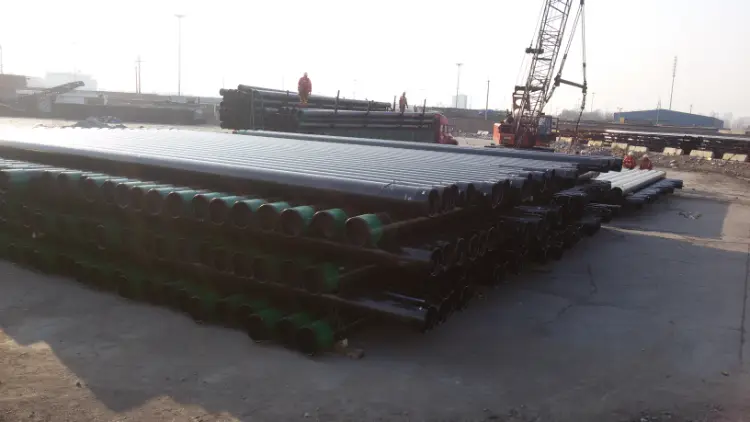
DIN 17100 St52-3 ERW Pipe Steel
DIN 17100 St52-3 ERW Pipe: Chemical Composition, Mechanical Properties & International Equivalents
Comprehensive technical data for DIN 17100 St52-3 electric resistance welded (ERW) pipe, including precise chemical composition, mechanical and physical properties, international cross-references, and application guidance for structural engineering.
Suitable for electric resistance welding, hot forming, cold bending, blanking, machining, and galvanising. Normalised or as-rolled condition depending on section thickness.
- Phone : +8618037372205
- Email : [email protected]
- WhatsApp: Contact via Whtsapp
- WeChat: +8618037372205
DIN 17100 St52-3 ERW Pipe Steel Introduction
DIN 17100 St52-3 is a weldable general structural steel grade formerly standardised in Germany. When manufactured as an electric resistance welded (ERW) pipe, it delivers a favourable combination of high strength, good ductility, and reliable weldability. Typical minimum yield strength is 355 MPa for wall thicknesses up to 16 mm, with tensile strength in the range of 490–630 MPa. The steel is normally supplied in the normalised condition (designated St52-3 N) and provides guaranteed impact toughness of at least 27 J at -20 °C. This makes the pipe suitable for a wide variety of static and dynamically loaded welded structures, mechanical engineering components, and fluid transportation lines. The material corresponds closely to modern grade S355J0 (+N) per EN 10025-2 and is equivalent to ASTM A572 Grade 50.
DIN 17100 St52-3 ERW Pipe Steel Chemical composition
The ladle analysis limits for St52-3 according to DIN 17100 are shown in the table.
- The steel is fully killed and may be fine-grained treated with elements such as Al, Nb, Ti, or V.
- A maximum carbon equivalent (CEV) of 0.47 % is normally specified for welding assurance, especially for pipe intended for structural welding.
- Nitrogen content is limited to improve impact toughness.
| Element | Standard value (max. %) | Remarks |
|---|---|---|
| Carbon (C) | 0.20 | Lower for better weldability; dependent on thickness |
| Silicon (Si) | 0.55 | Deoxidation element; contributes to strength |
| Manganese (Mn) | 1.60 | Primary solid-solution strengthener |
| Phosphorus (P) | 0.040 | For higher toughness requirements, lower levels may be ordered |
| Sulfur (S) | 0.040 | Controlled for formability and weld quality |
| Nitrogen (N) | 0.009 | Limitation for avoiding strain ageing (optional agreement) |
| Carbon Equivalent (CEV) | 0.47 | Typical maximum for weldability; CEV = C+Mn/6+(Cr+Mo+V)/5+(Ni+Cu)/15 |
DIN 17100 St52-3 ERW Pipe Steel Physical and thermal properties
The physical data presented below are typical for low-alloy/non-alloy structural steels of the St52-3 type.
- These values may vary slightly with actual heat treatment and exact chemical composition.
- They are applicable for design calculations including heat transfer, thermal expansion, and electrical resistivity requirements.
| Property | Typical value | Unit | Test condition / remarks |
|---|---|---|---|
| Density (ρ) | 7.85 | kg/dm³ | At 20 °C |
| Modulus of elasticity (E) | 210 | GPa | At 20 °C, tension |
| Shear modulus (G) | ≈ 81 | GPa | At 20 °C, calculated from E and Poisson's ratio |
| Poisson's ratio (ν) | 0.3 | – | Elastic range, at 20 °C |
| Thermal expansion coefficient (α) | 12.1 | 10⁻⁶/K | Between 20 °C and 100 °C |
| Thermal expansion coefficient (α) | 12.8 | 10⁻⁶/K | Between 20 °C and 200 °C |
| Thermal conductivity (λ) | ≈ 51 | W/(m·K) | At 20 °C |
| Specific heat capacity (cp) | ≈ 460 | J/(kg·K) | At 20 °C |
| Electrical resistivity (ρₑ) | ≈ 0.22 | μΩ·m | At 20 °C |
DIN 17100 St52-3 ERW Pipe Steel Mechanical properties
The mechanical property requirements are based on DIN 17100 and are valid for wall thicknesses ≤ 16 mm. Impact energy is determined on longitudinal Charpy V-notch specimens at -20 °C. For larger thicknesses the minimum yield strength decreases gradually. Values for the finished ERW pipe may be verified according to EN 10219-1 for cold-formed hollow sections or EN 10217-1 for pressure pipes, maintaining the same base material strength class.
| Property | Required value | Unit | Test condition |
|---|---|---|---|
| Yield strength (ReH) | ≥ 355 | MPa | Wall thickness t ≤ 16 mm, room temperature |
| Yield strength (ReH) | ≥ 345 | MPa | Wall thickness 16 < t ≤ 40 mm, room temperature |
| Tensile strength (Rm) | 490 – 630 | MPa | Room temperature |
| Elongation (A5) | ≥ 22 (longitudinal) | % | Gauge length 5.65√So, room temperature |
| Elongation (A5) | ≥ 20 (transverse) | % | Gauge length 5.65√So, room temperature |
| Bend test (mandrel diameter) | 2t (for t ≤ 16 mm) | – | 180° bend; no cracks |
| Charpy impact energy (KV) | ≥ 27 (mean of 3 specimens) | J | At -20 °C, longitudinal |
| Charpy impact energy (KV) | ≥ 19 (individual minimum) | J | At -20 °C, longitudinal (one specimen may be lower) |
DIN 17100 St52-3 ERW Pipe Steel Exact and directly equivalent standards and grades
| Country/Region | Standard | Grade | Remarks |
|---|---|---|---|
| European Union | EN 10025-2:2019 | S355J0 (1.0553) | Direct successor; guaranteed impact 27 J at 0 °C; normalised (+N) condition recommended for full equivalence to St52-3 N. |
| European Union | EN 10025-2:2019 | S355J2 (1.0577) | Higher toughness variant with 27 J at -20 °C; matches the St52-3 impact requirement exactly. |
| USA | ASTM A572/A572M | Grade 50 | Minimum yield 345 MPa; similar mechanical range and weldability; often used in pipe production to ASTM A53 or A500. |
| Japan | JIS G3106 | SM490A | Min. 325–365 MPa yield depending on thickness; weldable rolled steel for welded structures; widely accepted as equivalent. |
| China | GB/T 1591-2018 | Q355B (or Q355C) | Q355B with 0 °C impact is the closest; Q355C (-20 °C impact) matches St52-3 toughness. |
DIN 17100 St52-3 ERW Pipe Steel Application Introduction
St52-3 ERW pipe is a versatile choice for structural and mechanical applications where good weldability, cold formability, and reliable toughness are required.
- It is widely used in the construction of steel frameworks, bridges, and offshore platforms.
- The pipe form is particularly suited for columns, trusses, and conveying systems.
- Its guaranteed low-temperature toughness makes it acceptable for cold climate service and dynamic loading situations.
Product Applications: Structural hollow sections (square, rectangular, circular), Welded pipes for fluid/steam transport, Scaffolding and falsework, Crane booms and lattice towers, Tubular piling and foundation caissons, Conveyor rollers and idlers
Processed into products: Column and beam members, Chassis and subframe components of heavy vehicles, Wind turbine tower sections, Pipeline supports and sleepers, Hydraulic cylinder bodies, Pressed flanges and welded pipe fittings, Jack-up legs of mobile offshore units
Application industries: Building and civil engineering, Bridge construction, Mechanical and vehicle manufacturing, Shipbuilding and marine structures, Energy and pipeline infrastructure, Agricultural and material handling equipment
DIN 17100 St52-3 ERW Pipe Steel Closely related alternative materials
| Country/Region | Standard | Grade | Remarks |
|---|---|---|---|
| European Union | EN 10025-2 | S355JR (1.0045) | Minimum impact 27 J at +20 °C; lower toughness priority but similar strength. |
| European Union | EN 10025-2 | S355K2 (1.0596) | Higher toughness (40 J at -20 °C); otherwise identical strength. |
| Germany (historic) | DIN 17100 | St52-3 U (unkilled) | Rare variant; same strength but limited toughness; not recommended for welded structures. |
| USA | AASHTO M270 / ASTM A709 | Grade 50 / 50W | Structural steel for bridges; similar mechanical properties and often ordered as hollow sections. |
| China | GB/T 700 | Q345q (bridge steel) | Contains extra quality requirements but mechanical base similar to St52-3. |
Notes:
- When ordering ERW pipe to the old DIN 17100, verify whether the pipe standard selected is DIN 1626 (for general welded steel pipes) or DIN 2395 (for precision rectangular/square tubes) or now EN 10219/EN 10217, and clearly specify the impact test temperature (-20 °C for St52-3).
- For welded connections, preheating is generally not required for thicknesses up to 40 mm when using low-hydrogen processes.
- St52-3 falls under Material Group 1.2 according to ISO/TR 15608 for welding procedure qualifications.
- Finishing treatments such as hot-dip galvanising are fully compatible.
- Share



