
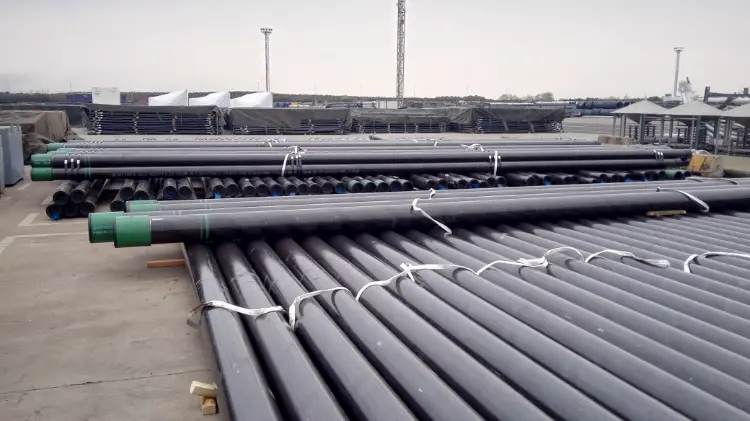
In-Depth Analysis of DIN 17100 St44-2 ERW Pipe
In-Depth Analysis of DIN 17100 St44-2 ERW Pipe: Properties, Equivalents & Applications
Detailed material data for St44-2 steel ERW pipe per DIN 17100, including chemical composition, mechanical properties, thermal properties, international equivalents, and application guide.
Electric resistance welding, cold forming, bending, cutting, machining, hot-dip galvanizing
- Phone : +8618037372205
- Email : [email protected]
- WhatsApp: Contact via Whtsapp
- WeChat: +8618037372205
In-Depth Analysis of DIN 17100 St44-2 ERW Pipe Introduction
DIN 17100 St44-2 is a general structural steel grade widely used for welded pipes and hollow sections. As an ERW (Electric Resistance Welded) tube material, it offers a good balance of strength, weldability, and formability. The steel features a minimum yield strength of 275 MPa for thicknesses up to 16 mm and a tensile strength range of 430–580 MPa. St44-2 is the predecessor of modern EN 10025-2 S275JR and is still referenced in legacy European pipe standards. It is typically supplied in the as-rolled or normalized condition and is suitable for cold forming and hot-dip galvanizing. This grade is not intended for low-temperature impact applications; for such requirements, St44-3 or higher grades should be considered.
In-Depth Analysis of DIN 17100 St44-2 ERW Pipe Chemical Composition
The chemical composition of St44-2 steel as specified in DIN 17100 (for thickness ≤16 mm) is listed below. These limits ensure adequate weldability and mechanical properties. Residual elements may be present but are not intentionally added. Nitrogen control is important for avoiding strain aging effects during cold forming.
| Chemical Element | Standard Value (wt%) | Remarks |
|---|---|---|
| Carbon (C) | ≤ 0.22 | Max |
| Silicon (Si) | ≤ 0.55 | Max (not specified in St44-2, but typical from steelmaking process) |
| Manganese (Mn) | ≤ 1.60 | Typical maximum, not explicitly limited in old standard |
| Phosphorus (P) | ≤ 0.050 | Max |
| Sulfur (S) | ≤ 0.050 | Max |
| Nitrogen (N) | ≤ 0.012 | Max (typically ≤0.009) |
| Copper (Cu) | ≤ 0.55 | Max residual |
| Iron (Fe) | Balance |
In-Depth Analysis of DIN 17100 St44-2 ERW Pipe Thermal and Electrical Physical Properties
The following physical properties are typical for carbon-manganese structural steels like St44-2 at room temperature unless otherwise noted. Variations can occur due to actual chemical analysis and processing. These values are suitable for engineering calculations.
| Property | Standard Required Value | Unit | Test Condition |
|---|---|---|---|
| Density (ρ) | 7.85 | g/cm³ | 20 °C |
| Elastic Modulus (E) | 210 | GPa | 20 °C |
| Shear Modulus (G) | 81 | GPa | 20 °C |
| Poisson's Ratio (ν) | 0.30 | — | 20 °C |
| Thermal Expansion Coefficient (α) | 12.0 × 10⁻⁶ | K⁻¹ | 20 °C – 100 °C |
| Thermal Expansion Coefficient (α) | 13.0 × 10⁻⁶ | K⁻¹ | 20 °C – 300 °C |
| Thermal Conductivity (λ) | 50 | W/(m·K) | 20 °C |
| Specific Heat Capacity (cp) | 460 | J/(kg·K) | 20 °C |
| Electrical Resistivity (ρe) | 0.16 | μΩ·m | 20 °C |
In-Depth Analysis of DIN 17100 St44-2 ERW Pipe Mechanical Properties
Mechanical properties for St44-2 ERW pipe are derived from the base material standard and pipe production standards like DIN 1626. Values depend on wall thickness. The tensile test is performed on strip/plate before pipe forming, and the bend test ensures ductility. No impact test is required for St44-2; if toughness is needed, St44-3 (S275J0) should be specified.
| Property | Standard Required Value | Unit | Test Condition |
|---|---|---|---|
| Yield Strength (ReH) | ≥ 275 | MPa | Wall thickness ≤ 16 mm |
| Yield Strength (ReH) | ≥ 265 | MPa | Wall thickness 16 < t ≤ 40 mm |
| Yield Strength (ReH) | ≥ 255 | MPa | Wall thickness 40 < t ≤ 63 mm |
| Yield Strength (ReH) | ≥ 245 | MPa | Wall thickness 63 < t ≤ 80 mm |
| Yield Strength (ReH) | ≥ 235 | MPa | Wall thickness 80 < t ≤ 100 mm |
| Tensile Strength (Rm) | 430–580 | MPa | Wall thickness ≤ 16 mm |
| Tensile Strength (Rm) | 410–560 | MPa | Wall thickness 16 < t ≤ 40 mm |
| Tensile Strength (Rm) | 400–550 | MPa | Wall thickness 40 < t ≤ 63 mm |
| Tensile Strength (Rm) | 390–540 | MPa | Wall thickness 63 < t ≤ 80 mm |
| Tensile Strength (Rm) | 370–530 | MPa | Wall thickness 80 < t ≤ 100 mm |
| Elongation (A5) | ≥ 22 | % | Wall thickness ≤ 40 mm |
| Elongation (A5) | ≥ 21 | % | Wall thickness 40 < t ≤ 63 mm |
| Elongation (A5) | ≥ 20 | % | Wall thickness 63 < t ≤ 100 mm |
| Bend Test (Mandrel Diameter) | d = 1t | — | Wall thickness ≤ 16 mm, 180° |
| Bend Test (Mandrel Diameter) | d = 2t | — | Wall thickness > 16 mm, 180° |
| Impact Energy (KV) | Not specified | J | For St44-2, no toughness guarantee; St44-3 offers 27 J @ 0 °C |
In-Depth Analysis of DIN 17100 St44-2 ERW Pipe Completely Equivalent Material Standards & Replaceable Grade Recommendations
| Country/Region | Standard | Grade | Remarks |
|---|---|---|---|
| Europe | EN 10025-2 | S275JR | Modern European standard; direct replacement for St44-2 |
| USA | ASTM A36 | A36 | Comparable general structural steel, yield 250 MPa |
| Japan | JIS G3101 | SS400 | General structural grade, tensile 400–510 MPa |
| China | GB/T 700 | Q275B | Similar carbon structural steel, yield 275 MPa |
| International | ISO 630-2 | Fe 430B | Old ISO designation equivalent to St44-2 |
In-Depth Analysis of DIN 17100 St44-2 ERW Pipe Application Introduction
St44-2 ERW pipes are utilized across a broad range of industries due to their reliable mechanical performance and ease of fabrication. The grade is well suited for welding, bending, and light galvanizing. Typical applications include structural hollow sections, conveyors, and fluid transport lines where internal pressure is moderate. For environments requiring impact toughness, alternative grades with guaranteed low‑temperature properties should be selected.
Product Applications: Electric resistance welded (ERW) round, square, and rectangular hollow sections, Spiral‑welded large‑diameter pipes, Galvanized water and gas pipes, Scaffolding tubes (EN 39, EN 10219), Structural profiles for modular buildings
Processed into products: Steel tube piles and sheet piling connectors, Mufflers and exhaust pipes, Fence posts and handrails, Conveyor rollers and idler frames, Hydraulic cylinder bodies (low pressure), Bicycle frames and fitness equipment
Application industries: Building and construction (columns, beams, trusses), Infrastructure (bridges, transmission towers), Mechanical engineering (frames, supports, guards), Automotive (exhaust systems, seat frames, roll cages), Pipe and tubing (water mains, gas distribution, fire sprinkler systems), Agricultural machinery (implements, greenhouses)
In-Depth Analysis of DIN 17100 St44-2 ERW Pipe Recommendations for Close/Similar Alternative Materials
| Country/Region | Standard | Grade | Remarks |
|---|---|---|---|
| Europe | EN 10025-2 | S275J0 | Same strength, guaranteed impact energy 27 J at 0 °C |
| Europe | EN 10025-2 | S275J2 | Same strength, impact 27 J at –20 °C, for cold climate |
| USA | ASTM A572 | Gr. 50 | Higher strength (345 MPa), may need design adjustments |
| Japan | JIS G3106 | SM400A | Welded structural steel with similar strength and weldability |
| China | GB/T 1591 | Q355B | Higher strength, requires process qualification |
Notes:
St44-2 has been superseded by EN 10025‑2 S275JR for new designs, but many existing specifications still refer to it. When ordering ERW pipes, the applicable pipe standard (e.g., DIN 1626, EN 10219) must be agreed upon. Galvanizing of this grade is possible, but silicon content should be kept below 0.04% to avoid excessive coating thickness; this may require ordering special silicon‑controlled St44‑2. For welded structures exposed to dynamic loads, it is recommended to use grades with specified impact energy.
- Share



