
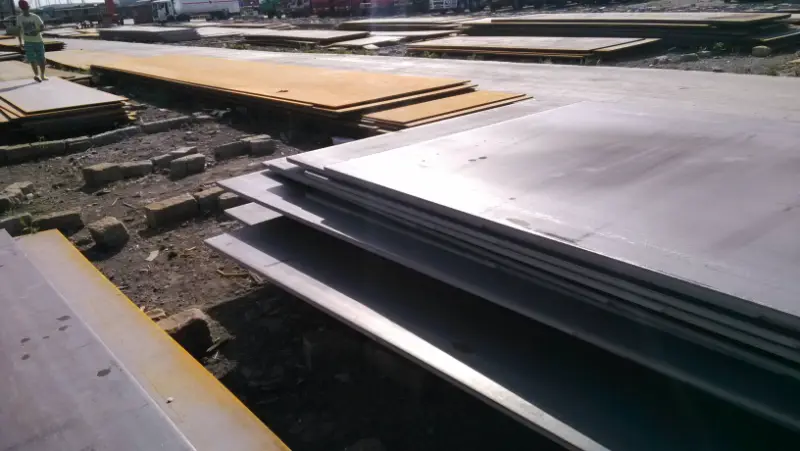
SPFH590 Hot Rolled High Strength Steel for Automobile Structures
SPFH590 Hot Rolled High Strength Steel for Automobile Structures - Q/BQB 310-2009
Detailed material data of SPFH590 steel according to Q/BQB 310-2009. Includes chemical composition, mechanical properties, physical properties, international equivalents, and application guidance.
Cold forming, bending, punching, stamping, welding, cutting
- Phone : +8618037372205
- Email : [email protected]
- WhatsApp: Contact via Whtsapp
- WeChat: +8618037372205
SPFH590 Hot Rolled High Strength Steel for Automobile Structures Introduction
SPFH590 is a hot-rolled high strength steel sheet/coil specified in Baosteel enterprise standard Q/BQB 310-2009, designed primarily for automotive structural applications. It offers a minimum tensile strength of 590 MPa combined with good formability and weldability. The grade is typically microalloyed with niobium (Nb) and titanium (Ti) to achieve fine grain strengthening and precipitation hardening, giving improved crashworthiness, fatigue resistance, and weight-saving potential. Thickness ranges from 1.6 mm to 6.0 mm. Common delivery conditions include as-hot-rolled, controlled-rolled, pickled and oiled, and optionally skin-passed.
SPFH590 Hot Rolled High Strength Steel for Automobile Structures Chemical Composition as per Q/BQB 310-2009
The chemical composition is based on ladle analysis. Microalloying elements like Nb and Ti are frequently added to obtain the required strength and grain refinement. Values are maximum unless a range or minimum is indicated.
- Alt: total aluminum, minimum content required for grain refinement.
- Nb, Ti, V: may be added singly or in combination at the steelmaker's discretion; listed maxima are typical upper limits.
| Element | Typical/Maximum Value (wt%) | Remarks |
|---|---|---|
| C | ≤0.18 | Max |
| Si | ≤0.60 | Max |
| Mn | ≤2.00 | Max |
| P | ≤0.025 | Max |
| S | ≤0.015 | Max |
| Alt | ≥0.010 | Min |
| Nb | ≤0.09 | Optional; typical max |
| Ti | ≤0.15 | Optional; typical max |
| V | ≤0.10 | Optional; typical max (rarely used alone) |
SPFH590 Hot Rolled High Strength Steel for Automobile Structures Thermal and Electrical Physical Properties
These values are typical for HSLA hot-rolled steel at room temperature unless otherwise noted. They are not part of the standard requirements but serve as design guidance. Variations may occur due to exact composition and processing.
| Property | Typical Value | Unit | Condition/Temperature |
|---|---|---|---|
| Density (ρ) | 7.85 | g/cm³ | 20 °C |
| Elastic modulus (E) | 210 | GPa | 20 °C |
| Shear modulus (G) | ≈80 | GPa | 20 °C |
| Poisson's ratio (ν) | 0.30 | – | 20 °C |
| Thermal expansion coefficient (α) | 11.8 × 10⁻⁶ | 1/K | 20–200 °C |
| Thermal conductivity (λ) | ~45 | W/(m·K) | 100 °C |
| Specific heat capacity (cₚ) | 460 | J/(kg·K) | room temperature |
| Electrical resistivity (ρₑ) | ~0.15 – 0.25 | μΩ·m | 20 °C |
SPFH590 Hot Rolled High Strength Steel for Automobile Structures Mechanical Properties
Properties are for hot-rolled sheet/strip in the as-delivered condition. Tensile test specimens are taken transverse to rolling direction. Elongation values depend on thickness. Bending test is conducted at 180° over a specified mandrel diameter, with no cracks on the outside of the bend.
| Property | Standard Requirement | Unit | Condition/Thickness (t) |
|---|---|---|---|
| Upper yield strength (ReH) | ≥355 | MPa | t ≤6.0 mm |
| Tensile strength (Rm) | 590 – 740 | MPa | All thicknesses |
| Elongation after fracture (A) | ≥17 | % | 1.6 mm ≤ t <2.0 mm |
| Elongation after fracture (A) | ≥18 | % | 2.0 mm ≤ t <2.5 mm |
| Elongation after fracture (A) | ≥20 | % | 2.5 mm ≤ t <3.2 mm |
| Elongation after fracture (A) | ≥21 | % | 3.2 mm ≤ t ≤6.0 mm |
| Bending test (180°) | Mandrel diameter = 1a | – | t ≤6.0 mm, no cracking |
SPFH590 Hot Rolled High Strength Steel for Automobile Structures Completely Equivalent Material Standards and Grades
| Country/Region | Standard | Grade | Remarks |
|---|---|---|---|
| China | Q/BQB 310-2009 | SPFH590 | Baosteel enterprise standard |
| Japan | JIS G 3135 | SPFH590 | Identical chemistry and properties |
| International (ISO) | ISO 20805:2006 | HCT590X | Equivalent hot-rolled HS formable steel |
SPFH590 Hot Rolled High Strength Steel for Automobile Structures Application Introduction
SPFH590 is designed for stamped and welded automotive structural parts where high strength and good fatigue resistance are critical. Its excellent formability and consistent mechanical properties allow complex shapes with high dimensional accuracy. The steel is suitable for thickness reduction (lightweighting) without sacrificing safety performance. Key application sectors:
- Passenger vehicles
- Commercial vehicles
- Construction machinery (cabins, frames)
Product Applications: Chassis longitudinal beams, Cross members and subframes, Seat frames and seat belt anchors, Bumper reinforcement beams, Wheel rim inner parts (discs), Body structural reinforcements (A/B pillar inner panels)
Processed into products: Stamped brackets and reinforcement plates, Spot-welded and MIG-welded assemblies, Hydroformed tubular parts (torsion beams, engine cradles), Laser-cut blanks for tailor welded blanks and tailored strips, Roll-formed sections used in truck chassis
Application industries: Automotive manufacturing, Construction machinery, Railway vehicles
SPFH590 Hot Rolled High Strength Steel for Automobile Structures Similar/Closely Related Alternative Materials
| Country/Region | Standard | Grade | Remarks |
|---|---|---|---|
| EU | EN 10149-2 | S550MC | Min YS 550 MPa, TS 600-760 MPa; slightly higher strength, good alternative for thickness ≤6 mm |
| China | GB/T 20887 (equivalent to ISO 20805) | HR590F840 | Hot-rolled high strength formable steel, TS 590 MPa min, similar applications |
| Japan | JIS G 3113 | SAPH590 | Hot-rolled automobile structural plate, TS ≥590 MPa, slightly different formability |
Notes:
For demanding cold forming operations, a controlled-rolled and skin-passed surface is recommended. Weldability is excellent with all common welding methods (spot, arc, laser). When replacing softer steel grades, adjust springback compensation in forming tools. Higher strength may require increased press capacity. For applications requiring corrosion resistance, a pickled and oiled surface is standard, and additional coating (e.g., galvanizing) can be applied by agreement.
- Share



