
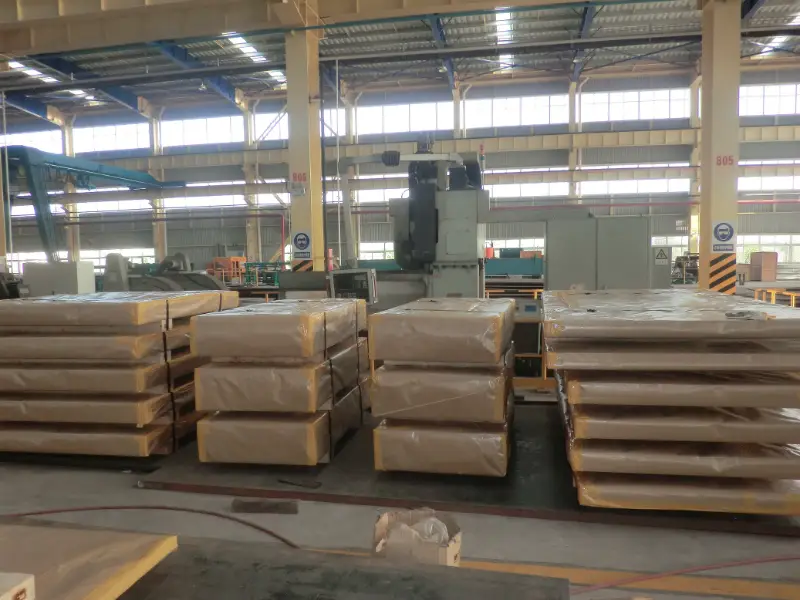
SPFH540 Hot-Rolled High-Strength Steel Plate for Automotive Structural Use
SPFH540 Hot-Rolled High-Strength Steel Plate for Automotive Structural Use | Q-BQB 310-2009
Comprehensive technical data for SPFH540 hot-rolled high-strength steel plate under Baosteel standard Q-BQB 310-2009, including chemical composition, mechanical properties, physical properties, equivalent grades, and application guidance.
Cold forming, bending, deep drawing (limited), shearing, punching, welding (resistance, arc, laser), and coating processes.
- Phone : +8618037372205
- Email : [email protected]
- WhatsApp: Contact via Whtsapp
- WeChat: +8618037372205
SPFH540 Hot-Rolled High-Strength Steel Plate for Automotive Structural Use Introduction
SPFH540 is a hot-rolled high-strength steel plate primarily used in automotive structural and reinforcement components. It offers a minimum tensile strength of 540 MPa and good formability, making it suitable for parts requiring both strength and moderate deformation. The grade is designed for cold forming and welding, with controlled chemical composition to ensure consistent mechanical properties and weldability. Typical applications include chassis, frames, and suspension parts. Under Baosteel's Q-BQB 310-2009, SPFH540 is supplied in the as-rolled or controlled-rolled condition with guaranteed mechanical properties.
SPFH540 Hot-Rolled High-Strength Steel Plate for Automotive Structural Use Chemical Composition
The chemical composition of SPFH540 steel is controlled to achieve a balance between strength, formability, and weldability. Carbon (C) is kept low to enhance formability and weldability, while manganese (Mn) and silicon (Si) provide solid-solution strengthening. Microalloying elements such as niobium (Nb) or titanium (Ti) may be added for grain refinement and precipitation strengthening, though they are not mandatory in the standard. Phosphorus (P) and sulfur (S) are limited to avoid brittleness.
| Element | Standard Value (max or range) | Remarks |
|---|---|---|
| C | ≤ 0.15% | Lower carbon improves formability and weldability |
| Si | ≤ 0.50% | Solid-solution strengthener; higher levels hinder surface quality |
| Mn | ≤ 1.60% | Enhances strength; excess may reduce ductility |
| P | ≤ 0.030% | Controlled to avoid cold shortness |
| S | ≤ 0.025% | Low sulfur for improved toughness and formability |
| Alt (total Al) | ≥ 0.015% | Used for deoxidation; fine grain practice |
| Nb, Ti or V (optional) | Total ≤ 0.22% | Microalloying elements may be used to achieve strength; not mandatory |
SPFH540 Hot-Rolled High-Strength Steel Plate for Automotive Structural Use Physical and Electrical Properties
The physical properties listed below are typical for low-carbon high-strength steels and are applicable to SPFH540. These values are not part of the Q/BQB 310-2009 standard but are provided for design and process engineering. Density, elastic modulus, and thermal conductivity are comparable to those of mild steel. Properties such as specific heat capacity and electrical resistivity vary slightly with temperature.
| Property | Typical Value | Unit | Test Condition / Remarks |
|---|---|---|---|
| Density (ρ) | 7.85 | g/cm³ | At 20°C |
| Elastic Modulus (E) | 210 | GPa | At 20°C; typical for steel |
| Shear Modulus (G) | 80 | GPa | Calculated from E and Poisson's ratio |
| Poisson's Ratio (ν) | 0.3 | – | Typical for steel |
| Coefficient of Thermal Expansion (α) | 12.0–12.5 | 10⁻⁶/K | 20–200°C range |
| Coefficient of Thermal Expansion (α) | 13.0–13.5 | 10⁻⁶/K | 20–400°C range |
| Thermal Conductivity (λ) | 50–52 | W/(m·K) | At 20°C |
| Specific Heat Capacity | 460–480 | J/(kg·K) | At 20°C |
| Electrical Resistivity (ρ_e) | 0.20–0.25 | µΩ·m | At 20°C |
SPFH540 Hot-Rolled High-Strength Steel Plate for Automotive Structural Use Mechanical Properties
The mechanical properties of SPFH540 are determined from transverse test pieces taken from hot-rolled strip or plate. The values meet the requirements of Q/BQB 310-2009. Yield strength (ReH) and tensile strength (Rm) are guaranteed, while elongation (A) depends on thickness. Bend test performance is typically not specified for this high-strength grade, but good formability is expected. Impact toughness is not required for this application. The data below represent minimum or typical values.
| Property | Standard Required Value | Unit | Test Condition / Remarks |
|---|---|---|---|
| Yield Strength (ReH) | ≥ 325 | MPa | Transverse; for thickness ≤ 6.0 mm |
| Yield Strength (ReH) | ≥ 305 | MPa | Transverse; for thickness > 6.0 mm |
| Tensile Strength (Rm) | ≥ 540 | MPa | Transverse; all thicknesses |
| Elongation (A) | ≥ 22 (thickness ≤ 3.2 mm) | % | Gauge length 50 mm; transverse |
| Elongation (A) | ≥ 23 (thickness > 3.2 – 6.0 mm) | % | Gauge length 50 mm; transverse |
| Elongation (A) | ≥ 24 (thickness > 6.0 mm) | % | Gauge length 50 mm; transverse |
SPFH540 Hot-Rolled High-Strength Steel Plate for Automotive Structural Use Fully Equivalent Material Standards and Substitutable Grades
| Country/Region | Standard | Grade | Remarks |
|---|---|---|---|
| Japan | JIS G 3134:2012 | SPFH540 | Hot-rolled high strength steel with improved formability; identical designation |
| China (Baosteel) | Q/BQB 310-2009 | SPFH540 | Original standard; identical grade |
| International | ISO 20807:2007 | HR2 | Comparable strength level; may require agreement on composition and testing |
| Europe | EN 10268:2006 | HC340LA | Microalloyed steel with min YS 340 MPa, TS 410-510 MPa; slightly lower strength but similar application |
| China (GB) | GB/T 20887.1-2007 | HR340LA | Based on ISO; similar strength range; may be considered as alternative |
SPFH540 Hot-Rolled High-Strength Steel Plate for Automotive Structural Use Application Introduction
SPFH540 is engineered for the automotive industry, where high strength-to-weight ratios and reliable formability are critical. It is suitable for cold-forming processes such as stamping, bending, and moderate drawing. The material can be welded using conventional methods (resistance spot welding, MIG/MAG, laser welding) without significant loss of joint strength. Due to its pickled surface, it is ready for subsequent coating (e.g., galvanizing, painting) or direct use. The grade is not intended for heat treatment quenching & tempering; mechanical properties are achieved through controlled rolling.
Product Applications: Passenger car chassis and subframes, Truck frame reinforcements, Suspension arms, torsion bars, and stabilizers, Wheel rims and discs, Seat structures and safety components, Bumper beams and door impact beams
Processed into products: Stamped structural brackets, Reinforcement plates and gussets, Formed channels and crossmembers, Welded assemblies for body-in-white, Bent tubular components (after forming), Laser-welded blanks for tailored properties
Application industries: Automotive manufacturing, Commercial vehicle and bus production, Railway vehicle components, Agricultural machinery, Light structural engineering
SPFH540 Hot-Rolled High-Strength Steel Plate for Automotive Structural Use Closely Related / Similar Substitute Material Recommendations
| Country/Region | Standard | Grade | Remarks |
|---|---|---|---|
| Japan | JIS G 3134 | SPFH590 | Higher strength (TS ≥ 590 MPa); can be substituted where higher load-bearing capacity is required |
| China | Q/BQB 310-2009 | SPFH490 | Lower strength (TS ≥ 490 MPa); suitable where lower strength but better formability is needed |
| Europe | EN 10268 | HC380LA | Microalloyed steel with TS 440-560 MPa; close in performance, may replace SPFH540 after verification |
| USA | ASTM A1011/A1011M | SS Grade 55 (380) | Structural steel with min YS 380 MPa; comparable strength but different forming characteristics |
| China (GB) | GB/T 20887.1 | HR550LA | Min TS 550 MPa; high-strength low-alloy steel for automotive; similar in strength |
Notes:
Surface condition: Typically supplied pickled and oiled (HRPO) to provide a clean surface for forming and welding. Special surface quality requirements (e.g., exposed vs. unexposed) must be agreed upon at the time of order. Thickness tolerance: According to Q/BQB 301 or as agreed. Weldability: Carbon equivalent (CEV) is usually below 0.30% to ensure good spot weldability. Formability: Although not a deep-drawing grade, SPFH540 exhibits acceptable stretch flanging and bending properties; local forming limits should be validated with the supplier. Corrosion protection: The oil film provides temporary protection; for long-term corrosion resistance, zinc-based coatings or painting is recommended.
- Share



