
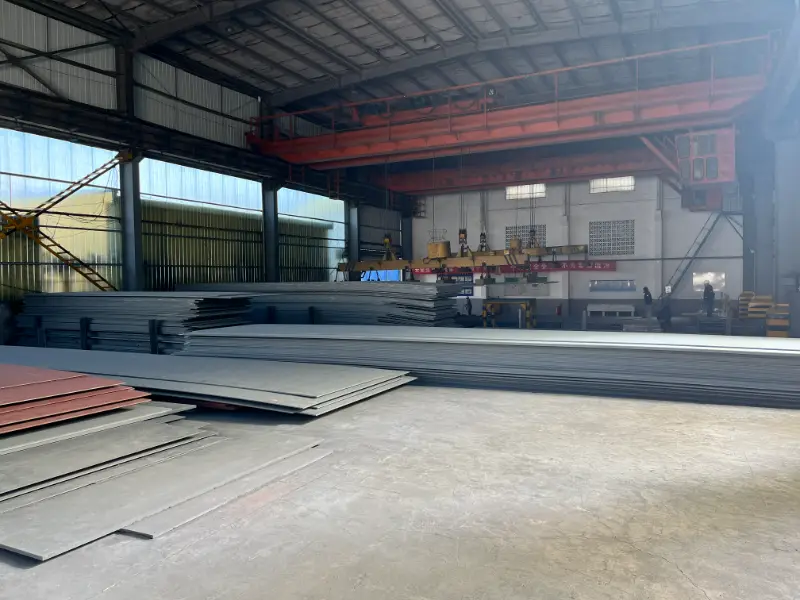
QStE340TM Automotive Structural Steel Plate
QStE340TM Automotive Structural Steel Plate | High Strength Hot Rolled Fine Grain Steel
Detailed material data for QStE340TM fine grain steel according to Q/BQB 310-2009, including chemical composition, mechanical properties, physical characteristics, equivalent grades, and application guide for automotive structural components.
Cold forming, bending, stamping, welding, cutting (laser/plasma), punching
- Phone : +8618037372205
- Email : [email protected]
- WhatsApp: Contact via Whtsapp
- WeChat: +8618037372205
QStE340TM Automotive Structural Steel Plate Introduction
QStE340TM is a hot-rolled high-strength low-alloy steel specifically designed for automotive structural applications. It complies with the Baosteel enterprise standard Q/BQB 310-2009 and belongs to the family of fine grain steels with minimum yield strength of 340 MPa, produced via thermomechanical rolling (TM process). The steel offers an excellent combination of strength, formability, and weldability, making it ideal for cold-formed parts where weight reduction and safety are critical.
QStE340TM Automotive Structural Steel Plate Chemical Composition
Chemical composition limits as specified in Q/BQB 310-2009 for QStE340TM. The steel is microalloyed with niobium, titanium, and/or vanadium to achieve fine grain strengthening. The sum of Nb, Ti, and V is restricted to ensure consistent mechanical properties.
| Element | Max. Value (%) | Remarks |
|---|---|---|
| C | 0.12 | |
| Si | 0.50 | |
| Mn | 1.30 | |
| P | 0.030 | |
| S | 0.025 | |
| Alt (total aluminum) | min. 0.015 | Minimal content for grain refinement |
| Nb | 0.09 | Sum Nb+Ti+V ≤ 0.22 % |
| Ti | 0.12 | Sum Nb+Ti+V ≤ 0.22 % |
| V | 0.12 | Sum Nb+Ti+V ≤ 0.22 % |
QStE340TM Automotive Structural Steel Plate Physical and Thermal Properties
Representative physical properties for QStE340TM at ambient conditions and typical thermal data for low-carbon microalloyed steel. Values are for general engineering use and may vary slightly with processing history.
| Property | Typical Value | Unit | Test Condition / Remarks |
|---|---|---|---|
| Density (ρ) | 7.85 | g/cm³ | Room temperature |
| Modulus of elasticity (E) | 210 | GPa | At 20 °C |
| Shear modulus (G) | approx. 80 | GPa | At 20 °C |
| Poisson's ratio (ν) | 0.3 | – | In elastic range |
| Thermal expansion coefficient (α) | 12.0 | 10⁻⁶/K | 20 °C to 100 °C |
| Thermal conductivity (λ) | 50 | W/(m·K) | At 20 °C |
| Specific heat capacity (c) | 460 | J/(kg·K) | At 20 °C – 100 °C |
| Electrical resistivity (ρₑ) | 0.16 | μΩ·m | At 20 °C |
QStE340TM Automotive Structural Steel Plate Mechanical Properties
Mechanical properties at room temperature for flat products in delivery condition according to Q/BQB 310-2009. Elongation values depend on specimen thickness. Transverse test pieces are normally used. The bending test demonstrates excellent cold formability.
| Property | Requirement | Unit | Test Condition / Thickness |
|---|---|---|---|
| Yield strength (ReH) | ≥ 340 | MPa | All thicknesses |
| Tensile strength (Rm) | 400 – 540 | MPa | All thicknesses |
| Elongation after fracture (A) | ≥ 25 | % | Thickness ≤ 3 mm, transverse, specimen length L0 = 80 mm or 50 mm |
| Elongation after fracture (A) | ≥ 23 | % | Thickness > 3 mm, transverse, specimen length L0 = 5.65√S0 |
| Bend test | No cracks | – | Bend angle 180°, mandrel diameter d = 0.5a (a = specimen thickness), for thickness ≤ 8 mm |
QStE340TM Automotive Structural Steel Plate Fully Equivalent International Standards and Substitute Grades
| Country/Region | Standard | Grade | Remarks |
|---|---|---|---|
| Europe | EN 10149-2:2013 | S340MC | Thermomechanically rolled; identical chemistry and mechanical concept |
| International (ISO) | ISO 6930-1:2004 | FeE340 | High yield strength for cold forming |
| Japan | JIS G 3134:2018 | SPFH 540 | Closest grade, though min. YS is 325 MPa; can be used with approval |
| India | IS 11513:2017 | Fe 410 | Comparable microalloyed hot strip |
QStE340TM Automotive Structural Steel Plate Application Introduction
QStE340TM is engineered for complex cold-formed automotive parts requiring high strength and good fatigue resistance. Its fine grain structure and clean steel practice ensure consistent forming behavior and excellent weldability with all common processes.
Product Applications: Passenger car underbodies, Truck frames and crossmembers, Bus body structures, Trailer chassis components
Processed into products: Engine cradles / subframes, Suspension control arms and torsion beams, Bumper reinforcement beams, Seat frames and anchorage parts, Longitudinal rails and floor crossmembers, Wheelhouse and A/B-pillar reinforcements
Application industries: Automotive OEM and tier suppliers, Commercial vehicle manufacturing, Agricultural and construction vehicle production, Material handling equipment
QStE340TM Automotive Structural Steel Plate Similar / Substitute Material Recommendations with Comparable Performance
| Country/Region | Standard | Grade | Remarks |
|---|---|---|---|
| Europe | EN 10149-2 | S355MC | Higher strength (YS ≥355 MPa); may require process adjustment |
| Japan | JIS G 3113 | SAPH 440 | Automotive structural hot-rolled steel, YS ≥275 MPa; lower strength |
| China | Q/BQB 310-2009 | QStE380TM | Next strength level in the same standard, YS ≥380 MPa |
| USA | SAE J1392 | 050XLK | HSLA with YS ~340 MPa; comparable cold formability |
Notes:
Ordering considerations: When specifying QStE340TM according to Q/BQB 310-2009, the desired thickness range, surface quality class (e.g., FA, FB), and edge condition should be agreed upon at the time of enquiry and order. The steel can be supplied with improved surface (pickled and oiled) or as hot-rolled with mill scale. Impact properties at low temperatures are not mandatory but can be agreed (e.g., Charpy V-notch ≥ 40 J at -20 °C). Welding: No preheating required for thicknesses below 30 mm under normal conditions; common welding methods include MAG, resistance spot welding, and laser welding.
- Share



