
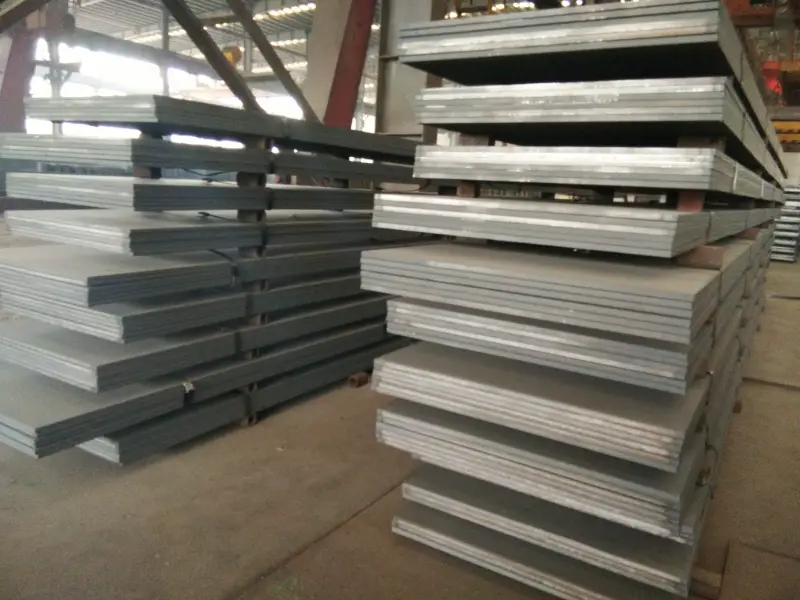
Q/BQB 310-2009 QStE380TM
Q/BQB 310-2009 QStE380TM: High-Strength Automotive Structural Steel with Excellent Formability
QStE380TM is a hot-rolled high-strength low-alloy (HSLA) steel for automotive structural applications, specified in Baosteel's Q/BQB 310-2009 standard. It offers minimum yield strength of 380 MPa with good weldability and formability.
Thermomechanical rolling, hot rolling, pickling, oiling, suitable for cold forming (bending, drawing, profiling), welding, and coating.
- Phone : +8618037372205
- Email : [email protected]
- WhatsApp: Contact via Whtsapp
- WeChat: +8618037372205
Q/BQB 310-2009 QStE380TM Introduction
QStE380TM is a microalloyed fine-grain structural steel produced by thermomechanical rolling. It is characterized by a minimum yield strength of 380 MPa, excellent cold formability, and good weldability. The controlled rolling process refines the grain structure, achieving high strength without compromising toughness. This grade is widely used in the automotive industry for safety and weight reduction. Its low carbon equivalent (Ceq) ensures reliable welding with conventional methods. Typical supply condition is hot-rolled, pickled and oiled, providing a clean surface suitable for subsequent forming and coating processes.
Q/BQB 310-2009 QStE380TM Chemical Composition
The chemical composition is designed to achieve high strength and fine grain size through microalloying with niobium, vanadium, and titanium. Low carbon and sulfur contents ensure good weldability and toughness. The values represent ladle analysis according to Q/BQB 310-2009.
| Element | Value (wt%) | Remarks |
|---|---|---|
| C | ≤0.10 | |
| Si | ≤0.50 | |
| Mn | ≤1.40 | |
| P | ≤0.025 | |
| S | ≤0.015 | |
| Al (total) | ≥0.015 | |
| Nb | ≤0.09 | |
| V | ≤0.20 | |
| Ti | ≤0.15 | |
| N | ≤0.015 | If not combined with other elements |
| Mo | ≤0.20 | May be present |
| Cr+Ni+Cu | ≤0.60 | Residual elements |
Q/BQB 310-2009 QStE380TM Physical Properties
Thermal and electrical properties are typical for microalloyed low-carbon steels and are not specified in the standard. They are provided for design purposes.
| Property | Typical Value | Unit | Condition |
|---|---|---|---|
| Density (ρ) | 7.85 | g/cm³ | 20 °C |
| Modulus of elasticity (E) | 210 | GPa | 20 °C |
| Shear modulus (G) | 81 | GPa | Calculated |
| Poisson's ratio (ν) | 0.3 | – | Typical for steel |
| Coefficient of thermal expansion (α) | 12.0 | 10⁻⁶ /K | 20–100 °C |
| Thermal conductivity (λ) | 50 | W/(m·K) | 20 °C |
| Specific heat capacity (cp) | 460 | J/(kg·K) | 20 °C |
| Electrical resistivity (ρe) | 0.13 | 10⁻⁶ Ω·m | 20 °C |
Q/BQB 310-2009 QStE380TM Mechanical Properties
Mechanical properties are based on transverse test pieces. The values vary with thickness; elongation is measured on gauge length A80 for sheet. Bend test demands no cracks on the outer surface. For thicknesses outside the specified range, properties shall be agreed upon.
| Property | Value | Unit | Test Condition / Thickness |
|---|---|---|---|
| Yield Strength (ReH) | ≥380 | MPa | t ≤ 4 mm |
| Yield Strength (ReH) | ≥380 | MPa | 4 < t ≤ 6 mm |
| Tensile Strength (Rm) | 450 – 590 | MPa | All thicknesses |
| Elongation after fracture (A80) | ≥23 | % | t ≤ 4 mm |
| Elongation after fracture (A80) | ≥21 | % | 4 < t ≤ 6 mm |
| Bend test (180°) | d = 0.5a | – | t ≤ 4 mm, bend axis transverse |
| Bend test (180°) | d = 1a | – | 4 < t ≤ 6 mm, bend axis transverse |
Q/BQB 310-2009 QStE380TM Equivalent Grades
| Country/Region | Standard | Grade | Remarks |
|---|---|---|---|
| EU | EN 10149-2 | S380MC (1.0974) | Exact equivalent – thermomechanical rolled |
| International | ISO 6930-2 | S380MC | Identical to EN 10149-2 |
| China | Q/BQB 310-2009 | QStE380TM | Original designation |
Q/BQB 310-2009 QStE380TM Application Introduction
QStE380TM is optimized for automotive structural components that require high strength, fatigue resistance, and good weldability. It allows weight reduction without sacrificing safety or durability. Typical processing includes blanking, cold stamping, bending, and welding. The steel is compatible with cathodic electrodeposition (E-coat) and other common coating systems after proper pre-treatment.
Product Applications: Vehicle chassis and frames, Suspension systems, Wheel rims and discs, Structural body-in-white reinforcements
Processed into products: Longitudinal beams, Cross members, Suspension control arms, Engine cradles, Bumper reinforcements, Towing hitches, Seat frames and recliner parts
Application industries: Automotive (passenger cars, light commercial vehicles), Transportation (truck frames, trailers), Construction machinery (structural parts)
Q/BQB 310-2009 QStE380TM Similar / Alternative Grades
| Country/Region | Standard | Grade | Remarks |
|---|---|---|---|
| China | Q/BQB 310-2009 | QStE340TM | Lower minimum yield strength (340 MPa), otherwise similar chemistry |
| China | Q/BQB 310-2009 | QStE420TM | Higher minimum yield strength (420 MPa), otherwise similar chemistry |
| EU | EN 10149-2 | S315MC | Lower strength category |
| EU | EN 10149-2 | S420MC | Higher strength category |
| Japan | JIS G3113 | SAPH440 | Structural hot-rolled automotive steel; yield ~305 MPa, tensile ≥440 MPa |
| China | GB/T 20887.1 | HR420F | Hot-rolled ferritic-bainitic steel for cold forming, higher strength |
Notes:
The steel can be supplied with improved surface quality (pickled & oiled) to enhance formability and coating adhesion. Welding parameters should be adjusted for the thermomechanical condition; low heat input welding and avoidance of excessive heat are recommended to preserve fine-grain structure. For hot-dip galvanizing, consult the producer regarding zinc bath compatibility. Tolerances on dimensions and shape conform to Q/BQB 301 or as agreed.
- Share



