
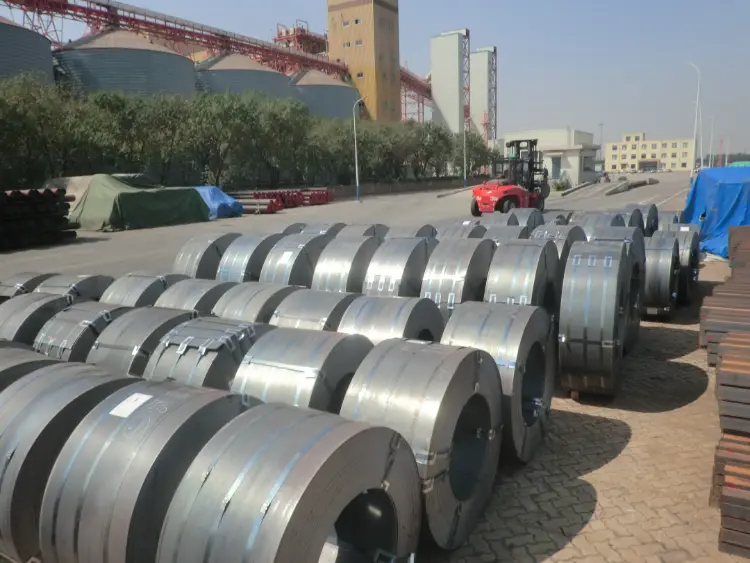
GB/T14164-2013 L245 (API 5L Grade B) PSL1 Pipeline Steel Coil
GB/T14164-2013 L245 (API 5L Grade B) PSL1 Pipeline Steel Coil - Composition, Properties & Equivalents
Explore the technical data of L245 (Grade B) pipeline steel coil per GB/T14164-2013: chemical composition, mechanical and physical properties, international equivalents, and application guidance for oil & gas transmission.
Hot rolling; subsequent processing includes cold forming, bending, longitudinal or spiral welding (SAW, ERW, HFW), and normalizing if required.
- Phone : +8618037372205
- Email : [email protected]
- WhatsApp: Contact via Whtsapp
- WeChat: +8618037372205
GB/T14164-2013 L245 PSL1 Pipeline Steel Coil Introduction
L245 (API 5L Grade B) PSL1 pipeline steel coil specified under GB/T14164-2013 is a widely used carbon-manganese steel for transmission of oil, gas and water. It corresponds to the PSL1 (Product Specification Level 1) requirements, which primarily control tensile properties and basic chemical composition. The steel offers good weldability, moderate strength and reliable notch toughness (when impact tested by agreement). Typical delivery condition is hot-rolled or normalized. The coil form is intended for subsequent forming and welding into longitudinal or spiral submerged-arc welded pipes.
GB/T14164-2013 L245 PSL1 Pipeline Steel Coil Chemical Composition
Chemical requirements for PSL1 steel according to GB/T 14164-2013 Table 5. L245 is designed to have low sulfur and phosphorus to ensure good weldability and toughness. Microalloying elements Nb, V, and Ti may be added individually or in combination. Residual elements such as Cu, Ni, Cr, Mo are not specified but shall not exceed usual steelmaking limits unless otherwise agreed.
| Element | Specified Value (max %) | Remark |
|---|---|---|
| C | 0.22 | Carbon equivalent CE IIW typically ≤0.43 for thickness ≤25 mm |
| Si | 0.45 | Silicon content may be lower; no minimum specified for PSL1 |
| Mn | 1.20 | Manganese may be adjusted to achieve required strength |
| P | 0.025 | For improved toughness and resistance to cracking |
| S | 0.015 | Low sulfur improves formability and reduces hot shortness |
| V+Nb+Ti | 0.15 | Sum of three elements; individually V≤0.05, Nb≤0.05, Ti≤0.04 typically |
| Al (total) | 0.060 max if added | Used for deoxidation; only required for killed steel practice |
GB/T14164-2013 L245 PSL1 Pipeline Steel Coil Thermal & Electrical Physical Properties
The following typical physical properties are provided for L245 pipeline steel in the as-rolled condition. These values are derived from general carbon-manganese steel data and are suitable for engineering design. Variations may occur depending on exact chemistry and processing.
| Property | Typical Value | Unit | Condition / Temperature |
|---|---|---|---|
| Density (ρ) | 7.85 | g/cm³ | At 20°C |
| Modulus of elasticity (E) | 207 | GPa | At 20°C |
| Shear modulus (G) | 79.3 | GPa | Calculated from E and ν |
| Poisson ratio (ν) | 0.30 | – | At 20°C |
| Thermal expansion coefficient (α) | 11.7 | 10⁻⁶/K | 20–100°C |
| Thermal expansion coefficient (α) | 12.5 | 10⁻⁶/K | 20–200°C |
| Thermal expansion coefficient (α) | 13.3 | 10⁻⁶/K | 20–400°C |
| Thermal conductivity (λ) | 53 | W/(m·K) | At 20°C |
| Thermal conductivity (λ) | 49 | W/(m·K) | At 200°C |
| Thermal conductivity (λ) | 43 | W/(m·K) | At 400°C |
| Specific heat capacity (cₚ) | 486 | J/(kg·K) | At 20°C |
| Electrical resistivity (ρₑ) | 0.16 | μΩ·m | At 20°C, typical for 0.2% C steel |
GB/T14164-2013 L245 PSL1 Pipeline Steel Coil Mechanical Properties
Mechanical properties are determined on transverse test specimens taken from the coil or produced pipe, according to GB/T 14164-2013 Tables 9 and 10. For PSL1 L245 grade, tensile and bend tests are mandatory; impact testing is optional by agreement. Elongation minimum is calculated per formula or taken from standard minima for strip/plate used in pipe manufacturing.
| Property | Typical / Required Value | Unit | Test Condition |
|---|---|---|---|
| Yield Strength (ReH) | 245 – 450 | MPa | Transverse test, ambient; rate as per standard |
| Tensile Strength (Rm) | 415 – 760 | MPa | Transverse test, ambient |
| Elongation after fracture (A) | ≥ 23 (for t ≤25.4 mm) | % | Longitudinal strip test, gauge length 5.65√S₀, ASTM A370 equivalent |
| Elongation after fracture (A) | ≥ 22 (for t >25.4 mm) | % | Longitudinal strip test, 5.65√S₀ |
| Bend test (180° bend) | No cracks | – | Former diameter: 6T (for OD≤114.3 mm) or as per table; specimen width 38 mm |
| Charpy V-notch impact (if agreed) | ≥ 27 J at 0°C (typical) | J | Transverse specimen, 10×10 mm; temperature and values by agreement |
GB/T14164-2013 L245 PSL1 Pipeline Steel Coil Completely Equivalent Material Standards & Grades
| Country/Region | Standard | Designation | Remark |
|---|---|---|---|
| International | ISO 3183:2019 | L245 PSL1 | Identical technical delivery conditions for pipeline steel; PSL1 option |
| USA | API 5L (46th Ed.) | Grade B PSL1 | Chemically wider (C max 0.28, P 0.030, S 0.030) but functionally equivalent |
| Europe | EN 10208-1 | L245GA | Seamless and welded steel pipes for combustible fluids; chemistry very close |
| Russia/CIS | GOST R ISO 3183 | L245 | Adopts ISO standard, same designation and requirements |
GB/T14164-2013 L245 PSL1 Pipeline Steel Coil Application Introduction
L245 pipeline steel coils are the starting material for welded line pipes used in low to medium pressure transmission systems. They are selected where cost-effectiveness and good weldability are paramount. The steel is suitable for onshore pipelines, gathering lines, and general structural pipework. Typical applications are outlined below.
Product Applications: Spiral submerged-arc welded (SSAW) pipes, Longitudinal submerged-arc welded (LSAW) pipes, Electric resistance welded (ERW/HFW) pipes, Plain-end or beveled pipes up to large diameters, Casing and tubing for low-pressure wells
Processed into products: Line pipe segments (straight pipes), Butt-welded pipe fittings (elbows, tees, reducers) fabricated from plate or coil, Flanges and connectors cut from plate, Pipeline induction bends and cold bends, Pipe piles and foundation tubes, Storage tank shells and roof structures (using coil into plate)
Application industries: Oil & gas upstream (gathering and flowlines), Long-distance high-pressure transmission (up to certain pressure ratings), Water and sewage transportation, Petrochemical and refinery piping, Structural engineering (piling, bridges, building frames)
GB/T14164-2013 L245 PSL1 Pipeline Steel Coil Similar / Alternative Material Grades with Slight Differences
| Country/Region | Standard | Designation | Remark |
|---|---|---|---|
| China | GB/T 14164-2013 | L245N (PSL2) | Fine-grain normalized version, with tighter chemistry and guaranteed impact energy at low temperature |
| China | GB/T 14164-2013 | L245M (PSL2) | Thermomechanically rolled, higher toughness, used for sour service or arctic pipelines |
| USA | API 5L | X42 PSL1 | Slightly higher yield strength (290 MPa), can substitute with reduced wall thickness in some designs |
| Japan | JIS G 3454 | STPG 370 | Carbon steel pipe for pressure service, yield ≥215 MPa; not for sour gas but similar general applications |
| Germany | DIN 1629 | St 37.0 | Structural/carbon steel pipe, yield ≥235 MPa; not specific for pipeline transmission |
Notes:
Additional remarks:
- Product analysis tolerances are permitted as per GB/T 14164-2013 Table 7. The sum of Cu+Ni+Cr+Mo shall not exceed 0.25% unless otherwise agreed.
- Carbon equivalent (CEV) shall be calculated and supplied with each coil if required by the purchaser. For PSL1, no maximum CEV is imposed by the standard, but typical CEV is ≤0.43 for thickness ≤25 mm.
- Hydrogen-induced cracking (HIC) testing is not a standard requirement for PSL1; if needed, a PSL2 grade with HIC conditioning should be specified.
- PSL1 designation means non-destructive testing (NDT) of the finished pipe is not mandatory; however, if pipe is ordered as coil for later pipe production, the final pipe NDT is governed by the pipe manufacturing standard.
- For sour service applications, this grade is generally not recommended without special qualification and restricted chemistry.
- Share



