
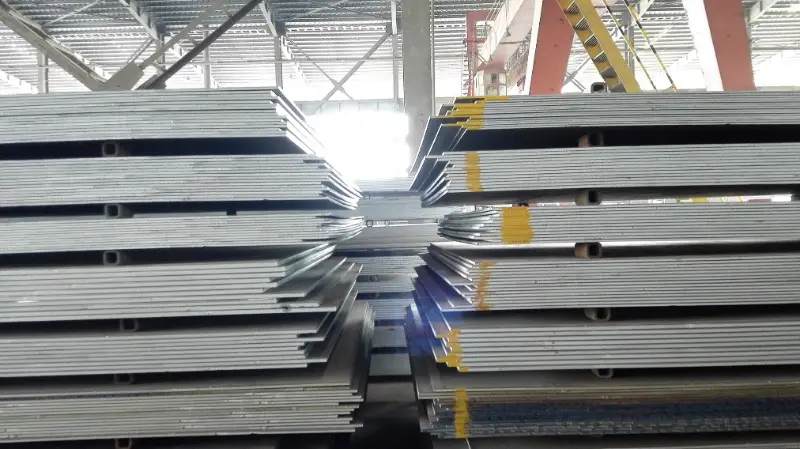
SAPH400 Automotive Structural Steel Plate
SAPH400 Automotive Structural Steel Plate | Q-BQB 310-2009 Hot Rolled Pickled Steel
SAPH400 is a hot-rolled pickled steel for automotive structural parts according to Baosteel standard Q-BQB 310-2009. It offers good formability and weldability, suitable for cold forming and bending applications.
Cutting, blanking, cold forming, bending, stamping, welding, punching, roll forming
- Phone : +8618037372205
- Email : [email protected]
- WhatsApp: Contact via Whtsapp
- WeChat: +8618037372205
SAPH400 Automotive Structural Steel Plate Introduction
SAPH400 is a hot-rolled pickled steel grade defined by Q/BQB 310-2009 (Baosteel enterprise standard for automobile structural steel). It belongs to the category of high-strength low-alloy (HSLA) steels with a minimum tensile strength of 400 MPa. The material combines good formability, weldability, and toughness, making it ideal for structural components in vehicles. Its controlled chemical composition (C ≤0.21%, Si ≤0.30%, Mn ≤1.20%, with low P and S) ensures consistent mechanical properties. Typical applications include chassis parts, frames, wheels, and reinforcements that require cold bending, stamping, and moderate drawing. The steel is supplied in as-hot-rolled and pickled condition, often with tight thickness tolerances.
SAPH400 Automotive Structural Steel Plate Chemical Composition
The chemical composition of SAPH400 is designed to achieve a minimum tensile strength of 400 MPa while maintaining good cold formability and weldability. The limits for carbon, manganese, and aluminum are tightly controlled. Phosphorus and sulfur are kept low to ensure ductility and toughness. No intentional addition of microalloying elements is required, but residual elements are permitted within limits specified by the standard.
| Element | Specified Value (max or min) | Remarks |
|---|---|---|
| C | ≤0.21 | Ladle analysis |
| Si | ≤0.30 | Ladle analysis |
| Mn | ≤1.20 | Ladle analysis |
| P | ≤0.030 | Ladle analysis |
| S | ≤0.025 | Ladle analysis |
| Alt | ≥0.010 | Total aluminum (acid soluble assumed) |
SAPH400 Automotive Structural Steel Plate Thermal and Electrical Physical Properties
Physical properties are typical for low-carbon HSLA steel and are provided for engineering design. Actual values may vary slightly with composition and processing. These data are not part of the mandatory standard requirements but represent commonly accepted reference values for steel of this type.
- Density: 7.85 g/cm³ (room temperature)
- Modulus of elasticity: 210 GPa (static), may slightly decrease with temperature
| Property | Typical Value | Unit | Test Condition / Remarks |
|---|---|---|---|
| Density (ρ) | 7.85 | g/cm³ | At 20°C |
| Modulus of elasticity (E) | 210 | GPa | Tensile, ambient |
| Shear modulus (G) | ≈80 | GPa | Calculated from E and ν |
| Poisson's ratio (ν) | 0.30 | Within elastic range | |
| Thermal expansion coefficient (α) | 11.5 | ×10⁻⁶/K | 20–100°C |
| Thermal expansion coefficient (α) | 12.2 | ×10⁻⁶/K | 20–200°C |
| Thermal expansion coefficient (α) | 13.0 | ×10⁻⁶/K | 20–400°C |
| Thermal conductivity (λ) | 52 | W/(m·K) | At 100°C |
| Specific heat capacity (cp) | 460 | J/(kg·K) | Ambient temperature |
| Electrical resistivity (ρe) | 0.18 | μΩ·m | At 20°C (typical carbon steel) |
SAPH400 Automotive Structural Steel Plate Mechanical Properties
The mechanical properties are determined from transverse test pieces taken from the as-delivered condition. Yield strength and tensile strength requirements are minimum values, while elongation depends on thickness. The bending test ensures adequate cold formability. Note that impact toughness is not a standard requirement for SAPH400 under Q/BQB 310; the steel is primarily evaluated for static room-temperature properties.
- Test method: Tensile test per ISO 6892-1 / JIS Z 2241
- Bend test: 180° bend, no cracking on outer surface
| Property | Required Value | Unit | Test Condition / Thickness Range |
|---|---|---|---|
| Yield strength (ReL) | ≥235 | MPa | All thicknesses, transverse |
| Tensile strength (Rm) | ≥400 | MPa | All thicknesses, transverse |
| Elongation (A, 50 mm gauge length) | ≥28 | % | 1.6 mm ≤ t < 2.0 mm |
| Elongation (A, 50 mm gauge length) | ≥30 | % | 2.0 mm ≤ t < 2.5 mm |
| Elongation (A, 50 mm gauge length) | ≥31 | % | 2.5 mm ≤ t < 3.15 mm |
| Elongation (A, 50 mm gauge length) | ≥33 | % | 3.15 mm ≤ t < 4.0 mm |
| Elongation (A, 50 mm gauge length) | ≥34 | % | 4.0 mm ≤ t < 6.0 mm |
| Elongation (A, 50 mm gauge length) | ≥35 | % | 6.0 mm ≤ t ≤ 8.0 mm |
| Bend test (180°) | d=0a (no crack) | t ≤ 3.15 mm | |
| Bend test (180°) | d=0.5a (no crack) | t > 3.15 mm |
SAPH400 Automotive Structural Steel Plate Full Equivalent Grades and Substitutable Designations
| Country/Region | Standard | Grade | Remarks |
|---|---|---|---|
| Japan | JIS G 3113 | SAPH400 | Direct equivalent, same strength and formability class |
| China (Baosteel) | Q/BQB 310-2009 | SAPH400 | Original standard; also covered by GB/T 20887.1 but not identical |
SAPH400 Automotive Structural Steel Plate Application Introduction
SAPH400 is extensively used in the automotive industry for parts that require a combination of strength and cold formability. Its good weldability allows joining by resistance spot welding and arc welding processes. The steel is typically formed into complex shapes by bending, drawing, and punching.Typical processing steps:
- Blanking and punching of cold rolled/pickled sheets
- Cold bending and stamping to final shape
- Welding (spot, projection, MAG)
- Surface coating (e-coating or painting) for corrosion protection
Product Applications: Passenger car chassis frames and sub-frames, Cross members and longitudinal beams for trucks, Wheel rims and disk wheels (for moderate load), Suspension arms and control arm brackets, Seat frames and seat belt reinforcements, Bumper reinforcement beams, Fuel tank straps, Engine mounting brackets, Stamped panels for body-in-white reinforcements
Processed into products: Chassis side rails, Cross-member brackets, Engine cradle components, Brake pedal brackets, Hinge reinforcements, Seat backrest frames, Winch brackets, Tow hook reinforcements, Battery trays, Exhaust system hanger brackets
Application industries: Automotive manufacturing, Commercial vehicle and trailer construction, Agricultural machinery, Railway vehicle components, General light structural engineering
SAPH400 Automotive Structural Steel Plate Similar / Alternative Steels with Comparable Properties
| Country/Region | Standard | Grade | Remarks |
|---|---|---|---|
| Europe | EN 10149-2 | S355MC | Comparable yield and tensile strength, similar formability, but lower minimum tensile strength (430 MPa) - may substitute in many structural applications |
| Japan | JIS G 3113 | SAPH440 | Higher tensile strength (≥440 MPa); can be used when higher strength is needed and formability allows |
| China | GB/T 20887.1 | HR400Y | Hot-rolled steel for cold forming; similar strength class, but check thickness tolerances and chemistry |
| Japan | JIS G 3134 | SPFH490 | Higher strength, used for automotive structural parts where greater load capacity is required |
| International | ISO 6930-1 | HR315F | Similar concept; yield strength ~315 MPa; not directly equivalent but can serve as substitute with design adjustments |
Notes:
Notes:
- This data is based on Q/BQB 310-2009 issued by Baosteel. For actual production, slight variations may occur; the certified mill test certificate prevails.
- The chemical composition is for ladle analysis; product analysis may have wider tolerances.
- Mechanical properties are only guaranteed for thicknesses typically from 1.6 mm up to 8.0 mm. For other thicknesses, inquire with the supplier.
- The bending test radius is specified for 180° bend; for more severe forming, formability assessments (e.g., FLD) are recommended.
- Physical property values are representative of structural carbon steel; thermal conductivity decreases with increasing temperature, and specific heat rises.
- Share



