
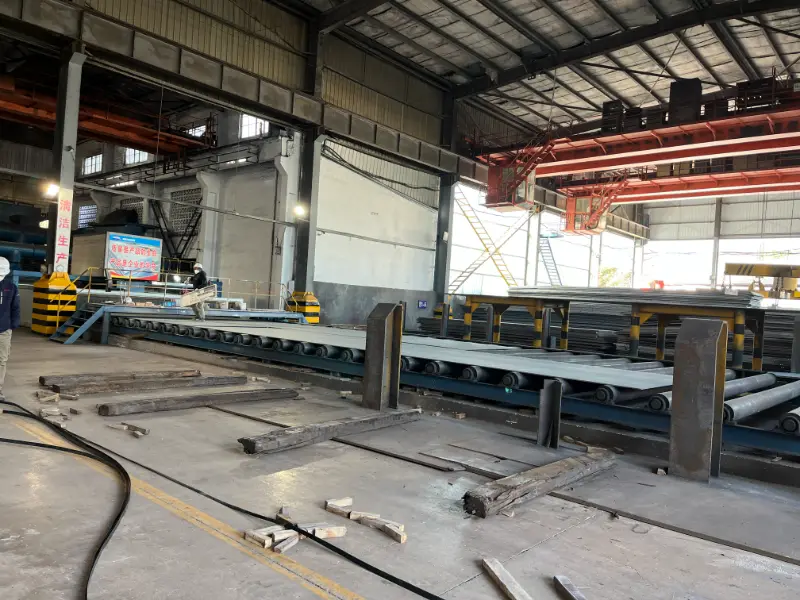
SAPH370 Automobile Structural Steel Plate
SAPH370 Automobile Structural Steel Plate - Q/BQB 310-2009 Analysis: Chemical, Mechanical & Thermal Properties
Comprehensive material data for SAPH370 steel plate according to Baosteel standard Q/BQB 310-2009, including chemical composition, mechanical properties, physical performance, international equivalents, and application guidance for automotive structural applications.
Hot rolling, pickling, oiling, cutting, cold forming, welding, stamping, bending
- Phone : +8618037372205
- Email : [email protected]
- WhatsApp: Contact via Whtsapp
- WeChat: +8618037372205
SAPH370 Automobile Structural Steel Plate Introduction
SAPH370 is a hot-rolled steel plate specifically designed for automobile structural components, specified in the Baosteel enterprise standard Q/BQB 310-2009, which is technically equivalent to JIS G 3113. It belongs to the family of high-strength, low-alloy structural steels with a minimum tensile strength of 370 MPa. The grade is characterized by
- Excellent formability and weldability, enabling complex stamping and joining operations;
- Good balance between strength and ductility, suitable for energy-absorbing parts;
- Controlled chemical composition with micro-alloying elements for grain refinement and improved toughness;
- Widely used in the automotive industry for chassis, frames, wheels, and other load-bearing structures.
The material is typically supplied in the as-rolled condition, and can also be delivered pickled and oiled. This data complies with the official product standard and represents typical values for quality assurance and design purposes.
SAPH370 Automobile Structural Steel Plate Chemical Composition
The chemical requirements for SAPH370 are based on ladle analysis according to Q/BQB 310-2009, which mirrors JIS G 3113. Controlled levels of carbon and manganese ensure weldability, while residual elements are limited to maintain ductility. Aluminum is typically added as a deoxidizer and grain refiner. Note: Silicon is not explicitly specified in the base standard but is commonly controlled for surface quality; the table includes typical limits. All values are maximum unless otherwise indicated.
| Element | Standard Value (max % unless noted) | Remarks |
|---|---|---|
| C | 0.21 | Ensures strength without compromising weldability |
| Si | 0.30 | Not specified in JIS G 3113, commonly restricted for surface quality |
| Mn | 0.75 | Contributes to strength and hardenability |
| P | 0.040 | Impurity limit |
| S | 0.040 | Impurity limit |
| Alt (total aluminum) | ≥ 0.015 | Minimum required for grain refinement and deoxidation |
SAPH370 Automobile Structural Steel Plate Thermal and Electrical Physical Properties
These physical properties are representative for low-carbon steel and are provided for engineering reference. They are not specified by Q/BQB 310-2009 but are based on typical data for similar grades. Variations may occur depending on exact chemical composition and processing. Density reflects standard steel, thermal conductivity and expansion are critical for distortion analysis during welding.
| Property | Typical Value | Unit | Test Condition / Remarks |
|---|---|---|---|
| Density (ρ) | 7.85 | g/cm³ | Room temperature |
| Elastic Modulus (E) | 210 | GPa | Room temperature |
| Shear Modulus (G) | 80 | GPa | Calculated (typical for steel) |
| Poisson's Ratio (ν) | 0.3 | - | Elastic range |
| Thermal Expansion Coefficient (α) | 11.7 × 10⁻⁶ | /K | 20–100 °C |
| Thermal Expansion Coefficient (α) | 12.5 × 10⁻⁶ | /K | 20–200 °C |
| Thermal Expansion Coefficient (α) | 13.3 × 10⁻⁶ | /K | 20–300 °C |
| Thermal Conductivity (λ) | 52 | W/(m·K) | At 25 °C |
| Specific Heat Capacity | 460 | J/(kg·K) | At 25 °C |
| Electrical Resistivity (ρₑ) | 0.13 – 0.14 | μΩ·m | Room temperature |
SAPH370 Automobile Structural Steel Plate Mechanical Properties
Mechanical properties are determined on test pieces taken in the transverse direction, except for tensile tests on thicknesses below 3.15 mm where longitudinal samples may apply. The values are according to Q/BQB 310-2009 / JIS G 3113 and depend on the nominal thickness. Bend test: 180° bending without cracks on the outside of the bent portion. No impact test is required by the standard.
| Property | Required Value | Unit | Test Condition / Thickness |
|---|---|---|---|
| Yield Strength (ReH) | ≥ 225 | MPa | Thickness ≤ 6 mm |
| Yield Strength (ReH) | ≥ 215 | MPa | 6 mm < thickness ≤ 8 mm |
| Yield Strength (ReH) | ≥ 205 | MPa | 8 mm < thickness ≤ 14 mm |
| Tensile Strength (Rm) | ≥ 370 | MPa | All thicknesses (up to 14 mm) |
| Elongation (A) | ≥ 26 | % | Thickness < 3.15 mm; JIS No. 5 test piece (L0=50 mm) |
| Elongation (A) | ≥ 32 | % | 3.15 mm ≤ thickness < 6 mm; JIS No. 1A test piece |
| Elongation (A) | ≥ 33 | % | 6 mm ≤ thickness ≤ 14 mm; JIS No. 10 test piece |
| Bend Test (180°) | Flat on itself | - | Thickness ≤ 2.0 mm; bend diameter = 0 |
| Bend Test (180°) | Bend diameter = 1.0 × thickness | - | 2.0 mm < thickness ≤ 3.2 mm |
| Bend Test (180°) | Bend diameter = 1.5 × thickness | - | Thickness > 3.2 mm |
SAPH370 Automobile Structural Steel Plate Equivalent Standards and Directly Substitutable Grades
| Country/Region | Standard | Grade | Remarks |
|---|---|---|---|
| Japan | JIS G 3113 | SAPH370 | Origin standard; identical technical requirements |
| China | Q/BQB 310-2009 | SAPH370 | Baosteel enterprise standard, directly adopted from JIS |
| Korea | KS D 3517 | SAPH370 | Korean standard equivalent to JIS G 3113 |
SAPH370 Automobile Structural Steel Plate Application Introduction
SAPH370 is specifically engineered for demanding automotive structural applications where a combination of strength, formability, and weldability is required. The steel is well-suited for mass production environments such as stamping and robotic welding lines. Typical uses include:
Product Applications: Passenger car chassis and subframes, Truck frame side rails and cross members, Wheel discs and wheel rims, Suspension control arms and torsion beams, Engine mounting brackets and reinforcement panels, Seat frames and backrest structures
Processed into products: Stamped and formed longitudinal beams, Brake pedal arms, Transmission support brackets, Towing hooks and fixtures, Battery mounting trays (in electric vehicles), Various welded assemblies where fatigue resistance is necessary
Application industries: Automotive manufacturing, Commercial vehicle and trailer production, Railway rolling stock components (secondary structures), Agricultural and construction machinery frames
SAPH370 Automobile Structural Steel Plate Similar or Alternative Materials with Comparable Performance
| Country/Region | Standard | Grade | Remarks |
|---|---|---|---|
| Europe | EN 10149-2 | S355MC | Hot-rolled high yield strength steel for cold forming; min. YS 355 MPa, TS 430–550 MPa; similar application but slightly higher strength |
| China | GB/T 20887.1 | HR340LA | High-strength low-alloy steel for cold forming; YS 340–420 MPa, TS 410–510 MPa; comparable formability |
| International | ISO 6930-2 | FeE355 | High yield strength steel for cold forming; similar weldability and toughness |
| Japan | JIS G 3113 | SAPH400 | Higher strength version (TS ≥400 MPa) of the same family; may be considered with adjustment of design |
Notes:
The grade SAPH370 is typically supplied without specific impact test requirements. When low-temperature toughness is needed, additional agreement or alternative grades (e.g., SAPH370 with fine grain practice) should be considered. The steel is not intended for heat treatment; mechanical properties are developed through controlled hot rolling. For service at elevated temperatures, the yield strength can decrease significantly; consult material data for temperature derating. Product dimensions and tolerances are according to Q/BQB 301 or referenced standards.
- Share



