
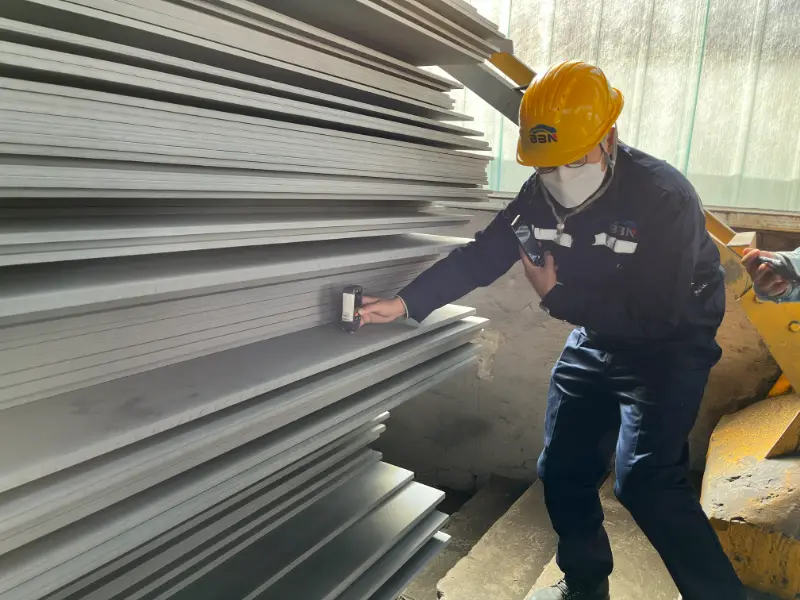
SAPH310 Automotive Hot-Rolled Steel Plate
SAPH310 Automotive Hot-Rolled Steel Plate - Q/BQB 310-2009
SAPH310 is a hot-rolled steel for automotive structural applications, characterized by excellent formability and moderate strength, compliant with Baosteel enterprise standard Q/BQB 310-2009.
Cold forming, stamping, bending, welding, punching, drawing
- Phone : +8618037372205
- Email : [email protected]
- WhatsApp: Contact via Whtsapp
- WeChat: +8618037372205
SAPH310 Automotive Hot-Rolled Steel Plate Introduction
SAPH310 is a ferritic hot-rolled steel grade defined in Q/BQB 310-2009, specifically developed for automobile structural parts requiring high formability and reliable weldability. With a minimum yield strength of 185 MPa and tensile strength of 305 MPa, it offers an excellent balance between ductility and strength for demanding cold-forming operations. The steel features controlled chemical composition (low carbon, low silicon, and micro-alloy additions optional) to ensure consistent mechanical properties across thicknesses. Its uniform microstructure and clean surface allow applications in suspension members, brackets, and chassis reinforcements. The steel is typically supplied in hot-rolled and pickled/oiled condition, suitable for direct forming without intermediate annealing.
SAPH310 Automotive Hot-Rolled Steel Plate Chemical Composition
The chemical composition of SAPH310 is designed for excellent formability and weldability. Low carbon and manganese contents ensure high ductility and low hardenability during welding. Tight control of sulphur and phosphorus improves cold formability and resistance to cracking. Aluminum is added as a deoxidizer and grain refiner. The standard allows small additions of niobium, titanium, or vanadium for grain refinement, though not mandatory; the listed values represent the maximum or specified limits from Q/BQB 310-2009.
| Element | Value (max unless noted) | Remarks |
|---|---|---|
| C | 0.10 % | |
| Si | 0.05 % | |
| Mn | 0.50 % | |
| P | 0.025 % | |
| S | 0.015 % | |
| Alt | ≥0.010 % | Total aluminum |
SAPH310 Automotive Hot-Rolled Steel Plate Thermal & Electrical Physical Properties
The following physical properties represent typical values for low-carbon steel similar to SAPH310. These data are not specified in the standard but are useful for engineering calculations involving thermal expansion, heat transfer, and electromagnetic design. The properties are slightly influenced by exact composition and processing but remain within the ranges typical for mild steels.
| Property | Typical Value | Unit | Test Condition / Remarks |
|---|---|---|---|
| Density (ρ) | 7.85 | g/cm³ | Room temperature |
| Elastic Modulus (E) | 210 | GPa | Room temperature, tensile |
| Shear Modulus (G) | ≈80 | GPa | Room temperature |
| Poisson's Ratio (ν) | ≈0.3 | - | Room temperature |
| Coefficient of Thermal Expansion (α) | 12.0 × 10⁻⁶ | /K | 20–100 °C |
| Thermal Conductivity (λ) | 50 | W/(m·K) | 20 °C |
| Specific Heat Capacity (c) | 460 | J/(kg·K) | 20–200 °C |
| Electrical Resistivity (ρₑ) | 0.18 | μΩ·m | Room temperature |
SAPH310 Automotive Hot-Rolled Steel Plate Mechanical Properties
Mechanical properties of SAPH310 are guaranteed as per Q/BQB 310-2009 at room temperature. Yield and tensile strength values depend on product thickness. The elongation increases with thickness, reflecting improved formability for thicker gauges. The bend test is a critical measure of formability, with smaller bend radii required for thin material. These values are based on longitudinal specimens taken from the product in as-delivered condition.
| Property | Specified Value | Unit | Test Condition |
|---|---|---|---|
| Yield Strength (ReH) | ≥185 | MPa | Thickness t < 16 mm |
| Yield Strength (ReH) | ≥175 | MPa | Thickness t ≥ 16 mm |
| Tensile Strength (Rm) | ≥305 | MPa | |
| Elongation (A) | ≥30 | % | t < 3.15 mm, gauge length L₀=50 mm |
| Elongation (A) | ≥32 | % | 3.15 ≤ t < 4.0 mm, L₀=50 mm |
| Elongation (A) | ≥34 | % | 4.0 ≤ t < 6.0 mm, L₀=50 mm |
| Elongation (A) | ≥36 | % | t ≥ 6.0 mm, L₀=50 mm |
| 180° Bend Test | d=1.0a (no cracks) | - | t < 3.15 mm; a=thickness |
| 180° Bend Test | d=1.5a (no cracks) | - | t ≥ 3.15 mm; a=thickness |
SAPH310 Automotive Hot-Rolled Steel Plate Identical Equivalent Standards & Substitute Grades
| Country / Region | Standard | Grade | Remarks |
|---|---|---|---|
| Japan | JIS G 3113 | SAPH310 | Completely equivalent chemical and mechanical requirements |
SAPH310 Automotive Hot-Rolled Steel Plate Application Introduction
SAPH310 is primarily used in the automotive industry for parts that require moderate strength combined with excellent cold-forming characteristics. Its uniform properties and fine surface quality (pickled/oiled) make it ideal for direct forming of complex geometries without intermediate annealing. Components are typically manufactured by stamping, bending, roll forming, and welding. The steel's good weldability allows efficient assembly into larger structures.
Product Applications: Chassis subframes and cross members, Lower and upper control arms, Wheel discs and rims (low-stress segments), Seat frames and recline mechanisms, Brackets, reinforcements, and stiffeners, Trailer and semi-trailer structural parts
Processed into products: Stamped suspension links, Formed cross-members, Welded brackets, Punched plates for wheel hubs, Bent chassis sections, Deep-drawn oil pans and covers (where applicable)
Application industries: Automotive manufacturing (passenger cars, commercial vehicles), Construction machinery, Agricultural equipment, Material handling equipment
SAPH310 Automotive Hot-Rolled Steel Plate Similar / Alternative Material Recommendations
| Country / Region | Standard | Grade | Remarks |
|---|---|---|---|
| Japan / China | Q/BQB 310-2009 / JIS G 3113 | SAPH370 | Higher strength (ReH ≥225 MPa), reduced formability; interchangeable where higher strength is needed. |
| European Union | EN 10149-2 | S315MC | Thermomechanically rolled, minimum yield 315 MPa, micro-alloyed; suitable for cold forming with higher strength requirements. |
| European Union | EN 10111 | DD11 | Commercial quality drawing steel, lower strength; suitable for very deep drawing applications. |
| Japan | JIS G 3131 | SPHD | Hot-rolled mild steel for deep drawing, lower strength but excellent drawability. |
Notes:
Processing recommendations: SAPH310 is designed for cold forming at ambient temperature; for severe forming operations, a skin-passed surface (delivered) improves consistency. The material can be welded with conventional resistance, arc, and gas-shielded methods without preheating. Storage in a dry environment is recommended to prevent red rust after pickling. When ordering, the thickness, width, coil/plate form, and surface condition (pickled/oiled or mill edge) should be specified according to Q/BQB 310-2009.
- Share



