
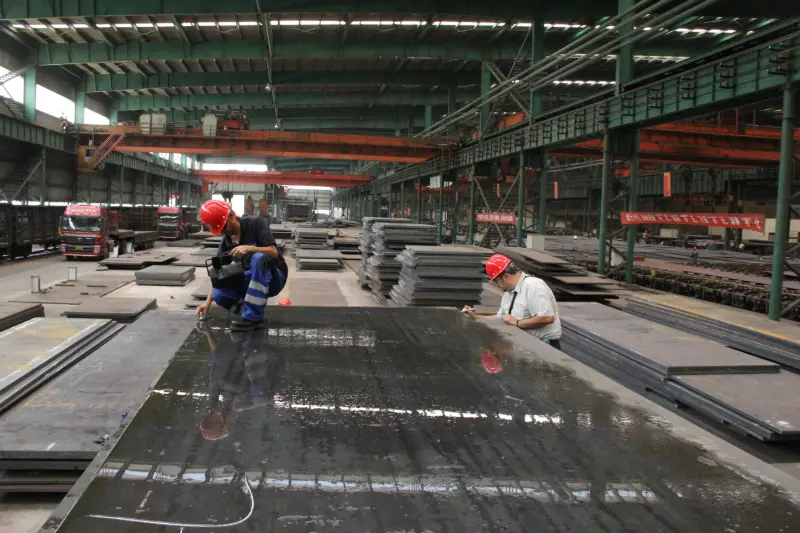
JIS G3113 SAPH440 Automotive Structure Steel Plate
JIS G3113 SAPH440 Automotive Structure Steel Plate - High-Strength Hot-Rolled Grade
Complete material profile for JIS G3113 SAPH440 steel: chemical composition, mechanical properties, thermal and electrical data, global equivalents, and application guidance for automotive structural components.
Hot rolling, cold forming, stamping, bending, arc/resistance welding, shearing
- Phone : +8618037372205
- Email : [email protected]
- WhatsApp: Contact via Whtsapp
- WeChat: +8618037372205
JIS G3113 SAPH440 Automotive Structure Steel Plate Introduction
JIS G3113 SAPH440 is a hot-rolled steel sheet and strip specifically developed for automobile structural applications. It belongs to the family of high-strength low-alloy (HSLA) steels, offering a minimum tensile strength of 440 MPa combined with excellent formability and weldability. The grade is supplied in the as-hot-rolled condition, often with a pickled and oiled surface finish, and can be used for cold-formed parts such as frames, wheels, brackets, and cross members. Its balanced chemical composition includes micro-alloying elements that refine grain size and improve strength without sacrificing ductility. SAPH440 is widely adopted in Japan and other Asian markets and has near equivalents in European and international standards, enabling global sourcing and interchangeable designs.
JIS G3113 SAPH440 Automotive Structure Steel Plate Chemical Composition – JIS G3113 SAPH440
The chemical composition of SAPH440 is controlled to achieve a good balance between strength and formability. Carbon (C) is limited to improve weldability, while Manganese (Mn) and micro-alloying elements such as Nb or Ti may be added for grain refinement and precipitation strengthening. Aluminum (Al) is required as a deoxidizer and grain refiner. The limits shown below are as per the JIS G3113 standard.
| Chemical Element | Value (wt%) | Remarks |
|---|---|---|
| Carbon (C) | ≤0.21 | For all thicknesses |
| Silicon (Si) | ≤0.30 | |
| Manganese (Mn) | ≤1.50 | |
| Phosphorus (P) | ≤0.030 | Low P for cold formability |
| Sulfur (S) | ≤0.025 | Low S for ductility |
| Aluminum (Al) | ≥0.01 | Soluble Al, deoxidation |
| Others (Nb, Ti) | May be added singly or in combination | Micro-alloying for strength and grain refinement |
JIS G3113 SAPH440 Automotive Structure Steel Plate Thermal & Electrical Physical Properties – SAPH440
Typical physical properties for SAPH440 hot-rolled steel at room temperature unless otherwise noted. These values are representative for low-alloy automotive structural steels and may vary slightly with actual composition and processing.
| Property | Typical Value | Unit | Test Condition / Reference |
|---|---|---|---|
| Density (ρ) | 7.85 | g/cm³ | Room temperature |
| Modulus of elasticity (E) | 205 | GPa | Room temperature, tensile |
| Shear modulus (G) | ~80 | GPa | Estimated from E and ν |
| Poisson's ratio (ν) | 0.29 | - | Within elastic range |
| Thermal expansion coefficient (α) | 12.0 | 10⁻⁶ / K | 20 °C to 100 °C range |
| Thermal conductivity (λ) | ~50 | W/(m·K) | At 20 °C |
| Specific heat capacity (c) | ~460 | J/(kg·K) | Room temperature range |
| Electrical resistivity (ρₑ) | 0.14 – 0.20 | μΩ·m | Room temperature |
JIS G3113 SAPH440 Automotive Structure Steel Plate Mechanical Properties – JIS G3113 SAPH440
Mechanical properties are specified for the as-hot-rolled condition. The yield strength and elongation values vary depending on the sheet thickness. The bend test is mandatory and demonstrates the steel's cold forming capability. Tensile tests are performed on JIS No.5 specimens taken in the rolling direction for thinner sheets, and on JIS No.1A for thicker products.
| Property | Standard Requirement | Unit | Test Condition |
|---|---|---|---|
| Upper yield strength (ReH) | ≥305 | MPa | Thickness t < 6.0 mm, rolling direction |
| Upper yield strength (ReH) | ≥295 | MPa | Thickness 6.0 mm ≤ t ≤ 14.0 mm, rolling direction |
| Tensile strength (Rm) | ≥440 | MPa | All thicknesses, rolling direction |
| Elongation (A) – t 1.6 to <2.0 mm | ≥31 | % | JIS No.5 specimen, rolling direction |
| Elongation (A) – t 2.0 to <2.5 mm | ≥32 | % | JIS No.5 specimen, rolling direction |
| Elongation (A) – t 2.5 to <3.15 mm | ≥33 | % | JIS No.5 specimen, rolling direction |
| Elongation (A) – t 3.15 to <4.0 mm | ≥35 | % | JIS No.5 specimen, rolling direction |
| Elongation (A) – t 4.0 to <6.3 mm | ≥36 | % | JIS No.5 specimen, rolling direction |
| Elongation (A) – t ≥6.3 mm | As agreed (typically ≥26) | % | JIS No.1A specimen, rolling direction |
| Bend test – t < 3.2 mm | 180°; inside radius = 0.5t | - | No cracking on outside of bend |
| Bend test – t ≥ 3.2 mm | 180°; inside radius = 1.0t | - | No cracking on outside of bend |
JIS G3113 SAPH440 Automotive Structure Steel Plate Directly Equivalent Standards & Replaceable Grades
| Country/Region | Standard | Grade | Remarks |
|---|---|---|---|
| Japan | JIS G3113 | SAPH440 | Original standard grade |
| China | Q/BQB 310 (Baosteel) | SAPH440 | Adopted same designation and requirements |
| South Korea | KS D 3512 | SAPH440 | Korean standard equivalent |
| Europe | EN 10149-2 | S420MC | Near equivalent; min. tensile 480 MPa, slightly higher strength, similar formability |
| International | ISO 6930-1 | FeE420 | Chemical composition and mechanical properties aligned with SAPH440 concept |
JIS G3113 SAPH440 Automotive Structure Steel Plate Application Introduction
SAPH440 is designed for automobile structural parts that require high strength, good fatigue resistance, and moderate formability. It is delivered in the hot-rolled condition and is typically processed by cold stamping, bending, and welding. The guaranteed minimum elongation values make it suitable for complex forming operations within the automotive production environment. The steel can be used without post-forming heat treatment, although stress relieving may be applied in some welded assemblies.
Product Applications: Vehicle chassis frames and subframes, Passenger car wheel rims and discs, Suspension control arms and torsion beams, Cross members and engine cradles, Reinforcement panels for doors and pillars, Truck longitudinal beams and cross members
Processed into products: Stamped body-in-white structural reinforcements, Welded tubular assemblies (axles, suspension links), Hot-rolled blanks for subsequent cold forming operations, Bent profiles for chassis components, Bolted or riveted structural joints in commercial vehicles
Application industries: Automotive manufacturing (passenger cars, commercial vehicles), Transportation (truck trailers, bus frames), Construction equipment (cabs, structural members), Agricultural machinery (chassis, brackets)
JIS G3113 SAPH440 Automotive Structure Steel Plate Similar/Approximate Substitute Materials
| Country/Region | Standard | Grade | Remarks |
|---|---|---|---|
| Japan | JIS G3113 | SAPH400 | Lower strength grade (min. tensile 400 MPa); higher formability, may be used where reduced strength is acceptable |
| Japan | JIS G3113 | SAPH450 | Slightly higher strength; limited formability compared to SAPH440 |
| Europe | EN 10149-2 | S355MC | Lower strength, but excellent formability and weldability; suitable for less demanding structural parts |
| USA | ASTM A1011 | HSLAS Grade 340 Class 1 | Comparable tensile range (min. 410 MPa), but different alloy approach; requires verification of chemical and forming behavior |
| International | ISO 6930-1 | FeE355 | One strength class below SAPH440; may be considered for weight reduction or formability critical applications |
Notes:
Testing and certification: Mechanical properties are verified using as-hot-rolled specimens according to JIS Z 2241 (tensile) and JIS Z 2248 (bend). Thickness tolerances follow JIS G 3193 for hot-rolled steel sheets and strips. Corrosion protection: The unpainted hot-rolled surface requires coating or painting for corrosion-prone environments. Welding: SAPH440 exhibits good resistance spot welding and arc welding performance with standard procedures; a small drop in heat-affected zone strength is typical for micro-alloyed grades. Formability: Despite its higher strength, SAPH440 maintains acceptable stretch-flangeability and drawability, making it suitable for parts with moderate deformation levels.
- Share



