
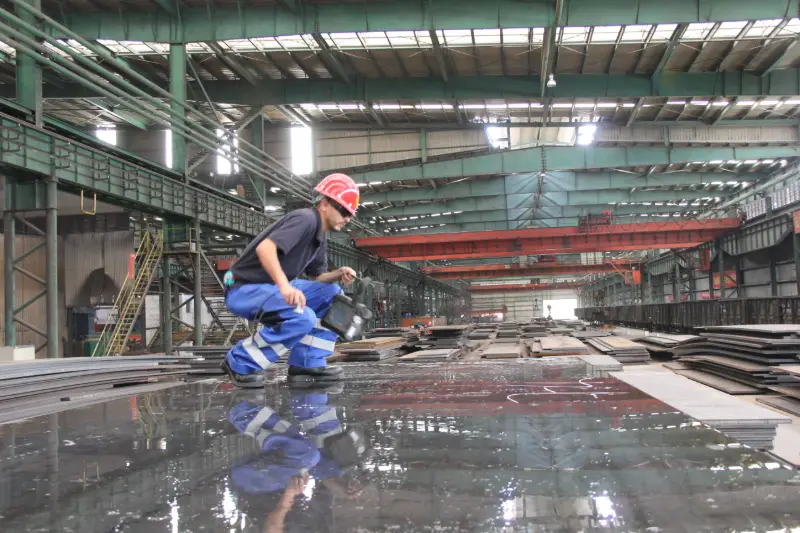
SAPH400 Automobile Structural Steel Plate
SAPH400 Automobile Structural Steel Plate - JIS G3113
Complete technical data for JIS G3113 SAPH400 hot-rolled automobile structure steel plate: chemical composition, mechanical and physical properties, equivalent grades, and application guidelines.
Cutting, blanking, bending, drawing, stamping, welding, punching, shearing
- Phone : +8618037372205
- Email : [email protected]
- WhatsApp: Contact via Whtsapp
- WeChat: +8618037372205
SAPH400 Automobile Structural Steel Plate Introduction
JIS G3113 SAPH400 is a hot-rolled steel sheet and strip primarily used in automotive structural applications. It belongs to the high-strength, low-alloy (HSLA) family with a minimum tensile strength of 400 N/mm². The grade offers good formability, weldability, and moderate yield strength, making it suitable for stamped and formed chassis components.
SAPH400 is characterized by a balanced chemical composition with controlled carbon and manganese levels and optional microalloying elements (Nb, V, Ti) to ensure fine grain structure and consistent mechanical performance after hot rolling. It is typically supplied in the as-rolled or pickled-and-oiled condition.
- Consistent mechanical properties across thickness (1.6–14 mm)
- Good elongation for bending and deep drawing
- Excellent weldability for assembly operations
- Wide usage in vehicle frames, cross members, and suspension parts
SAPH400 Automobile Structural Steel Plate Chemical Composition
Chemical composition limits according to JIS G3113 for SAPH400. The steel is fully killed and may contain microalloying elements (Nb, V, Ti) to refine grain size and improve mechanical properties. Typical content of such elements is agreed upon between producer and purchaser.
| Chemical Element | Standard Value (wt%) | Remarks |
|---|---|---|
| C | ≤ 0.21 | Max |
| Si | ≤ 0.25 | Max |
| Mn | ≤ 0.70 | Max |
| P | ≤ 0.040 | Max |
| S | ≤ 0.040 | Max |
SAPH400 Automobile Structural Steel Plate Thermal and Electrical Physical Properties
Typical physical properties for low-carbon hot-rolled steel of the SAPH400 type. These values are for general design and simulation purposes and may vary slightly with actual composition and processing. Not part of JIS G3113 mandatory requirements.
| Property | Typical Value | Unit | Condition / Temperature |
|---|---|---|---|
| Density (ρ) | 7.85 | g/cm³ | at 20 °C |
| Elastic Modulus (E) | 205 | GPa | at 20 °C |
| Shear Modulus (G) | 80 | GPa | at 20 °C |
| Poisson's Ratio (ν) | 0.29 | – | at 20 °C |
| Thermal Expansion Coefficient (α) | 11.7 × 10⁻⁶ | K⁻¹ | 20–100 °C |
| Thermal Conductivity (λ) | 50 | W/(m·K) | at 20 °C |
| Specific Heat Capacity (cp) | 486 | J/(kg·K) | at 20 °C |
| Electrical Resistivity (ρe) | 0.16 | μΩ·m | at 20 °C |
SAPH400 Automobile Structural Steel Plate Mechanical Properties
Mechanical properties based on JIS G3113 and typical test conditions. Values vary with product thickness. Tensile test specimens are JIS No.5 (gauge length 50 mm, width 25 mm) for sheet thickness ≤6.3 mm, and JIS No.1A for thicker gauges. Bend test requires no cracking on the outside of the bent portion.
Note: No impact test is required by this standard.
| Property | Required Value | Unit | Test Condition / Thickness Range |
|---|---|---|---|
| Yield Strength (ReH) | ≥ 235 | N/mm² | t ≤ 6 mm |
| Yield Strength (ReH) | ≥ 225 | N/mm² | 6 mm < t ≤ 8 mm |
| Yield Strength (ReH) | ≥ 205 | N/mm² | 8 mm < t ≤ 14 mm |
| Tensile Strength (Rm) | ≥ 400 | N/mm² | all thickness (1.6–14 mm) |
| Elongation (A) | ≥ 27 | % | t 1.6–2.0 mm (JIS No.5) |
| Elongation (A) | ≥ 26 | % | t 2.0–2.5 mm (JIS No.5) |
| Elongation (A) | ≥ 24 | % | t 2.5–3.15 mm (JIS No.5) |
| Elongation (A) | ≥ 23 | % | t 3.15–4.0 mm (JIS No.5) |
| Elongation (A) | ≥ 22 | % | t 4.0–6.3 mm (JIS No.5) |
| Elongation (A) | ≥ 21 | % | t 6.3–8.0 mm (JIS No.1A) |
| Elongation (A) | ≥ 20 | % | t 8.0–10 mm (JIS No.1A) |
| Elongation (A) | ≥ 19 | % | t 10–12.5 mm (JIS No.1A) |
| Elongation (A) | ≥ 18 | % | t 12.5–14 mm (JIS No.1A) |
| Bend Test (180°), inside radius | 1.0 × t | – | t < 3.2 mm |
| Bend Test (180°), inside radius | 1.5 × t | – | t ≥ 3.2 mm |
SAPH400 Automobile Structural Steel Plate Completely Equivalent Material Standards and Replaceable Grades
| Country / Region | Standard | Grade | Remarks |
|---|---|---|---|
| Japan | JIS G3113 | SAPH400 | Original standard and grade |
| China | Q/BQB 310 (Baosteel) | SAPH400 | Identical chemical and mechanical requirements |
| South Korea | KS D 3512 | SAPH400 | Korean standard for automobile structural hot-rolled steel |
SAPH400 Automobile Structural Steel Plate Application Introduction
SAPH400 is optimized for automotive structural parts that require a combination of moderate strength, good ductility, and excellent weldability. It is widely used in passenger cars, commercial vehicles, and trailers where stamped or formed components are assembled by welding.
Typical applications include:
Product Applications: Vehicle underbody frames, Chassis long members and cross members, Suspension control arms and mounting brackets, Wheel rims and disc wheels, Structural reinforcements (pillars, door impact beams)
Processed into products: Frame side rails and crossmembers, Suspension arms (stamped and welded), Wheel webs and rims, Engine mounting brackets, Seat frame rails, Bumper reinforcement beams, Tow hitch brackets, Battery tray supports
Application industries: Automotive manufacturing, Light and heavy commercial vehicles, Trailer and coach building, Agricultural and construction machinery (structural parts)
SAPH400 Automobile Structural Steel Plate Similar / Alternative Material Recommendations
| Country / Region | Standard | Grade | Remarks |
|---|---|---|---|
| Japan | JIS G3113 | SAPH370 | Lower tensile strength (≥370 N/mm²), comparable formability |
| Japan | JIS G3113 | SAPH440 | Higher tensile strength (≥440 N/mm²), slightly reduced elongation |
| International | ISO 6930-1 | HR400 | Approximate strength, may not include all forming requirements of SAPH400 |
| Europe | EN 10149-2 | S315MC | Higher yield (≥315 N/mm²), similar tensile range (390–510 N/mm²), for cold forming |
| USA | ASTM A1011 | HSLAS Grade 45 Class 1 | Yield ≥310 N/mm², tensile ≥410 N/mm², higher strength and alloying |
| Japan | JFS A1001 | SPFH540 | High-strength hot-rolled sheet (≥540 N/mm² tensile), for structural parts with higher loads |
Notes:
Special considerations: While JIS G3113 does not mandate impact testing, SAPH400 exhibits good room-temperature toughness for the intended structural applications. For cold forming operations, it is recommended to use pickled and oiled surface to improve die life and surface quality. Welding can be performed by all conventional methods (MAG, resistance spot welding) without preheating.
- Share



