
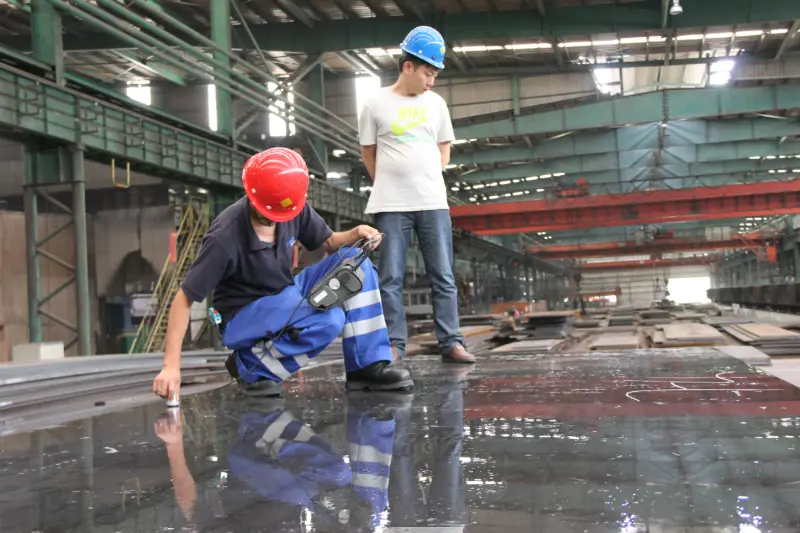
SAPH370 Hot-Rolled Automotive Structural Steel Plate
SAPH370 Hot-Rolled Automotive Structural Steel Plate - JIS G3113 Grade Data
Complete technical data for SAPH370 steel: chemical composition, mechanical properties, thermal and electrical physical properties, international equivalents, and application guide for automotive structural components.
Hot rolling, cold forming, bending, stamping, welding, coating
- Phone : +8618037372205
- Email : [email protected]
- WhatsApp: Contact via Whtsapp
- WeChat: +8618037372205
SAPH370 Hot-Rolled Automotive Structural Steel Plate Introduction
SAPH370 is a hot-rolled steel plate grade specified in JIS G3113, primarily designed for automotive structural applications requiring good formability, weldability, and moderate strength. With a minimum tensile strength of 370 MPa, it is widely used for frame parts, reinforcements, and chassis components. The steel exhibits a typical ferritic-pearlitic microstructure and is supplied in the as-rolled condition. Key characteristics include:
- Consistent mechanical properties across a thickness range of 1.6 mm to 14 mm
- Excellent bendability with tight bend radii
- Good coatability and suitability for subsequent cold forming operations
- Low carbon equivalent facilitates resistance spot welding and arc welding
This grade is often selected when a balance between strength and ductility is critical.
SAPH370 Hot-Rolled Automotive Structural Steel Plate Chemical Composition
The chemical composition of SAPH370 is controlled according to JIS G3113. The steel is aluminum-killed to ensure fine grain size. Stricter limits on phosphorus and sulfur improve formability and weldability. No intentional additions of microalloying elements are specified; the grade relies on C-Mn solid solution strengthening.
| Element | Standard Value (max or range) | Remarks |
|---|---|---|
| Carbon (C) | ≤ 0.21 | Ladle analysis |
| Silicon (Si) | ≤ 0.25 | |
| Manganese (Mn) | ≤ 0.75 | |
| Phosphorus (P) | ≤ 0.040 | |
| Sulfur (S) | ≤ 0.040 | |
| Aluminum (Al) | ≥ 0.01 | Acid-soluble aluminum |
SAPH370 Hot-Rolled Automotive Structural Steel Plate Thermal and Electrical Physical Properties
The following physical properties are typical for carbon-manganese structural steels and can be applied to SAPH370. These values are not part of the JIS G3113 standard but are useful for design and process simulation. The data correspond to a nominal density of 7.85 g/cm³ and a room-temperature reference condition unless otherwise noted.
| Property | Typical Value | Unit | Condition / Temperature |
|---|---|---|---|
| Density (ρ) | 7.85 | g/cm³ | 20 °C |
| Elastic Modulus (E) | 210 | GPa | 20 °C |
| Shear Modulus (G) | 80 | GPa | 20 °C |
| Poisson's Ratio (ν) | 0.3 | – | 20 °C |
| Thermal Expansion Coefficient (α) | 11.7 | 10⁻⁶/K | 20–100 °C |
| Thermal Expansion Coefficient (α) | 12.2 | 10⁻⁶/K | 20–200 °C |
| Thermal Expansion Coefficient (α) | 12.8 | 10⁻⁶/K | 20–300 °C |
| Thermal Conductivity (λ) | 51.9 | W/(m·K) | 20 °C |
| Specific Heat Capacity | 486 | J/(kg·K) | 20 °C |
| Electrical Resistivity (ρ_e) | 0.142 | µΩ·m | 20 °C |
SAPH370 Hot-Rolled Automotive Structural Steel Plate Mechanical Properties
Mechanical properties of SAPH370 are guaranteed at room temperature in the as-rolled delivery condition. The tensile test is performed in accordance with JIS Z 2241. The specified values depend on product thickness. The bend test requires 180° bending without cracking on the outside of the bend. The following data are the minimum required values.
| Property | Standard Requirement | Unit | Test Condition / Thickness |
|---|---|---|---|
| Yield Strength (ReH) – min | 225 | MPa | t ≤ 6.0 mm |
| Yield Strength (ReH) – min | 215 | MPa | 6.0 < t ≤ 8.0 mm |
| Yield Strength (ReH) – min | 205 | MPa | 8.0 < t ≤ 14.0 mm |
| Tensile Strength (Rm) – min | 370 | MPa | All thicknesses |
| Elongation (A) – min, 1A test piece | 30 | % | 1.6 ≤ t < 2.0 mm, longitudinal |
| Elongation (A) – min, 1A test piece | 31 | % | 2.0 ≤ t < 2.5 mm, longitudinal |
| Elongation (A) – min, 1A test piece | 32 | % | 2.5 ≤ t < 3.15 mm, longitudinal |
| Elongation (A) – min, 1A test piece | 33 | % | 3.15 ≤ t < 4.0 mm, longitudinal |
| Elongation (A) – min, No. 5 test piece | 34 | % | 4.0 ≤ t < 6.3 mm, longitudinal |
| Elongation (A) – min, No. 5 test piece | 35 | % | 6.3 ≤ t < 8.0 mm, longitudinal |
| Elongation (A) – min, No. 5 test piece | 36 | % | 8.0 ≤ t ≤ 14.0 mm, longitudinal |
| Bend Test (180°) – Inside radius | Flat on itself (0t) | – | t ≤ 2.0 mm |
| Bend Test (180°) – Inside radius | 0.5t | – | 2.0 < t ≤ 3.2 mm |
| Bend Test (180°) – Inside radius | 1.0t | – | t > 3.2 mm |
SAPH370 Hot-Rolled Automotive Structural Steel Plate Completely Equivalent Material Standards and Substitutable Grades
| Country/Region | Standard | Grade | Remarks |
|---|---|---|---|
| Japan | JIS G3113 | SAPH370 | Original specification |
| International | ISO 4997 | HR2 | Similar chemical and mechanical properties |
| Europe | EN 10149-2 | S315MC | Comparable yield and tensile strength; thermomechanically rolled |
| China | GB/T 3273 | B370L | Close match for automotive hot-rolled plates |
SAPH370 Hot-Rolled Automotive Structural Steel Plate Application Introduction
SAPH370 is designed for automotive components where moderate strength, excellent formability, and reliable weldability are required. It can be processed by punching, bending, drawing, and resistance welding. Typical uses include:
Product Applications: Passenger car frames and sub-frames, Truck chassis side rails and cross members, Bumper reinforcements and mounting brackets, Suspension control arms and trailing arms, Seat frames and seat belt anchors, Wheel discs and rims
Processed into products: Longitudinal beams and sill reinforcements, Cross members and floor panels, Engine cradle components, Shock absorber mountings, Tow hooks and towing eye brackets, Structural brackets and stiffeners
Application industries: Automotive and light truck manufacturing, Railway vehicle structures, Agricultural and construction machinery, General engineering and fabrication
SAPH370 Hot-Rolled Automotive Structural Steel Plate Similar/Comparable Substitute Materials
| Country/Region | Standard | Grade | Remarks |
|---|---|---|---|
| USA | ASTM A1011/A1011M | HSLAS Grade 50 Class 1 | Higher yield strength (340 MPa min) but similar tensile range; HSLA grade |
| Europe | EN 10149-2 | S355MC | Higher yield strength, comparable formability |
| India | IS 11513 | IS 350H | Close tensile strength; often used in automotive frames |
| Japan | JIS G3134 | SPFH590 | Higher strength hot-rolled HSLA; suitable for upgraded designs |
Notes:
Welding: SAPH370 has good weldability by all common methods (MAG, resistance spot and projection welding). Preheating is generally not required for thicknesses below 30 mm.
Forming: The low yield-to-tensile ratio provides a wide forming window. Minimum bending radii as specified in the bend test are suitable for 90° flanging.
Surface condition: Available with mill scale, pickled and oiled, or dry. For exposed or coated applications, the surface should be free of heavy scale.
Certification: The grade is typically supplied with a test certificate according to EN 10204 type 2.2 or 3.1, confirming chemical analysis and mechanical properties.
Further processing: Can be hot-dip galvanized or electro-galvanized without significant loss of strength.
- Share



