
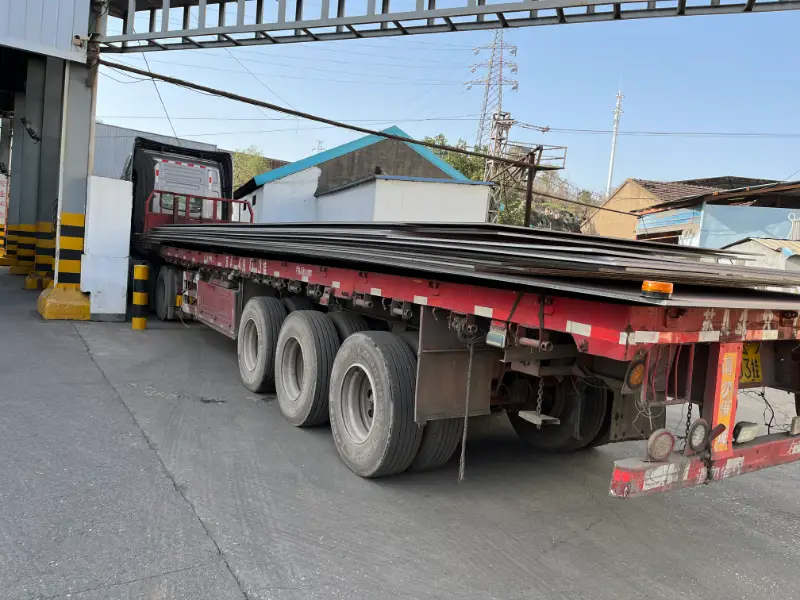
EN 10149-2 S700MC High-Strength Low-Alloy Automotive Structural Steel
EN 10149-2 S700MC High-Strength Low-Alloy Automotive Structural Steel: Composition, Properties, and Equivalents
Detailed technical data for EN 10149-2 S700MC – a thermomechanically rolled microalloyed steel for cold forming, featuring minimum 700 MPa yield strength. Includes chemical composition, mechanical & physical properties, international equivalents, and application guidance.
Cold forming (bending, stamping, roll forming), welding (MAG, laser, spot), machining, cutting (shearing, plasma, laser)
- Phone : +8618037372205
- Email : [email protected]
- WhatsApp: Contact via Whtsapp
- WeChat: +8618037372205
EN 10149-2 S700MC High-Strength Low-Alloy Automotive Structural Steel Introduction
S700MC is a high-strength low-alloy (HSLA) microalloyed structural steel specified in EN 10149-2:2013, intended for cold-forming applications. It achieves its minimum yield strength of 700 MPa through thermomechanical rolling and fine-grain precipitation strengthening by elements such as niobium, vanadium, and titanium. The steel combines high strength with good formability and excellent weldability, making it ideal for weight-reducing structural components in automotive and mobile machinery. Typical applications include chassis frames, longitudinal beams, cross members, suspension arms, and reinforcements. It is supplied as hot‑rolled sheet, plate, or coil, often with a pickled and oiled surface. The low carbon content (≤0.12%) ensures good weldability without preheating. Strict limits on phosphorus and sulfur guarantee superior cleanliness and ductility. S700MC meets the requirements for safety‑critical components where fatigue resistance and impact performance are required at reduced thicknesses.
EN 10149-2 S700MC High-Strength Low-Alloy Automotive Structural Steel Chemical Composition
The ladle analysis limits for S700MC according to EN 10149-2:2013. Values are weight percent maximum unless a range or minimum is indicated. Microalloying elements (Nb, V, Ti) may be used singly or in combination; the sum of Nb+V+Ti shall not exceed 0.22%.
| Element | Standard Value (wt%) | Remarks |
|---|---|---|
| C | ≤ 0.12 | Promotes strength while maintaining weldability |
| Si | ≤ 0.60 | Deoxidiser and strength enhancer |
| Mn | ≤ 2.10 | Solid solution strengthening |
| P | ≤ 0.025 | Limit for formability and toughness |
| S | ≤ 0.015 | Low level for cleanliness |
| Al (total) | ≥ 0.015 | Minimum for fine grain practice and deoxidation |
| Nb | ≤ 0.09 | Grain refiner and precipitation strengthener |
| V | ≤ 0.20 | Precipitation strengthener |
| Ti | ≤ 0.22 | Grain refiner and precipitation strengthener |
| Mo | ≤ 0.50 | Hardenability agent (optional) |
| B | ≤ 0.005 | Optional for increased strength |
EN 10149-2 S700MC High-Strength Low-Alloy Automotive Structural Steel Physical Properties
Physical constants for S700MC are typical for low‑carbon high‑strength steels and are valid at ambient temperature unless otherwise stated. These values are derived from standard reference data and are not guaranteed by EN 10149-2 but may be used for design calculations.
| Property | Typical Value | Unit | Test Condition |
|---|---|---|---|
| Density (ρ) | 7.85 | g/cm³ | 20 °C |
| Modulus of elasticity (E) | 210 | GPa | 20 °C |
| Shear modulus (G) | ~ 80 | GPa | 20 °C |
| Poisson's ratio (ν) | 0.3 | — | 20 °C |
| Thermal expansion coefficient (α) | 12.0 × 10⁻⁶ | 1/K | 20 – 100 °C |
| Thermal conductivity (λ) | ~ 50 | W/(m·K) | 20 °C |
| Specific heat capacity | ~ 460 | J/(kg·K) | 20 °C |
| Electrical resistivity (ρ_e) | ~ 0.22 × 10⁻⁶ | Ω·m | 20 °C |
EN 10149-2 S700MC High-Strength Low-Alloy Automotive Structural Steel Mechanical Properties
Mechanical performance at room temperature as per EN 10149-2:2013. Tensile testing in accordance with EN ISO 6892-1. Elongation values depend on thickness and gauge length: A₈₀ for thickness t < 3 mm, A₅ for t ≥ 3 mm. Impact properties are optional and must be agreed upon at the time of order; the table shows a commonly requested requirement (KV at -20 °C). Bending test according to EN ISO 7438.
| Property | Specified Value | Unit | Test Condition |
|---|---|---|---|
| Yield strength (ReH) | ≥ 700 | MPa | Room temperature, all thicknesses |
| Tensile strength (Rm) | 750 – 950 | MPa | Room temperature, all thicknesses |
| Elongation (A₈₀) | ≥ 10 | % | Thickness < 3 mm, gauge length 80 mm |
| Elongation (A₅) | ≥ 12 | % | Thickness ≥ 3 mm, gauge length 5.65√S₀ |
| Bend test (180°) – t ≤ 6 mm | Crack-free at 180° | — | Bend diameter d = 2 a (a = thickness) |
| Bend test (180°) – t > 6 mm | Crack-free at 180° | — | Bend diameter d = 3 a |
| Impact energy (KV₂) at -20 °C (optional) | ≥ 40 (longitudinal, average) | J | Charpy V-notch, 10×10 mm, EN ISO 148-1 (if agreed) |
EN 10149-2 S700MC High-Strength Low-Alloy Automotive Structural Steel Identical Materials – International Standards and Equivalent Grades
The following standards contain the S700MC designation with identical chemical and mechanical requirements as per EN 10149-2. They are fully interchangeable.
| Country / Region | Standard | Grade | Remarks |
|---|---|---|---|
| European Union | EN 10149-2:2013 | S700MC | Original standard; also adopted by CEN member countries |
| International (ISO) | ISO 6930-1:2015 | S700MC | Adopts EN 10149-2; identical requirements |
| Germany | DIN EN 10149-2 | S700MC | German edition of EN standard |
| United Kingdom | BS EN 10149-2 | S700MC | British edition of EN standard |
| France | NF EN 10149-2 | S700MC | French edition of EN standard |
| Italy | UNI EN 10149-2 | S700MC | Italian edition of EN standard |
EN 10149-2 S700MC High-Strength Low-Alloy Automotive Structural Steel Application Introduction
S700MC steel was specifically developed for lightweight automotive and mobile machinery construction. Its high yield strength enables down‑gauging (thinner sheets) compared to conventional structural steels, resulting in lower vehicle weight and improved fuel efficiency. The low carbon content and clean microstructure guarantee excellent welding and cold‑forming performance.
Product Applications: Automotive body‑in‑white structural parts, Chassis frames and sub‑frames, Longitudinal and cross members, Suspension control arms and torque rods, Reinforcement panels and brackets, Boom sections for mobile cranes
Processed into products: Side impact beams, Bumper reinforcements, Spring and shock absorber mounts, Tow‑bar brackets, Trailer chassis beams, Engine cradle (sub‑frame) components
Application industries: Automotive (passenger cars, trucks, trailers), Construction machinery and earth‑moving equipment, Agricultural machinery (harvesters, tractors), Railway rolling stock (bogies, chassis structures), Crane and lifting equipment
EN 10149-2 S700MC High-Strength Low-Alloy Automotive Structural Steel Similar / Alternative Grades for S700MC
The grades listed below offer properties comparable to S700MC but may differ in yield strength range or alloying philosophy. They can be considered as potential substitutes after evaluating the specific design requirements.
| Country / Region | Standard | Grade | Remarks |
|---|---|---|---|
| European Union | EN 10149-2 | S650MC | Yield strength ≥ 650 MPa; slightly lower strength, better formability |
| European Union | EN 10149-2 | S800MC | Yield strength ≥ 800 MPa; higher strength, slightly reduced elongation |
| Japan | JIS G 3134 | SPFH 780 | Minimum tensile strength 780 MPa class; similar application, requires matching of YS and formability |
| China | GB/T 20564.3 | HC700/980DP | Dual-phase steel with minimum tensile strength 980 MPa; not identical, but used in similar automotive structural parts |
Notes:
Welding: S700MC exhibits excellent weldability with all common methods (MAG, laser, spot, friction). For thicknesses above ~10 mm, a small preheat (75–150 °C) may be beneficial to avoid hydrogen cracking in restrained conditions. Filler material selection should aim for a matching (or slightly undermatched) strength level. Forming: The low carbon content and fine grain structure permit hot and cold bending. Severely deformed zones may benefit from stress‑relief annealing (e.g., 550–600 °C for 1 h) to restore toughness. Surface protection: Suited for electro‑galvanising and hot‑dip coating (e.g., zinc). Maintain adequate cleaning to remove residual mill scale or oil. Certification: EN 10204 inspection certificate 3.1 is typically supplied. Optional impact testing (-20 °C / -40 °C) must be agreed at the enquiry stage.
- Share



