
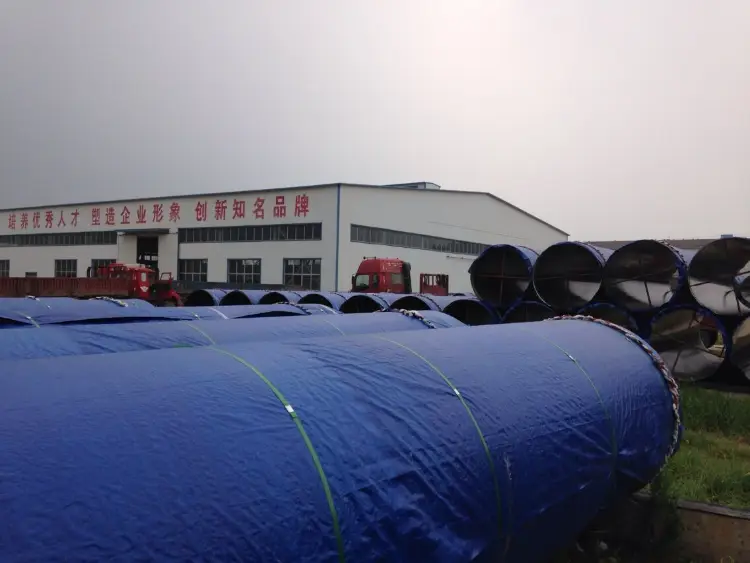
S690QL ERW Pipe
S690QL ERW Pipe: Quenched & Tempered High-Strength Steel per EN 10025-6
Detailed material data and application analysis for S690QL electric-resistance welded pipe manufactured from EN 10025-6 fine-grain structural steel.
Welding (all common processes with adequate preheat), cold and hot forming, machining, oxy-fuel/plasma/laser cutting
- Phone : +8618037372205
- Email : [email protected]
- WhatsApp: Contact via Whtsapp
- WeChat: +8618037372205
S690QL ERW Pipe Introduction
S690QL is a quenched and tempered weldable fine-grain structural steel specified in EN 10025-6. It offers a minimum yield strength of 690 MPa and guaranteed impact toughness at -40 °C (L grade). The steel is designed for heavily loaded welded structures where weight savings and high strength are critical. ERW (Electric Resistance Welded) pipes produced from S690QL strip or plate combine the material's excellent mechanical properties with the dimensional accuracy and cost-effectiveness of the high-frequency welding process. Typical delivery condition is quenched and tempered.
Key characteristics:
- High yield and tensile strength
- Excellent low-temperature toughness (27 J at -40 °C)
- Good weldability with controlled carbon equivalent
- Enables lightweight designs in mobile cranes, offshore structures, and pressure pipework
S690QL ERW Pipe Chemical Composition
The table below shows the maximum and minimum alloying element contents for S690QL according to EN 10025-6. The composition is controlled to achieve the required high strength and low-temperature toughness while maintaining satisfactory weldability. A carbon equivalent value (CEV) is often restricted for thicker products to limit cold cracking risk.
- Elements not listed are present as residuals.
- Grain refining elements such as Al, Nb, V, and Ti are added to obtain a fine austenitic grain structure.
| Chemical Element | Standard Value (wt%) | Remarks |
|---|---|---|
| C | ≤ 0.20 | Max. |
| Si | ≤ 0.80 | Max. |
| Mn | ≤ 1.70 | Max. |
| P | ≤ 0.020 | Max. |
| S | ≤ 0.010 | Max. |
| Alt (total) | ≥ 0.015 | Min. |
| Nb | ≤ 0.06 | Max. |
| V | ≤ 0.12 | Max. |
| Ti | ≤ 0.05 | Max. |
| Cr | ≤ 1.50 | Max. |
| Ni | ≤ 2.00 | Max. |
| Mo | ≤ 0.70 | Max. |
| Cu | ≤ 0.50 | Max. |
| N | ≤ 0.015 | Max. |
| B | ≤ 0.005 | Max. |
| CEV (typical for t ≤ 50 mm) | ≤ 0.52 | Upon agreement; depends on thickness |
S690QL ERW Pipe Thermal and Electrical Physical Properties
The physical data below represent typical engineering values for quenched and tempered low-alloy steel of the S690QL class. They are not part of the EN 10025-6 standard but are widely accepted for design calculations. Actual values may vary slightly with the exact chemical composition and processing history.
| Property | Typical Value | Unit | Test Condition |
|---|---|---|---|
| Density (ρ) | 7850 | kg/m³ | At 20 °C |
| Elastic modulus (E) | 210 | GPa | At 20 °C, static |
| Shear modulus (G) | 80 | GPa | At 20 °C |
| Poisson's ratio (ν) | 0.3 | Elastic range, at 20 °C | |
| Coefficient of thermal expansion (α) | 12.0 × 10⁻⁶ | K⁻¹ | 20 – 100 °C |
| Coefficient of thermal expansion (α) | 13.0 × 10⁻⁶ | K⁻¹ | 20 – 200 °C |
| Thermal conductivity (λ) | 40 | W/(m·K) | At 20 °C |
| Thermal conductivity (λ) | 38 | W/(m·K) | At 200 °C |
| Specific heat capacity (cₚ) | 460 | J/(kg·K) | At 20 °C |
| Electrical resistivity (ρₑ) | 0.20 × 10⁻⁶ | Ω·m | At 20 °C (≈ 0.20 μΩ·m) |
S690QL ERW Pipe Mechanical Properties
The mechanical properties below are the minimum and range requirements from EN 10025-6 for flat products tested in the quenched and tempered condition. Testing is performed on transverse specimens taken from the final product or from strip used to make ERW pipes. Values vary with product thickness; the most common thickness ranges are shown. Impact energy is measured on longitudinal Charpy-V specimens at -40 °C.
| Property | Standard Requirement | Unit | Test Condition |
|---|---|---|---|
| Yield strength (ReH) | ≥ 690 | MPa | t ≤ 50 mm, transverse, room temperature |
| Yield strength (ReH) | ≥ 650 | MPa | 50 < t ≤ 100 mm, transverse |
| Yield strength (ReH) | ≥ 630 | MPa | 100 < t ≤ 150 mm, transverse |
| Tensile strength (Rm) | 770 – 940 | MPa | t ≤ 50 mm, transverse |
| Tensile strength (Rm) | 760 – 930 | MPa | 50 < t ≤ 100 mm, transverse |
| Tensile strength (Rm) | 710 – 900 | MPa | 100 < t ≤ 150 mm, transverse |
| Elongation after fracture (A5) | ≥ 14 | % | t ≤ 50 mm, L₀ = 5.65√S₀, transverse |
| Elongation after fracture (A5) | ≥ 14 | % | 50 < t ≤ 100 mm, transverse |
| Elongation after fracture (A5) | ≥ 14 | % | 100 < t ≤ 150 mm, transverse |
| Bend test (180°) – bend diameter | D = 3t | t ≤ 16 mm, transverse | |
| Bend test (180°) – bend diameter | D = 4t | 16 < t ≤ 50 mm, transverse | |
| Bend test (180°) – bend diameter | D = 5t | 50 < t ≤ 100 mm, transverse | |
| Impact energy KV (-40 °C) | ≥ 27 (average) | J | t ≥ 6 mm, longitudinal, min. single value 20 J |
| Impact energy KV (-40 °C) | ≥ 27 (average) | J | t ≤ 150 mm, longitudinal |
S690QL ERW Pipe Completely Equivalent Material Standards and Replaceable Grades
| Country/Region | Standard | Grade | Remarks |
|---|---|---|---|
| European Union | EN 10025-6 | S690QL | Base specification |
| International | ISO 630-3 | S690QL | Technically identical to EN 10025-6 S690QL |
| Germany | DIN EN 10025-6 | S690QL | Adopted European standard |
| France | NF EN 10025-6 | S690QL | Adopted European standard |
| United Kingdom | BS EN 10025-6 | S690QL | Adopted European standard |
| Italy | UNI EN 10025-6 | S690QL | Adopted European standard |
| Spain | UNE EN 10025-6 | S690QL | Adopted European standard |
| China | GB/T 16270-2009 | Q690E | Yield ≥ 690 MPa, -40 °C impact; slightly different chemical composition |
| USA | ASTM A514/A514M | Grade E | Min. yield 690 MPa for thickness ≤ 65 mm; impact at -40 °F ≈ -40 °C; similar strength/ toughness combination |
S690QL ERW Pipe Application Introduction
Thanks to its combination of ultra-high strength, good toughness, and reliable weldability, S690QL ERW pipe is suited for weight-critical structural and fluid-conveying applications. It is widely adopted in:
- Mobile and crawler cranes where slim, high-strength booms reduce fuel consumption
- Offshore platforms and subsea structures requiring high strength and Arctic-grade toughness
- Heavy-duty scaffolding, piling pipes, and conductor pipes
- High-pressure hydraulic lines and water injection pipes in mining and oil & gas
- Structural tubular members in bridges, stadiums, and large-scale architecture
Product Applications: Telescopic crane booms and lattice sections, Dump truck and tipper bodies, High-pressure ERW line pipes, Offshore platform conductor and riser pipes, Structural hollow sections for bridges and buildings, Piling and foundation pipes, Hydraulic cylinder tubes and drill rods
Processed into products: Welded pipe spools and elbows for hydraulic systems, Flanges and slip-on connectors made from S690QL pipe, Tubular bracings and truss members in cranes, Cut and machined ring stiffeners and gussets, ERW pipe segments for pump barrels and penstock linings, Rolled and welded sections for excavator arms and booms, Pipe-based adapters and transition pieces in offshore risers
Application industries: Construction and earthmoving machinery, Offshore and marine engineering, Bridge and structural engineering, Oil and gas (onshore/offshore pipelines and structures), Mining and quarrying equipment, Pressure vessel and penstock fabrication, Shipbuilding and heavy transport
S690QL ERW Pipe Similar or Alternative Materials
| Country/Region | Standard | Grade | Remarks |
|---|---|---|---|
| European Union | EN 10025-6 | S690Q | S690QL without L-quality; impact at -20 °C instead of -40 °C |
| European Union | EN 10025-6 | S690QL1 | Better low-temperature toughness: impact at -60 °C |
| European Union | EN 10025-6 | S890QL | Higher strength class (890 MPa yield), comparable weldability and impact requirements |
| USA | ASTM A514/A514M | Grade B | Yield ≥ 690 MPa, tensile 760–895 MPa, typically -20 °C impact; needs verification for -40 °C service |
| China | GB/T 16270-2009 | Q690D | Yield ≥ 690 MPa, -20 °C impact; suitable only if less stringent low-temperature toughness is acceptable |
| Japan | JIS G 3128 | SHY685 | Yield ≥ 685 MPa; similar strength level but different production standard, negotiate toughness requirements |
| Japan | JIS G 3128 | SHY685N | Normalized/controlled rolled; strength similar but not quenched and tempered, lower yield strength after welding |
Notes:
Welding recommendations: When welding S690QL ERW pipes, low-hydrogen processes (GMAW, GTAW, FCAW, SMAW with basic electrodes) and controlled heat inputs are essential to avoid cold cracking. Preheat (typically 75–150 °C, depending on thickness) and interpass temperature control are required. Post-weld heat treatment is rarely applied to avoid strength reduction; stress relieving, if needed, must be carried out at temperatures below the tempering temperature.
Corrosion protection: In aggressive environments, S690QL pipes require appropriate coating systems (e.g., three-layer polyethylene, fusion-bonded epoxy, or thermal sprayed zinc/aluminum).
Cold forming: Minimum bending radii shall comply with the bend test recommendations; for severe cold forming, a subsequent stress relief may be necessary.
Additional requirements: The steel can be supplied with enhanced properties (e.g., through-thickness tensile properties per Z-quality, ultrasonic testing, or specific fine-grain requirements) by agreement at the time of enquiry and order.
- Share



