
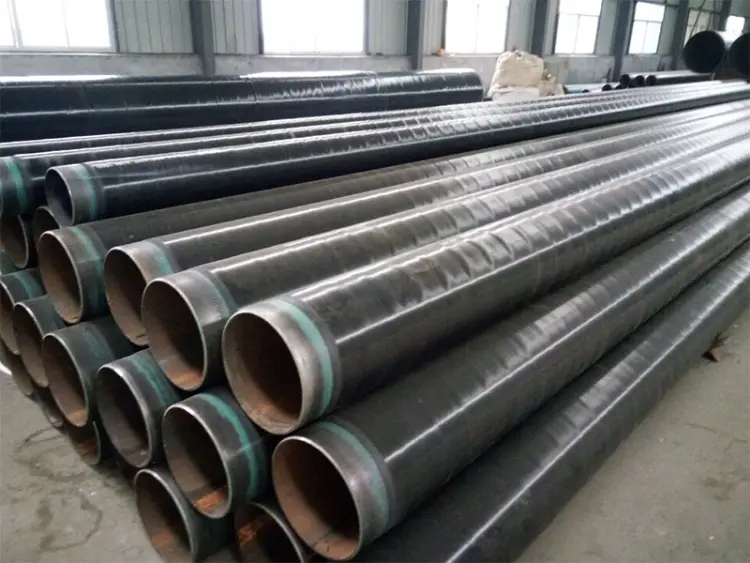
EN10025-6 S690Q ERW Pipe
EN10025-6 S690Q ERW Pipe: High-Strength Quenched & Tempered Steel for Demanding Welded Tubular Structures
Explore the detailed material properties, chemical composition, mechanical and thermophysical performance of S690Q steel according to EN 10025-6, commonly used for ERW pipes in heavy engineering, cranes, and offshore structures.
Hot rolling, cold forming, welding (ERW, SAW), machining
- Phone : +8618037372205
- Email : [email protected]
- WhatsApp: Contact via Whtsapp
- WeChat: +8618037372205
EN10025-6 S690Q ERW Pipe Introduction
S690Q, designated in EN 10025-6, is a quenched and tempered structural steel with a minimum yield strength of 690 MPa. It offers an excellent combination of high strength, good toughness, and weldability, making it suitable for heavily loaded welded structures. The grade is available in flat products and can be formed into ERW (Electric Resistance Welded) pipes for applications in mobile cranes, bridges, pressure vessels, and offshore platforms. Its fine-grained microstructure and controlled alloying ensure reliable performance even at low temperatures. Typical delivery condition is quenched and tempered (Q), meeting stringent toughness requirements down to -20°C (optionally -40°C as S690QL).
EN10025-6 S690Q ERW Pipe Chemical Composition
The chemical composition of S690Q is defined in EN 10025-6. Limits are for heat analysis. The steel is microalloyed with elements such as Nb, V, Ti, and B to achieve high strength after quenching and tempering. Carbon equivalent (CEV) requirements may apply for weldability.
| Element | Standard Value (max %) | Remarks |
|---|---|---|
| C | ≤0.20 | |
| Si | ≤0.80 | |
| Mn | ≤1.70 | |
| P | ≤0.025 | |
| S | ≤0.015 | |
| N | ≤0.015 | |
| B | ≤0.005 | |
| Cr | ≤1.50 | |
| Cu | ≤0.50 | |
| Mo | ≤0.70 | |
| Nb | ≤0.06 | |
| Ni | ≤2.0 | |
| Ti | ≤0.05 | |
| V | ≤0.12 | |
| Zr | ≤0.15 | |
| Al (total) | ≥0.015 | Minimum for fine grain practice |
EN10025-6 S690Q ERW Pipe Thermophysical and Electrical Properties
Physical properties are typical for quenched and tempered high-strength structural steels and are not mandatory per EN 10025-6. Values are given for reference at room temperature unless otherwise specified. Thermal conductivity and specific heat vary slightly with temperature.
| Property | Typical Value | Unit | Test Condition / Temperature |
|---|---|---|---|
| Density (ρ) | 7850 | kg/m³ | 20°C |
| Young's modulus (E) | 210 | GPa | 20°C |
| Shear modulus (G) | 81 | GPa | 20°C |
| Poisson's ratio (ν) | 0.3 | - | 20°C |
| Thermal expansion coefficient (α) | 11.1 × 10⁻⁶ | K⁻¹ | 20 – 100°C |
| Thermal expansion coefficient (α) | 12.5 × 10⁻⁶ | K⁻¹ | 20 – 300°C |
| Thermal conductivity (λ) | 36 | W/(m·K) | 20°C |
| Specific heat capacity (cp) | 460 | J/(kg·K) | 20°C |
| Electrical resistivity (ρ_e) | 0.23 × 10⁻⁶ | Ω·m | 20°C |
EN10025-6 S690Q ERW Pipe Mechanical Properties
Mechanical properties are valid for quenched and tempered condition (+Q) and refer to longitudinal test pieces. The values depend on product thickness. For ERW pipes, the properties are derived from the parent plate/strip unless otherwise specified. Impact test temperature for S690Q is typically -20°C (27J min).
| Property | Standard Requirement | Unit | Test Condition / Thickness |
|---|---|---|---|
| Yield strength (ReH) | ≥ 690 | MPa | t ≤ 50 mm |
| Yield strength (ReH) | ≥ 650 | MPa | 50 < t ≤ 100 mm |
| Yield strength (ReH) | ≥ 630 | MPa | 100 < t ≤ 150 mm |
| Tensile strength (Rm) | 770 – 940 | MPa | t ≤ 50 mm |
| Tensile strength (Rm) | 700 – 900 | MPa | 50 < t ≤ 100 mm |
| Tensile strength (Rm) | 690 – 860 | MPa | 100 < t ≤ 150 mm |
| Elongation (A, 5.65√So) | ≥ 14 | % | t ≤ 50 mm, longitudinal |
| Elongation (A, 5.65√So) | ≥ 14 | % | 50 < t ≤ 100 mm |
| Elongation (A, 5.65√So) | ≥ 14 | % | 100 < t ≤ 150 mm |
| Impact energy (KV) | ≥ 27 | J | -20°C, longitudinal |
| Bending test | Min. mandrel diameter = 3 × thickness | - | Bend angle 180° (for t ≤ 12 mm) |
EN10025-6 S690Q ERW Pipe Fully Equivalent Material Standards and Substitute Grades
| Country/Region | Standard | Grade | Remarks |
|---|---|---|---|
| Europe | EN 10025-6 | S690Q | Directly equivalent |
| UK | BS EN 10025-6 | S690Q | Identical to EN |
| Germany | DIN EN 10025-6 | S690Q | Formerly S690QL (if -40°C) |
| International | ISO 4951-1 | S690Q | Same numerical designation |
| USA | ASTM A514 | Grade S | Similar high strength QT plate; yield 690 MPa |
| Japan | JIS G 3128 | SHY 685 | Same yield class; QT treatment |
| China | GB/T 16270 | Q690D | Comparable; QT high strength structural steel |
EN10025-6 S690Q ERW Pipe Application Introduction
S690Q finds extensive use in welded structures where weight reduction is critical without sacrificing strength. The quenched and tempered condition offers a balance of toughness and ductility suitable for dynamic loads and low-temperature service. Typical applications span multiple engineering sectors.
Product Applications: ERW pipes for structural and mechanical applications, Welded box sections and hollow profiles, Cut-to-length sheets and coils for forming, Heavy-duty jibs, booms, and outrigger beams, Offshore platform components (legs, braces, decks), High-pressure vessels and gas cylinders, Mining truck frames and excavator buckets
Processed into products: Tubular lattice structures and trusses, Welded flanges and stiffeners, Pin-jointed connecting elements, Hydraulic cylinder housings, Welded ring flanges for wind towers, Reinforcement ribs and pad eyes for offshore modules
Application industries: Mobile crane and heavy lifting equipment, Offshore and marine engineering, Bridge construction, Pressure vessel and storage tank fabrication, Mining and earth-moving machinery, Wind energy (turbine towers and foundations), General heavy steel construction
EN10025-6 S690Q ERW Pipe Similar or Comparable Alternatives
| Country/Region | Standard | Grade | Remarks |
|---|---|---|---|
| Europe | EN 10025-6 | S690QL | -40°C impact test variant; otherwise identical chemistry and strength |
| Europe | EN 10025-6 | S700MC | Hot-rolled, high-strength low-alloy steel; minimum yield 700 MPa, but no QT, lower carbon equivalent, thinner gauges |
| Europe | EN 10025-4 | S690M | +M (thermomechanical rolled) option, similar strength but different production route and weldability |
| USA | ASTM A517 | Grade S | Quenched and tempered alloy steel plate for pressure vessels; comparable strength |
| Japan | JIS G 3106 | SM570 | Lower yield (570 MPa) but often used as a high-strength alternative |
Notes:
For ERW pipe production, the starting material is normally a hot-rolled strip of S690Q. The pipe manufacturing process may involve post-weld heat treatment (PWHT) to restore the mechanical properties in the heat-affected zone. It is recommended to refer to the pipe Manufacturer's specification for supplementary testing and tolerances. Preheating and controlled interpass temperature are required during welding due to the high carbon equivalent. The designation 'S690Q' implies delivery condition +Q (quenched and tempered), and impact testing at -20°C is standard; if low-temperature toughness at -40°C is needed, grade S690QL should be specified.
- Share



