
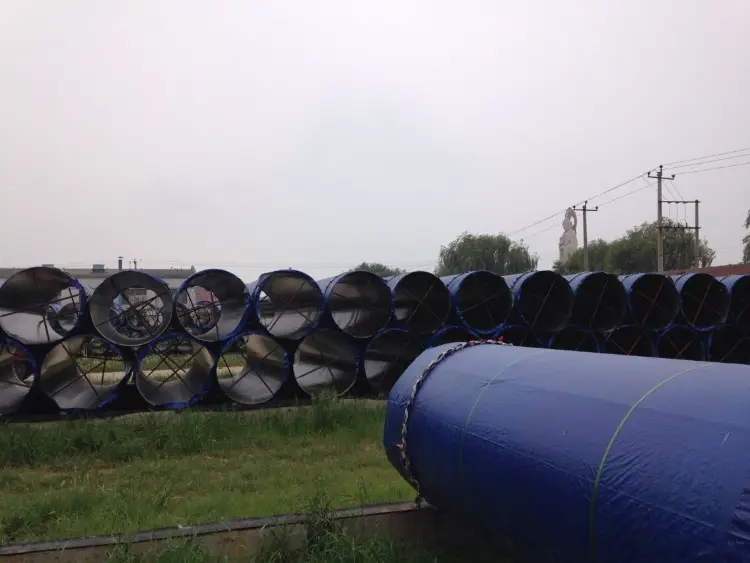
EN 10025-6 S690QL1 ERW Pipe
EN 10025-6 S690QL1 ERW Pipe: High-Strength Quenched and Tempered Steel for Structural Applications
Explore the properties, chemical composition, mechanical and thermal characteristics of S690QL1 steel according to EN 10025-6, specifically for ERW pipe applications.
Welding (ERW, SAW, SMAW, GMAW), hot forming, cold forming (with restrictions), machining and flame cutting.
- Phone : +8618037372205
- Email : [email protected]
- WhatsApp: Contact via Whtsapp
- WeChat: +8618037372205
EN 10025-6 S690QL1 ERW Pipe Introduction
S690QL1 is a high-strength, quenched and tempered structural steel defined in EN 10025-6, designed for demanding welded structures and heavy-duty applications. It offers a minimum yield strength of 690 MPa in thicknesses up to 50 mm, combined with good toughness at low temperatures (-40 °C). The ERW (Electric Resistance Welded) pipe form leverages the steel's excellent weldability and uniform mechanical properties, making it ideal for:
- Mobile crane booms and chassis
- Offshore platforms and structural tubulars
- Bridges and high-stress pipelines
With tight control over carbon equivalent and residual elements, S690QL1 ensures reliable weld performance and resistance to brittle fracture, even under severe service conditions.
EN 10025-6 S690QL1 ERW Pipe Chemical Composition
The chemical composition of S690QL1 according to EN 10025-6:2019 ensures high strength and good weldability. Carbon equivalent (CEV) values are controlled based on product thickness. Typical limits shown for thicknesses ≤50 mm; some elements may be added individually or in combination to achieve the required properties.
| Element | Standard Value (max, %) | Remarks |
|---|---|---|
| C | 0.20 | For thickness >50 mm, max. 0.22 |
| Si | 0.80 | Silicon |
| Mn | 1.70 | Manganese; for thickness >50 mm, max. 1.80 |
| P | 0.020 | Phosphorus |
| S | 0.010 | Sulfur |
| N | 0.015 | Nitrogen |
| B | 0.005 | Boron |
| Cr | 1.50 | Chromium |
| Cu | 0.50 | Copper |
| Mo | 0.70 | Molybdenum |
| Nb | 0.06 | Niobium |
| Ni | 2.0 | Nickel (for thickness >50 mm, max. 1.0) |
| Ti | 0.05 | Titanium |
| V | 0.12 | Vanadium; Nb + V ≤ 0.22 |
| Zr | 0.15 | Zirconium |
EN 10025-6 S690QL1 ERW Pipe Thermal and Electrical Physical Properties
The following properties are typical for quenched and tempered S690QL1 steel at room temperature and ambient pressure. These values are indicative and may vary slightly depending on the exact product form and heat treatment condition. The data are based on industry accepted material data sheets and EN 10025-6 general references.
| Property | Typical Value | Unit | Test Condition / Remarks |
|---|---|---|---|
| Density (ρ) | 7850 | kg/m³ | At 20 °C |
| Modulus of elasticity (E) | 210 | GPa | At 20 °C, tension |
| Shear modulus (G) | ~81 | GPa | Calculated from E and ν |
| Poisson's ratio (ν) | 0.3 | - | Elastic range, room temperature |
| Thermal expansion coefficient (α) | 12 × 10-6 | K-1 | Between 20 °C and 100 °C |
| Thermal conductivity (λ) | 38 | W/(m·K) | At 20 °C |
| Specific heat capacity (cp) | 460 | J/(kg·K) | At 20 °C |
| Electrical resistivity (ρe) | 0.23 | μΩ·m | At 20 °C |
EN 10025-6 S690QL1 ERW Pipe Mechanical Properties
Mechanical properties are based on longitudinal test pieces in accordance with EN 10025-6. The values apply to ERW pipe manufactured from hot-rolled strip/plate. Yield strength and tensile strength decrease with increasing thickness. Impact energy is guaranteed at -40 °C (longitudinal direction). Bending test requirements depend on the nominal thickness and the minimum specified yield strength.
| Property | Required Value | Unit | Test Condition |
|---|---|---|---|
| Yield strength (ReH) | ≥ 690 | MPa | Nominal thickness ≤ 50 mm |
| Yield strength (ReH) | ≥ 650 | MPa | 50 < thickness ≤ 100 mm |
| Yield strength (ReH) | ≥ 630 | MPa | 100 < thickness ≤ 150 mm |
| Tensile strength (Rm) | 770 - 940 | MPa | Nominal thickness ≤ 150 mm |
| Tensile strength (Rm) | 760 - 950 (for info) | MPa | Thickness 150 < t ≤ 200 mm (optional) |
| Elongation after fracture (A) | ≥ 14 | % | Longitudinal, gauge length L0 = 5.65√S0, thickness ≤ 150 mm |
| Impact energy (KV2) | ≥ 27 | J | Longitudinal, -40 °C, average of 3 tests; single min 19 J |
| Bending test (bend angle 180°) | d = 4t (for t ≤ 16 mm) | - | Bend mandrel diameter 'd', specimen thickness 't' |
| Bending test (bend angle 180°) | d = 5t (for 16 < t ≤ 50 mm) | - | Bend mandrel diameter 'd', specimen thickness 't' |
| Bending test (bend angle 180°) | d = 6t (for 50 < t ≤ 100 mm) | - | Bend mandrel diameter 'd', specimen thickness 't' |
EN 10025-6 S690QL1 ERW Pipe Equivalent Designations and Standards
| Country/Region | Standard | Grade | Remarks |
|---|---|---|---|
| Europe | EN 10025-6:2019 | S690QL1 | The base designation; ERW pipe may be covered by EN 10219 for cold-formed welded structural hollow sections. |
| International (ISO) | ISO 4950-2 / ISO 4950-3 | E690QL1 | High yield strength flat steel products; technically identical to S690QL1. |
| Germany | DIN EN 10025-6 | S690QL1 | Adopted as DIN standard. |
| United Kingdom | BS EN 10025-6 | S690QL1 | Adopted British Standard. |
| France | NF EN 10025-6 | S690QL1 | Adopted French Standard. |
| Italy | UNI EN 10025-6 | S690QL1 | Adopted Italian Standard. |
EN 10025-6 S690QL1 ERW Pipe Application Introduction
S690QL1 ERW pipe offers a unique combination of high strength, good formability, and excellent low-temperature toughness, enabling lightweight design without compromising safety. Its good weldability with proper procedures makes it suitable for a broad range of structural applications. Typical applications include:
Product Applications: Structural hollow sections for buildings and bridges, Jack-up rig legs and offshore platform braces, Telescopic crane booms and lattice boom sections, Trailer chassis and heavy-duty underframes, Pipeline for high-pressure fluid transport (if certified), Wind turbine monopiles and transition pieces
Processed into products: ERW pipes and tubulars, Box columns and truss chords, Rotary kiln shells and kiln tyres support rollers, Pressure vessel shells (when supplementary requirements met), Excavator arms and lifting lugs, Shipbuilding and marine stiffeners
Application industries: Construction & Heavy Infrastructure, Offshore & Marine Engineering, Mobile Crane & Lifting Equipment, Transportation & Commercial Vehicles, Mining & Earthmoving Machinery, Renewable Energy (Wind turbine towers, foundation structures)
EN 10025-6 S690QL1 ERW Pipe Similar / Closely Related Materials
| Country/Region | Standard | Grade | Remarks |
|---|---|---|---|
| Europe | EN 10025-6 | S690Q | Lower impact energy requirement (KV 0 °C), otherwise similar strength. |
| Europe | EN 10025-6 | S690QL | Impact at -20 °C; otherwise chemical and mechanical properties comparable to QL1. |
| USA | ASTM A514/A514M | Grade F / Grade S | Quenched and tempered alloy steel with min. yield 690 MPa; some grades have different chemistry. Usually heavier plate, not always directly rolled into pipe. |
| Japan | JIS G 3128 | SHY 685N / SHY 685NS | High yield strength steel for welded structures; min. yield 685 MPa with low-temperature impact options; composition differs from S690QL1. |
| China | GB/T 16270 | Q690D | Quenched and tempered high strength structural steel; min. yield 690 MPa; impact at -20°C; similar but not identical in chemical fine-tuning. |
Notes:
For ERW pipe applications, ensure compliance with applicable pipe standards such as EN 10219 (cold-formed welded structural hollow sections) or EN 10210 (hot finished). Additional tests, including weld seam quality, flattening tests, and NDT, may be specified. Always consult the mill for the latest CEV tables and specific product range availability. The material can be hot-dip galvanized with consideration for hydrogen embrittlement risks in high-strength steels. Preheating and interpass temperature controls are essential during welding to maintain toughness.
- Share



