
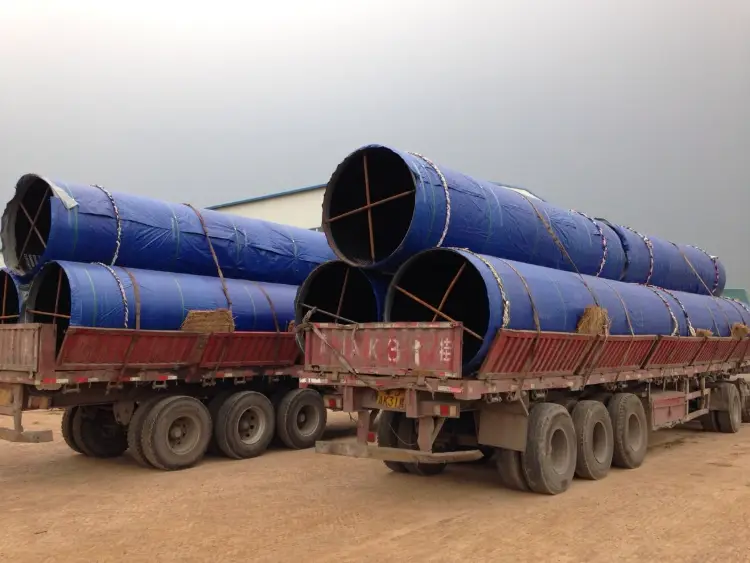
S620QL ERW Pipe: High Strength Quenched & Tempered Structural Steel
S620QL ERW Pipe: High Strength Quenched & Tempered Structural Steel | EN 10025-6
Comprehensive material data for S620QL steel according to EN 10025-6, used for electric resistance welded (ERW) pipes. Includes chemical composition, mechanical and physical properties, international equivalents, and application guidelines.
Hot rolling, quenching and tempering, cold forming, welding (ERW, SAW, etc.), machining, bending
- Phone : +8618037372205
- Email : [email protected]
- WhatsApp: Contact via Whtsapp
- WeChat: +8618037372205
S620QL ERW Pipe: High Strength Quenched & Tempered Structural Steel Introduction
S620QL is a high-strength quenched and tempered structural steel defined in EN 10025-6. It belongs to the group of fine grain steels with minimum yield strength of 620 MPa for thicknesses up to 50 mm. The grade designation 'Q' indicates quenching and tempering, and 'L' specifies a minimum impact energy of 30 J at -40°C. This steel offers excellent weldability, good toughness at low temperatures, and high resistance to static and dynamic loads. It is typically supplied as plates or strips, which are subsequently formed into ERW (Electric Resistance Welded) pipes for demanding structural and pressure applications. The chemical composition is microalloyed with elements such as niobium, vanadium, and titanium to ensure fine grain structure and enhanced mechanical properties. Typical delivery condition is quenched and tempered, providing a balanced combination of strength and ductility.
S620QL ERW Pipe: High Strength Quenched & Tempered Structural Steel Chemical Composition
The chemical composition according to EN 10025-6:2019 for product thickness ≤ 50 mm. The steel is microalloyed with niobium, vanadium, and titanium to achieve the required strength and toughness. Total aluminum content is specified to ensure fine grain practice. Copper, nickel, chromium, and molybdenum may be added as residuals or intentionally to enhance hardenability, but their levels are limited to maintain weldability.
| Element | Standard Value (≤ 50 mm) | Remarks |
|---|---|---|
| Carbon (C) | 0.20 % max. | Influences hardness and weldability |
| Silicon (Si) | 0.80 % max. | Deoxidizer, contributes to strength |
| Manganese (Mn) | 1.70 % max. | Improves hardenability and toughness |
| Phosphorus (P) | 0.020 % max. | Impurity, limits for toughness |
| Sulfur (S) | 0.010 % max. | Impurity, improves machinability but reduces toughness |
| Chromium (Cr) | 1.50 % max. | Increases hardenability |
| Molybdenum (Mo) | 0.70 % max. | Increases high-temperature strength and hardenability |
| Nickel (Ni) | 2.00 % max. | Enhances low-temperature toughness |
| Vanadium (V) | 0.12 % max. | Grain refiner, precipitation hardening |
| Titanium (Ti) | 0.05 % max. | Grain refiner, nitrogen fixation |
| Niobium (Nb) | 0.06 % max. | Grain refiner, precipitation hardening |
| Aluminum (Al total) | 0.018 % min. | Required for fine grain practice |
| Boron (B) | 0.005 % max. | Powerful hardenability agent |
| Zirconium (Zr) | 0.15 % max. | Sulfide shape control |
| Nitrogen (N) | 0.015 % max. | Impurity, can combine with Al, Ti |
| Copper (Cu) | 0.50 % max. | Residual element, may improve corrosion resistance |
S620QL ERW Pipe: High Strength Quenched & Tempered Structural Steel Thermal and Electrical Physical Properties
Physical properties for S620QL steel. These values are not specified in EN 10025-6 but represent typical data for quenched and tempered alloy structural steels. Actual values may vary depending on exact chemical composition and heat treatment condition.
| Property | Typical Value | Unit | Test Condition / Remarks |
|---|---|---|---|
| Density (ρ) | 7850 | kg/m³ | At room temperature |
| Modulus of elasticity (E) | 210 | GPa | At room temperature, tension |
| Shear modulus (G) | 81 | GPa | Calculated from E and ν |
| Poisson's ratio (ν) | 0.3 | – | In elastic range |
| Thermal expansion coefficient (α) | 11.7 | ×10⁻⁶/K | 20 – 100 °C |
| Thermal conductivity (λ) | 30 | W/(m·K) | At room temperature |
| Specific heat capacity | 460 | J/(kg·K) | At room temperature |
| Electrical resistivity (ρ_e) | 0.25 | ×10⁻⁶ Ω·m | At room temperature |
S620QL ERW Pipe: High Strength Quenched & Tempered Structural Steel Mechanical Properties
Mechanical properties for quenched and tempered condition according to EN 10025-6, valid for thickness ≤ 50 mm. The values represent longitudinal direction specimens unless otherwise noted. For ERW pipe made from S620QL plates/strips, the weld seam efficiency must be considered separately; the parent material meets these requirements.
| Property | Requirement | Unit | Test Condition |
|---|---|---|---|
| Upper yield strength (ReH) | ≥ 620 | MPa | t ≤ 50 mm, longitudinal |
| Tensile strength (Rm) | 700 – 890 | MPa | t ≤ 50 mm, longitudinal |
| Elongation after fracture (A5) | ≥ 14 | % | Gauge length 5.65√So, longitudinal |
| Bend test (mandrel diameter) | ≥ 3t | – | t ≤ 16 mm, bend angle 180° |
| Bend test (mandrel diameter) | ≥ 4t | – | 16 mm < t ≤ 50 mm, bend angle 180° |
| Impact energy (KV), at -40°C | ≥ 30 | J | Charpy-V, longitudinal, average of 3 tests |
| Impact energy (KV), at -40°C | ≥ 27 | J | Charpy-V, transverse, average of 3 tests |
S620QL ERW Pipe: High Strength Quenched & Tempered Structural Steel Fully Equivalent Material Standards and Substitutable Grades
| Region | Standard | Grade | Remarks |
|---|---|---|---|
| Europe | EN 10025-6 | S620QL | Primary standard; quenched and tempered condition |
| International | ISO 630-6 | S620QL | Equivalent when adopted; identical technical content to EN |
S620QL ERW Pipe: High Strength Quenched & Tempered Structural Steel Application Introduction
S620QL ERW pipes are used in industries demanding high load-bearing capacity with reduced weight. Their excellent weldability and low-temperature toughness make them suitable for critical welded structures. Typical applications include:
Product Applications: Electric resistance welded (ERW) pipes for fluid conveyance and structural support, Crane booms, jibs, and outriggers, Mobile crane chassis and telescopic arms, Trailer and truck frames, Bridge box girders and arch ribs, Jacket legs and nodes for offshore platforms, High-pressure vessels and heat exchangers
Processed into products: Welded tubular columns and beams, Bent and welded pipe elbows, reducers, tees, Flanges and fittings for high-pressure piping systems, Machined pins, bushings, and wear plates, Laser or plasma cut profile parts for heavy machinery, Piling pipe sections welded together for foundation engineering
Application industries: Heavy lifting and transport equipment, Bridge construction, Offshore and marine engineering, Pressure vessel and storage tank manufacturing, Mining and earthmoving machinery, Structural pipes for high-rise buildings and stadiums
S620QL ERW Pipe: High Strength Quenched & Tempered Structural Steel Similar or Alternative Material Recommendations
| Region | Standard | Grade | Remarks |
|---|---|---|---|
| US | ASTM A514 / A517 | Grade Q | Yield strength 690 MPa, tensile 760-895 MPa; similar strength class but different composition; verify toughness |
| US | ASTM A709 | Grade HPS 100W | High-performance steel, similar yield ~690 MPa; may require additional testing for substitution |
| Japan | JIS G 3128 | SHY685 | Yield ≥ 685 MPa, tensile 780-930 MPa; used for similar high-strength welded structures |
| China | GB/T 16270 | Q620D/Q620E | High strength structural steel plates, quenched and tempered; compare impact test temperature |
Notes:
Welding considerations: S620QL has good weldability but requires careful heat input control to avoid softening in the heat-affected zone (HAZ). Preheating up to 150–200°C is recommended for thicker sections, and post-weld heat treatment is generally not required for small welds but may be needed to relieve residual stresses. ERW pipe seam shall undergo proper heat treatment (normalizing) if specified. Corrosion protection: As a low-alloy steel, S620QL is not stainless; protective coatings or painting are necessary for outdoor or marine environments.
- Share



