
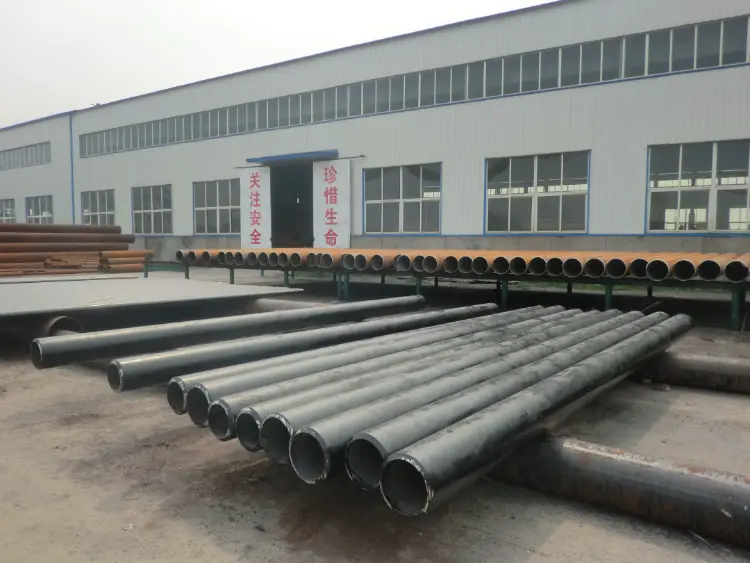
S550Q Quenched & Tempered High Yield Steel for SSAW Pipes
S550Q Quenched & Tempered High Yield Steel for SSAW Pipes - EN 10025-6
Detailed material data for S550Q steel according to EN 10025-6, including chemical composition, mechanical and physical properties, international equivalents, and application guidance for spiral submerged arc welded pipes.
Hot rolling, quenching and tempering, cold forming (limited), welding, thermal cutting, bending
- Phone : +8618037372205
- Email : [email protected]
- WhatsApp: Contact via Whtsapp
- WeChat: +8618037372205
S550Q Quenched & Tempered High Yield Steel for SSAW Pipes Introduction
S550Q is a quenched and tempered high yield strength structural steel grade defined in EN 10025-6. With a minimum yield strength of 550 MPa and excellent toughness at -20°C, it is designed for heavy-duty welded structures such as spiral submerged arc welded (SSAW) pipes, crane booms, offshore platforms, and pressure vessels. The steel provides a good balance of strength, weldability, and formability, delivered in the Quenched and Tempered (Q) condition. It is characterised by a low carbon equivalent to facilitate welding and consistent mechanical properties across a wide thickness range (up to 150 mm).
S550Q Quenched & Tempered High Yield Steel for SSAW Pipes Chemical Composition
The table shows the maximum (or minimum where indicated) permitted contents according to EN 10025-6:2004 for grade S550Q. If other grain refining elements (Nb, V, Ti) are used, the minimum Al content may be replaced or supplemented. The steel may contain small amounts of residual elements such as Cr, Ni, Mo, Cu up to specified maxima by agreement.
| Element | Standard Value | Remarks |
|---|---|---|
| Carbon (C) | ≤ 0.20 | Maximum |
| Silicon (Si) | ≤ 0.80 | Maximum |
| Manganese (Mn) | ≤ 1.70 | Maximum |
| Phosphorus (P) | ≤ 0.025 | Maximum |
| Sulfur (S) | ≤ 0.015 | Maximum |
| Nitrogen (N) | ≤ 0.015 | Maximum; higher N permitted if adequate nitrogen-binding elements are present |
| Aluminium (Altotal) | ≥ 0.015 | Minimum if aluminium is used as grain refining element; alternative microalloying with Nb, V, Ti allowed |
S550Q Quenched & Tempered High Yield Steel for SSAW Pipes Thermal and Electrical Physical Properties
The following physical properties are typical for quenched and tempered structural steels similar to S550Q at room temperature, unless otherwise indicated. They are provided for design guidance but are not mandatory requirements of the material standard.
| Property | Typical Value | Unit | Test Condition / Remarks |
|---|---|---|---|
| Density (ρ) | 7850 | kg/m³ | At 20°C |
| Elastic Modulus (E) | 210 | GPa | At 20°C, static |
| Shear Modulus (G) | ≈ 81 | GPa | Calculated from E and Poisson's ratio |
| Poisson's Ratio (ν) | 0.3 | – | Elastic range |
| Thermal Expansion Coefficient (α) | 11.5 – 12.5 | 10⁻⁶ /K | 20°C to 100°C; 12.0 × 10⁻⁶/K typical |
| Thermal Expansion Coefficient (α) | 12.5 – 13.5 | 10⁻⁶ /K | 20°C to 200°C |
| Thermal Conductivity (λ) | 40 – 50 | W/(m·K) | At 20°C; decreases with increasing temperature |
| Specific Heat Capacity (c) | ≈ 460 | J/(kg·K) | Around room temperature |
| Electrical Resistivity (ρe) | 0.20 – 0.25 | µΩ·m | At 20°C; typical 0.22 µΩ·m |
S550Q Quenched & Tempered High Yield Steel for SSAW Pipes Mechanical Properties
Mechanical properties are guaranteed in the delivery condition (Quenched and Tempered) for transverse or longitudinal test pieces as indicated, according to EN 10025-6. Values depend on product thickness. The impact test temperature is -20°C for the basic S550Q grade.
| Property | Required Value | Unit | Test Condition / Remarks |
|---|---|---|---|
| Yield Strength (ReH) | ≥ 550 | MPa | Nominal thickness t ≤ 50 mm; longitudinal or transverse |
| Yield Strength (ReH) | ≥ 530 | MPa | 50 < t ≤ 100 mm |
| Yield Strength (ReH) | ≥ 490 | MPa | 100 < t ≤ 150 mm |
| Tensile Strength (Rm) | 640 – 820 | MPa | All thicknesses up to 150 mm |
| Elongation (A5) | ≥ 16 | % | t ≤ 50 mm; longitudinal (L₀ = 5.65√S₀) |
| Elongation (A5) | ≥ 15 | % | 50 < t ≤ 100 mm; longitudinal |
| Elongation (A5) | ≥ 14 | % | 100 < t ≤ 150 mm; longitudinal |
| Impact Energy (KV) | ≥ 27 | J | At -20°C; longitudinal; min. average of 3 tests (single min. ≥ 70% of required value) |
| Bend Test (bending angle 180°) | d ≤ 3 t | – | t ≤ 50 mm; longitudinal, e.g. d = mandrel diameter, t = sample thickness |
| Bend Test | d ≤ 4 t | – | 50 < t ≤ 100 mm |
| Bend Test | d ≤ 5 t | – | 100 < t ≤ 150 mm |
S550Q Quenched & Tempered High Yield Steel for SSAW Pipes Completely Equivalent Material Standards and Replaceable Grades
| Country / Region | Standard | Grade | Remarks |
|---|---|---|---|
| Europe (EU/EFTA) | EN 10025-6 | S550Q | Original standard, quenched and tempered |
| International | ISO 4950-2 | E550Q | Technically identical; high yield strength flat products |
| United Kingdom | BS EN 10025-6 | S550Q | UK implementation of EN standard |
| Germany | DIN EN 10025-6 | S550Q | German implementation |
| France | NF EN 10025-6 | S550Q | French implementation |
| China | GB/T 16270-2009 | Q550D | Comparable grade with min. yield 550 MPa and -20°C impact; also Q550E for -40°C |
S550Q Quenched & Tempered High Yield Steel for SSAW Pipes Application Introduction
S550Q steel is predominantly used in welded constructions requiring high strength-to-weight ratio and good ductility. The quenched and tempered condition guarantees consistent mechanical properties, making it suitable for safety-critical components. For SSAW pipe applications, the material is formed into spirally welded pipes used for conveying liquids, structural piling, and pressure containment. Proper welding procedures with controlled heat input, preheating and post-weld heat treatment (when needed) are essential to avoid hydrogen-induced cracking and to maintain toughness.
Product Applications: Spiral welded pipes (SSAW pipes) for pipelines and structural piling, Pressure vessels and storage tanks designed to PED/ASME codes, Welded I-beams and box girders for bridges, Offshore platform legs, nodes and conductor pipes, Crane jibs, booms and outriggers, Masts, towers and wind turbine support structures, Heavy-duty trailers and tipper bodies
Processed into products: SSAW pipe: line pipe for oil/gas/water, penstock pipes, pipe piles, structural casings, Crane: main chords and lattice members of lattice boom cranes, Bridge: flange plates and web plates in composite bridges, Offshore: jacket braces, deck beams, transition pieces, Pressure equipment: cylindrical and spherical shells, flanges and reinforcement pads, Machinery: welded frames of heavy presses, lift tables, excavator booms
Application industries: Oil & Gas (offshore platforms, pipelines, subsea structures), Civil Engineering & Construction (bridges, stadiums, high-rise building columns), Heavy Machinery & Transport (crane booms, truck frames, earthmoving equipment), Water Supply & Penstock (SSAW pipes for water transmission), Wind Energy (tower sections, foundation structures), Shipbuilding (special high-strength structural parts)
S550Q Quenched & Tempered High Yield Steel for SSAW Pipes Similar / Substitute Material Recommendations
| Country / Region | Standard | Grade | Remarks |
|---|---|---|---|
| Europe | EN 10025-6 | S550QL | Same strength, better low-temperature toughness (-40°C); suitable for colder environments |
| Europe | EN 10025-6 | S500Q | Slightly lower yield strength (500 MPa), similar weldability and applications |
| Europe | EN 10025-6 | S690Q | Higher strength (690 MPa), more alloyed, higher carbon equivalent, needs adapted welding procedures |
| USA / International | ASTM A514/A514M | Grade B, H, F (etc.) | Quenched and tempered high strength steel plates; yield strength typically ≥ 690 MPa, over-matching S550Q; verify design requirements |
| International (Pipelines) | API 5L / ISO 3183 | X70 (L485) | Pipeline steel with yield strength 485 MPa; often used for SSAW pipes; lower yield but higher toughness delivery options |
Notes:
Welding: Due to the quenched and tempered condition, heat input and interpass temperature must be strictly controlled (typically ≤ 200°C). Low-hydrogen welding consumables are mandatory. A suitable preheat temperature (depending on thickness and combined carbon equivalent) is usually required.
Forming: Cold forming can be performed on limited radius; hot forming may alter mechanical properties and is not recommended without requalification.
Delivery conditions: EN 10025-6 permits different inspection levels and supplementary requirements (e.g., improved through-thickness properties per EN 10164). SSAW pipe orders should specify additional testing such as weld seam impact tests and hydrostatic test requirements.
- Share



