
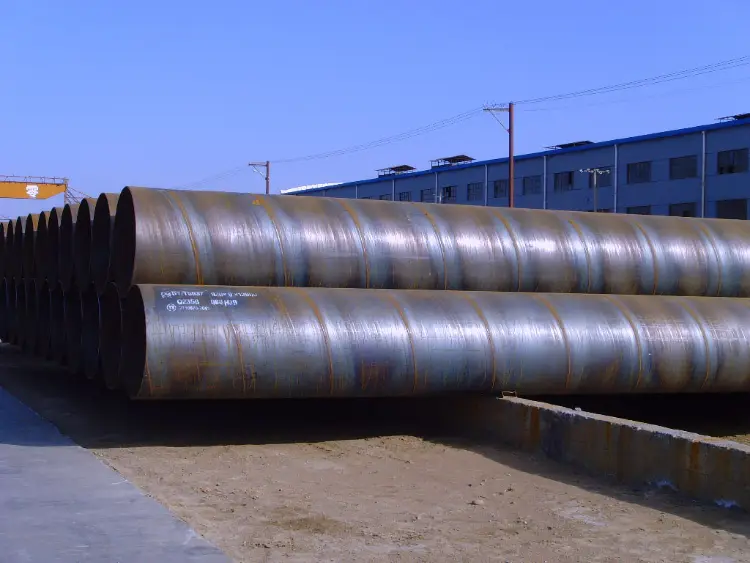
S500QL1 High-Strength Quenched & Tempered Steel for SSAW Pipes
S500QL1 High-Strength Quenched & Tempered Steel for SSAW Pipes | EN 10025-6 Data
Comprehensive material data of EN 10025-6 S500QL1 steel used in spiral submerged arc welded pipes. Chemical composition, mechanical properties, thermal and electrical physics, international equivalents, and application guidance.
Cutting, cold forming, welding (with appropriate consumables and heat input control), machining
- Phone : +8618037372205
- Email : [email protected]
- WhatsApp: Contact via Whtsapp
- WeChat: +8618037372205
S500QL1 High-Strength Quenched & Tempered Steel for SSAW Pipes Introduction
S500QL1 is a high-strength quenched and tempered structural steel specified in EN 10025-6, primarily designed for welded structures where weight reduction and high load-bearing capacity are essential. It offers a minimum yield strength of 500 MPa for thicknesses up to 50 mm, with excellent low-temperature toughness (L1 grade: minimum 27 J at -40°C). Typical forms include plates and strips used for manufacturing spiral submerged arc welded (SSAW) pipes, heavy machinery, and offshore structures. The quenched and tempering heat treatment ensures a fine-grained microstructure providing a balanced combination of strength, ductility, and weldability. Its low carbon equivalent (CEV) facilitates good weldability without excessive preheat, making it suitable for critical applications in harsh environments.
S500QL1 High-Strength Quenched & Tempered Steel for SSAW Pipes Chemical Composition
The table below shows the ladle analysis limits as per EN 10025-6:2019 for steel grade S500QL1. All elements are given in maximum percent, except where a range is indicated. The steel is fully killed and fine grained.
- The carbon equivalent value (CEV) is typically controlled to ensure weldability, usually ≤ 0.47% for products up to certain thicknesses.
- Nb, V, Ti, and Al may be added for grain refinement.
- Controlled sulfur and phosphorus levels enhance toughness and cleanliness.
| Element | Standard Value (max or range) | Remarks |
|---|---|---|
| Carbon (C) | ≤ 0.18% | Max for thickness ≤ 50 mm; slight increase for thicker sections per standard |
| Silicon (Si) | ≤ 0.50% | Max |
| Manganese (Mn) | ≤ 1.70% | Max |
| Phosphorus (P) | ≤ 0.020% | Max |
| Sulfur (S) | ≤ 0.010% | Max |
| Aluminum (Al) total | ≥ 0.020% | Minimum, for fine grain practice |
| Nitrogen (N) | ≤ 0.015% | Max |
| Chromium (Cr) | ≤ 1.50% | Max; typically present in QT steels for hardenability |
| Nickel (Ni) | ≤ 1.00% | Max; contributes to toughness |
| Molybdenum (Mo) | ≤ 0.70% | Max; enhances hardenability |
| Copper (Cu) | ≤ 0.50% | Max; may be limited for certain applications |
| Vanadium (V) | ≤ 0.08% | Max; a microalloying element |
| Niobium (Nb) | ≤ 0.05% | Max; for grain refinement |
| Titanium (Ti) | ≤ 0.05% | Max; for grain refinement and nitrogen control |
| Boron (B) | ≤ 0.005% | Max; if intentionally added |
S500QL1 High-Strength Quenched & Tempered Steel for SSAW Pipes Physical and Thermal Properties
The following values are typical for quenched and tempered structural steels of this strength level and are not part of the mandatory standard requirements. They should be used for estimation in design, not for acceptance tests.
- Density is slightly affected by alloy content but generally constant.
- Thermal expansion, conductivity, and specific heat vary with temperature; values given at 20°C unless noted.
- Electrical resistivity is typical for low-alloy steel.
| Property | Typical Value | Unit | Test Condition / Remarks |
|---|---|---|---|
| Density (ρ) | 7850 | kg/m³ | At 20°C |
| Elastic Modulus (E) | 210 | GPa | At 20°C, static |
| Shear Modulus (G) | 81 | GPa | At 20°C, calculated from E and Poisson's ratio |
| Poisson's Ratio (ν) | 0.3 | – | At 20°C, elastic range |
| Thermal Expansion Coefficient (α) | 11.7 × 10⁻⁶ | K⁻¹ | Linear expansion, 20–100°C |
| Thermal Expansion Coefficient (α) | 12.2 × 10⁻⁶ | K⁻¹ | 20–200°C |
| Thermal Expansion Coefficient (α) | 12.8 × 10⁻⁶ | K⁻¹ | 20–300°C |
| Thermal Conductivity (λ) | 38 | W/m·K | At 20°C |
| Thermal Conductivity (λ) | 37 | W/m·K | At 100°C |
| Specific Heat Capacity (cp) | 460 | J/kg·K | At 20°C |
| Specific Heat Capacity (cp) | 480 | J/kg·K | At 100°C |
| Electrical Resistivity (ρe) | 0.23 | μΩ·m | At 20°C |
S500QL1 High-Strength Quenched & Tempered Steel for SSAW Pipes Mechanical Properties
Mechanical properties according to EN 10025-6 for flat products (plates, strips) in the quenched and tempered condition. The values are valid for product thicknesses as indicated. For SSAW pipes, the properties of the base material (plate) typically apply; however, the pipe standard (e.g., EN 10219 or API 5L) may have slight variations.
- The lower yield strength (ReH) or 0.2% proof stress (Rp0.2) is used depending on the steel behavior.
- Charpy V-notch impact energy at -40°C for the L1 quality class is guaranteed.
- Elongation values are measured on proportional test pieces.
| Property | Standard Requirement Value | Unit | Test Condition / Remarks |
|---|---|---|---|
| Yield Strength (ReH) | ≥ 500 | MPa | Thickness ≤ 50 mm, transverse test piece |
| Yield Strength (ReH) | ≥ 480 | MPa | Thickness > 50 mm ≤ 100 mm |
| Tensile Strength (Rm) | 590 – 770 | MPa | Thickness ≤ 100 mm, transverse |
| Elongation (A5/A50) | ≥ 17 | % | Gauge length L0=5.65√S0, transverse, thickness ≤ 50 mm |
| Elongation (A5/A50) | ≥ 16 | % | Thickness > 50 mm ≤ 100 mm |
| Impact Energy (KV, Charpy V) | ≥ 27 J (average), ≥ 19 J (single) | J | at -40 °C (L1 quality), longitudinal test piece |
| Bend Test (Mandrel Diameter) | No cracks after 180° bending | – | Mandrel diameter = 3 × thickness (t ≤ 16 mm), 4t (16–50 mm), 5t (>50–100 mm) |
S500QL1 High-Strength Quenched & Tempered Steel for SSAW Pipes Fully Equivalent Material Standards and Substitutable Grades
The following international designations are considered fully equivalent or directly replaceable, provided the same quenched and tempered delivery condition and toughness requirements (L1, minimum 27 J at -40°C) are met. Always verify the latest standard edition.
| Country/Region | Standard | Grade | Remarks |
|---|---|---|---|
| European Union | EN 10025-6:2019 | S500QL1 | Original standard; the reference grade. |
| International | ISO 4951-2:2018 | S500Q | Same strength level; toughness class must be specified as L1 or equivalent (-40°C). |
| Germany | DIN EN 10025-6 | S500QL1 | Identical adoption. |
| United Kingdom | BS EN 10025-6 | S500QL1 | Identical adoption. |
S500QL1 High-Strength Quenched & Tempered Steel for SSAW Pipes Application Introduction
S500QL1 steel, with its high strength and excellent low-temperature toughness, is extensively used in heavy welded structures. As a quenched and tempered material, it must be fabricated following strict temperature control during welding and hot forming to preserve the mechanical properties. Working processes:
- Cold forming: minimal springback, requires care to avoid cracking at tight radii.
- Welding: low-hydrogen processes (SMAW, GMAW, SAW) with appropriate preheat/interpass temperature based on thickness and carbon equivalent. Post-weld heat treatment usually not required.
- Machining: good machinability in the QT condition; carbide tools recommended.
Product Applications: SSAW (spiral submerged arc welded) pipes, LSAW (longitudinal submerged arc welded) pipes, Heavy welded structural beams and columns, Pressure vessel shells and heads, Offshore platform legs and braces, Crane and excavator booms
Processed into products: Pipe spools and fittings, Welded connections and gusset plates, Load-bearing brackets and cleats, Flanges and stiffening rings, Welded T-joints and K-joints, Transition pieces for wind turbine towers, Cutter heads and buckets for mining machinery
Application industries: Offshore engineering (jackets, topside structures, subsea pipelines), Bridge construction (orthotropic decks, heavy beams), Pressure vessels and storage tanks (for low-temperature service), Crane and mobile equipment manufacturing (booms, chassis), Mining and earth-moving machinery, Renewable energy (wind turbine towers, transition pieces), Pipe manufacturing (SSAW, LSAW) for oil, gas, and water transmission
S500QL1 High-Strength Quenched & Tempered Steel for SSAW Pipes Similar / Comparable Alternative Material Recommendations
These materials offer comparable strength and toughness but may differ in chemical composition ranges, rolling/delivery conditions, or testing requirements. Substitution should be carefully evaluated for weldability, notch toughness at the design temperature, and compliance with the applicable construction code.
| Country/Region | Standard | Grade | Remarks |
|---|---|---|---|
| United States | ASTM A514/A514M | Grade B (or Grade E, H) | Yield strength 690 MPa typical; need to order quenched & tempered and confirm impact at -40°C. Not identical to S500QL1 (strength level higher, CEV may differ). |
| United States | ASTM A709/A709M | Grade 50W (HPS 50W) | Lower strength (345 MPa) but weathering; 500 MPa yield grade would be HPS 70W, which is closer but still higher. |
| Japan | JIS G 3128 | SHY685 | Yield strength ≥ 685 MPa, quenched and tempered. Slightly higher strength; check toughness class and carbon equivalent. |
| China | GB/T 16270 | Q500D | Quenched and tempered high strength steel with yield ≥ 500 MPa; D-quality indicates -20°C impact test. May require supplemental requirement for -40°C. |
| Russia | GOST R 52927 | S500QL1 | Adopted from EN standard; often identical. |
Notes:
All data are based on EN 10025-6:2019 standard requirements and typical reference values from reputable steel producer datasheets. For actual procurement, consult the material certificate according to EN 10204 Type 3.1 or 3.2. For SSAW pipes, the pipe manufacturing specification (e.g., EN 10219-1 for cold-formed welded structural hollow sections, or API 5L for line pipe) may impose additional testing and tolerances beyond the base plate standard.
- Share



