
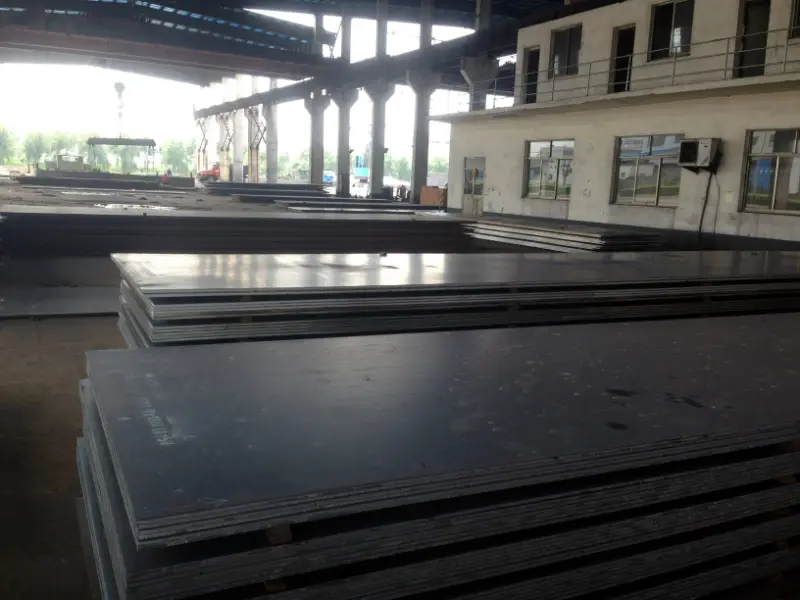
S460QL1 High-Strength Quenched & Tempered Steel
S460QL1 High-Strength Quenched & Tempered Steel for ERW Pipe per EN 10025-6
Comprehensive analysis of S460QL1 steel for ERW pipe applications, covering chemical composition, mechanical and physical properties, international equivalents, and typical uses in heavy engineering.
Electric resistance welding (ERW), gas metal arc welding, submerged arc welding, bending, cold forming, laser/plasma cutting
- Phone : +8618037372205
- Email : [email protected]
- WhatsApp: Contact via Whtsapp
- WeChat: +8618037372205
S460QL1 High-Strength Quenched & Tempered Steel Introduction
S460QL1 is a high-strength, fine-grain structural steel specified in EN 10025-6 for hot-rolled flat and long products in the quenched and tempered condition. The designation 'S' denotes structural steel, '460' indicates a minimum yield strength of 460 MPa, 'Q' stands for quenched and tempered, 'L' guarantees impact energy down to -50°C, and '1' confirms a minimum 27J with longitudinal test pieces. When manufactured into ERW (Electric Resistance Welded) pipe, the material retains its excellent weldability, toughness, and high strength-to-weight ratio, making it ideal for demanding applications such as offshore structures, heavy-duty machinery, crane booms, and oil & gas pipelines. The low carbon equivalent and microalloying elements (Nb, V, Ti) ensure good formability and resistance to brittle fracture at subzero temperatures.
S460QL1 High-Strength Quenched & Tempered Steel Chemical Composition
The chemical composition of S460QL1 is tightly controlled to achieve high strength and excellent low-temperature toughness. Maximum limits apply to residuals like phosphorus and sulfur. Microalloying elements (Nb, V, Ti) contribute to grain refinement. The carbon equivalent value (CEV) is typically maintained ≤0.52 to ensure weldability.
- Aluminum is present as a grain refiner and deoxidizer.
- Nitrogen may be bound by Al or microalloys.
| Element | Standard Value (max %) | Remarks |
|---|---|---|
| Carbon (C) | ≤0.20 | For t ≤ 50 mm; for t > 50 to 100 mm: ≤0.22 |
| Silicon (Si) | ≤0.80 | Typical 0.15–0.50 |
| Manganese (Mn) | ≤1.70 | Higher Mn improves strength and toughness |
| Phosphorus (P) | ≤0.025 | Strictly controlled for toughness |
| Sulfur (S) | ≤0.015 | Low S for cleanliness |
| Aluminum (total, Al) | ≥0.015 | Mandatory for fine-grain practice |
| Niobium (Nb) | ≤0.06 | Microalloy for grain refinement |
| Vanadium (V) | ≤0.12 | Optional microalloy |
| Titanium (Ti) | ≤0.05 | Optional microalloy |
| Nickel (Ni) | ≤2.00 | Maximum residual; beneficial for toughness |
| Chromium (Cr) | ≤1.50 | Maximum residual |
| Molybdenum (Mo) | ≤0.70 | Maximum residual |
| Copper (Cu) | ≤0.50 | Maximum residual |
| Nitrogen (N) | ≤0.015 | Bound by Al or microalloys |
S460QL1 High-Strength Quenched & Tempered Steel Physical Properties
These physical properties are typical for S460QL1 steel in the quenched and tempered condition. They are derived from general data for low-alloy structural steels and may vary slightly depending on exact composition and heat treatment. Values are provided for engineering design.
- Thermal conductivity decreases with increasing temperature.
- Specific heat capacity and thermal expansion are relevant for welding and thermal processing.
| Property | Typical Value | Unit | Test Condition |
|---|---|---|---|
| Density (ρ) | 7850 | kg/m³ | Room temperature |
| Modulus of Elasticity (E) | 210 | GPa | Room temperature |
| Shear Modulus (G) | 80 | GPa | Calculated from E and ν |
| Poisson's Ratio (ν) | 0.3 | — | Room temperature |
| Coefficient of Thermal Expansion (α) | 11.1 | 10⁻⁶/K | 20–100°C |
| Coefficient of Thermal Expansion (α) | 12.3 | 10⁻⁶/K | 20–200°C |
| Thermal Conductivity (λ) | 50 | W/(m·K) | Room temperature |
| Specific Heat Capacity (cp) | 460 | J/(kg·K) | Room temperature |
| Electrical Resistivity (ρₑ) | 0.23 | µΩ·m | Room temperature |
S460QL1 High-Strength Quenched & Tempered Steel Mechanical Properties
Mechanical properties comply with EN 10025-6. The yield strength, tensile strength, and elongation are guaranteed at room temperature. The charpy impact energy at -50°C distinguishes the 'L1' quality. Values for ERW pipe may be subject to additional requirements per pipe specification (e.g., EN 10219, EN 10210).
- Bend test is performed with a mandrel diameter of 3t (t = specimen thickness) for 180° bending.
- Impact test is carried out on standard 10×10 mm² specimens.
| Property | Standard Requirement | Unit | Test Condition |
|---|---|---|---|
| Upper Yield Strength (ReH) | ≥460 | MPa | t ≤ 50 mm; room temperature |
| Tensile Strength (Rm) | 550 – 720 | MPa | t ≤ 50 mm; room temperature |
| Elongation after Fracture (A) | ≥17 | % | t ≤ 50 mm; gauge length L₀ = 5.65√S₀ |
| Charpy Impact Energy (KV) | ≥27 | J | Longitudinal; -50°C |
| Bend Test (Mandrel Diameter) | No cracks after 180° bending | — | d = 3t for t ≤ 12 mm; d = 4t for t > 12–20 mm |
S460QL1 High-Strength Quenched & Tempered Steel Identical Material Standards and Replaceable Grades
| Country/Region | Standard | Grade | Remarks |
|---|---|---|---|
| Europe | EN 10025-6:2019 | S460QL1 | Original specification for quenched and tempered structural steel |
| International | ISO 4950-2:1995 | S460QL1 | Equivalent high yield strength structural steel |
| Germany | DIN EN 10025-6 | S460QL1 | Adopted as national standard |
| China | GB/T 16270-2009 | Q460GJ-C | Comparable grade with similar mechanical properties; verify impact energy at -50°C |
S460QL1 High-Strength Quenched & Tempered Steel Application Introduction
S460QL1 ERW pipe is primarily used in heavy structural engineering where high strength, weldability, and reliable low-temperature toughness are critical. The ERW process allows efficient production of circular, square, or rectangular hollow sections from hot-rolled strip. Typical applications span offshore oil & gas platforms, mobile crane telescopic booms, heavy-duty chassis and trailer parts, and high-pressure pipelines. The material is suitable for both static and dynamically loaded structures.
Product Applications: Electric resistance welded (ERW) steel pipes, Structural hollow sections (SHS, RHS, CHS), Crane boom sections, Offshore jacket legs and nodes, Heavy-duty trailer chassis, Compressed natural gas (CNG) storage systems, Pressure vessels and boiler shells
Processed into products: Telescopic crane booms, Offshore platform structural nodes, Excavator arms and chassis, Hydraulic cylinder outer bodies, Pipeline for sour service (with appropriate HIC testing), Welded I-beams and box girders
Application industries: Offshore and marine engineering, Mobile crane and heavy lifting equipment, Bridge construction, Transport and logistics (heavy vehicles), Mining and earth-moving machinery, Oil and gas transmission pipelines, Renewable energy (wind turbine towers and foundations)
S460QL1 High-Strength Quenched & Tempered Steel Near-Equivalent or Similar Alternative Materials
| Country/Region | Standard | Grade | Remarks |
|---|---|---|---|
| Europe | EN 10025-6 | S460QL (basic 'L' quality) | Impact test at -50°C but with lower guaranteed KV (27J) and less restrictive chemical limits |
| Europe | EN 10025-6 | S460QL2 | Slightly higher toughness than QL1 at -50°C (ensure additional requirements) |
| USA | ASTM A514 / A514M | Grade E (or B) | Yield strength 690 MPa; similar quenched and tempered high-strength steel but higher tensile. May require evaluation for exact thickness and welding |
| Japan | JIS G 3106 | SM570Q | Similar high-strength structural steel with impact test options |
| Europe | EN 10225 | S355G10+N (offshore) | Lower yield strength but used in offshore; for less demanding applications |
Notes:
Additional considerations for ERW pipe: The pipe shall comply with the relevant dimensional and testing standard (e.g., EN 10219 for cold-formed structural hollow sections, EN 10210 for hot-finished, or API 5L for line pipe). For S460QL1 strip, the CEV is typically ≤0.52 for thickness up to 50 mm. Supplementary requirements like through-thickness properties (Z35) or CTOD testing may be agreed. The material is not intended for elevated temperature service above 580°C due to tempering effects. Always verify the latest material test certificates and specific product standards.
- Share



