
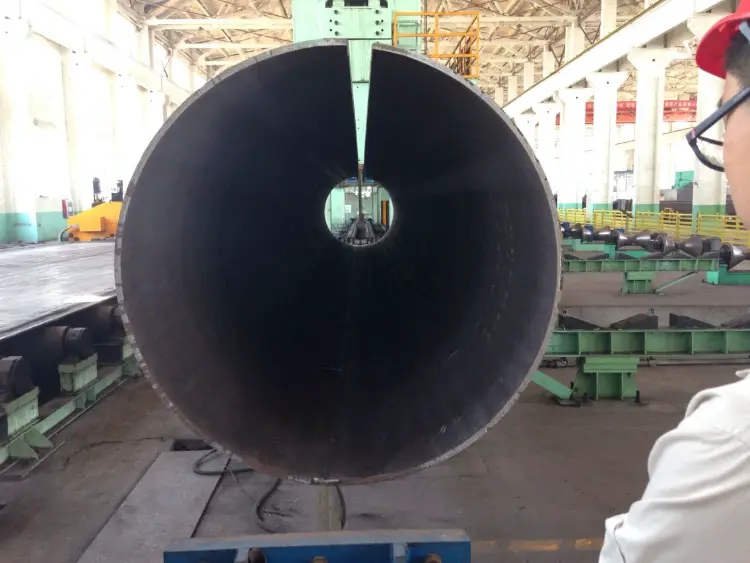
EN 10025-6 S500Q ERW Pipe Steel
EN 10025-6 S500Q ERW Pipe Steel: High-Strength Quenched & Tempered Material for Welded Pipe Fabrication
Detailed material data for S500Q grade according to EN 10025-6, used for electric resistance welded (ERW) pipe, featuring chemical composition, mechanical and physical properties, equivalent grades, and typical applications.
Quenching and tempering, cold forming, welding (electric resistance welding for pipes), stress relief heat treatment
- Phone : +8618037372205
- Email : [email protected]
- WhatsApp: Contact via Whtsapp
- WeChat: +8618037372205
EN 10025-6 S500Q ERW Pipe Steel Introduction
EN 10025-6 S500Q is a quenched and tempered high-strength structural steel with a minimum yield strength of 500 MPa for thicknesses up to 50 mm. It is characterized by good weldability, high toughness at low temperatures (down to -20°C for standard Q quality), and excellent strength-to-weight ratio. This steel is commonly supplied as plates or strips and is suitable for fabricating electric resistance welded (ERW) pipes used in demanding structural and mechanical applications. The fine-grain microstructure ensures uniform properties after tempering, meeting strict notch toughness requirements. Typical delivery condition for the base material is quenched and tempered; for ERW pipe, the strip is formed, welded, and may undergo stress relief to reduce residual stresses. The material conforms to EU standard and is widely used in crane building, heavy machinery, bridges, and offshore structures.
EN 10025-6 S500Q ERW Pipe Steel Chemical Composition as per EN 10025-6 for S500Q
Chemical composition requirements for ladle analysis of S500Q steel. Values are maximum unless otherwise stated. The steel is fine-grain treated with microalloying elements such as Nb, V, Ti, and Al to achieve desired strength and toughness. The carbon equivalent value (CEV) is restricted to ensure good weldability.
| Element | Value (wt. %) | Remarks |
|---|---|---|
| Carbon (C) | ≤0.20 | Standard maximum for all thicknesses |
| Silicon (Si) | ≤0.80 | |
| Manganese (Mn) | ≤1.70 | |
| Phosphorus (P) | ≤0.025 | |
| Sulfur (S) | ≤0.015 | |
| Nitrogen (N) | ≤0.015 | |
| Chromium (Cr) | ≤1.50 | Optionally added |
| Nickel (Ni) | ≤2.0 | |
| Molybdenum (Mo) | ≤0.70 | |
| Copper (Cu) | ≤0.50 | |
| Boron (B) | ≤0.005 | |
| Vanadium (V) | ≤0.12 | Sum V+Nb+Ti ≤ 0.12% for flat products |
| Niobium (Nb) | ≤0.06 | See note on sum |
| Titanium (Ti) | ≤0.05 | See note on sum |
| Aluminium (Al total) | ≥0.020 (typically) | For fine grain practice |
| CEV max (t≤50 mm) | ≤0.65 | Carbon equivalent, CEV = C + Mn/6 + (Cr+Mo+V)/5 + (Ni+Cu)/15 |
CEV max (50| ≤0.67 | | |
CEV max (100| ≤0.72 | |
EN 10025-6 S500Q ERW Pipe Steel Thermal and Electrical Physical Properties
Typical physical properties for S500Q steel at room temperature. These values are not specified by EN 10025-6 but are representative for quenched and tempered high-strength low-alloy steels. Actual values may vary slightly depending on exact chemical composition and heat treatment.
| Property | Typical Value | Unit | Condition / Remarks |
|---|---|---|---|
| Density (ρ) | 7850 | kg/m³ | At 20°C |
| Young's modulus (E) | 205–210 | GPa | At 20°C |
| Shear modulus (G) | ~81 | GPa | Calculated from E and ν=0.3 |
| Poisson's ratio (ν) | 0.3 | – | Elastic range |
| Thermal expansion coefficient (α) 20–100°C / 20–200°C / 20–300°C | 11.1 / 12.1 / 13.1 | 10⁻⁶/K | Mean coefficient |
| Thermal conductivity (λ) | ~42 | W/(m·K) | At 20°C |
| Specific heat capacity (c) | ~460 | J/(kg·K) | At 20°C |
| Electrical resistivity (ρₑ) | ~0.25 | 10⁻⁶ Ω·m | At 20°C |
EN 10025-6 S500Q ERW Pipe Steel Mechanical Properties per EN 10025-6 for S500Q Flat Products
Mechanical properties at room temperature for quenched and tempered condition. Values depend on product thickness. Longitudinal test pieces are standard; transverse values are given for thin plates. Impact energy tested on Charpy V-notch specimens at -20°C (S500Q). Bending test requirements ensure formability without cracking. Note: Impact test is only mandatory for thickness ≥6 mm; transverse values for thickness >50 mm are not required unless agreed.
| Property | Requirement | Unit | Condition / Thickness |
|---|---|---|---|
| ReH (min) | ≥500 | MPa | t ≤ 50 mm, longitudinal |
| ReH (min) | ≥480 | MPa | 50 < t ≤ 100 mm, longitudinal |
| ReH (min) | ≥440 | MPa | 100 < t ≤ 150 mm, longitudinal |
| Rm | 590–770 | MPa | t ≤ 50 mm |
| Rm | 590–770 | MPa | 50 < t ≤ 100 mm |
| Rm | 540–720 | MPa | 100 < t ≤ 150 mm |
| A (L₀=5.65√S₀), long. | ≥17 | % | t ≤ 50 mm |
| A (L₀=5.65√S₀), long. | ≥17 | % | 50 < t ≤ 100 mm |
| A (L₀=5.65√S₀), long. | ≥17 | % | 100 < t ≤ 150 mm |
| A (L₀=5.65√S₀), trans. | ≥15 | % | t ≤ 50 mm (if specified) |
| KV (longitudinal) at -20°C | ≥30 | J | All thicknesses ≥6 mm |
| KV (transverse) at -20°C | ≥27 | J | t ≤ 50 mm (if specified) |
| Bend test (180°) mandrel | 3t | t ≤ 16 mm | |
| Bend test (180°) mandrel | 4t | 16 < t ≤ 50 mm | |
| Bend test (180°) mandrel | 5t | 50 < t ≤ 100 mm | |
| Bend test (180°) mandrel | 6t | 100 < t ≤ 150 mm |
EN 10025-6 S500Q ERW Pipe Steel Identical/Equivalent Material Standards and Substitution Grades
| Country/Region | Standard | Grade | Remarks |
|---|---|---|---|
| European Union (CEN) | EN 10025-6 | S500Q | Original standard, quenched and tempered |
| Germany / Austria | DIN EN 10025-6 | S500Q | National adoption, identical |
| France | NF EN 10025-6 | S500Q | National adoption, identical |
| United Kingdom | BS EN 10025-6 | S500Q | National adoption, identical |
| Italy | UNI EN 10025-6 | S500Q | National adoption, identical |
| Spain | UNE EN 10025-6 | S500Q | National adoption, identical |
| Sweden | SS-EN 10025-6 | S500Q | National adoption, identical |
| Poland | PN-EN 10025-6 | S500Q | National adoption, identical |
| International (ISO) | ISO 4951-2:2001 | S500Q | Similar, but may have slight deviations; verify latest revision |
| China (not identical) | GB/T 16270-2009 | Q500D/Q500E | Approximate comparable, not a direct equivalent |
EN 10025-6 S500Q ERW Pipe Steel Application Introduction
S500Q ERW pipe is ideal for applications requiring high strength, good weldability, and reliable toughness. It is commonly used in the following sectors and product forms:
Product Applications: Electric resistance welded (ERW) pipes and hollow sections, Welded structural tubes and columns, Hydraulic cylinder tubing, Crane and lifting equipment, Bridge and infrastructure components, Offshore platform legs and braces
Processed into products: Pipe piles and casing, Welded beams and box girders, Chassis frames for heavy vehicles, Boom sections for mobile cranes, High-pressure fluid conduits, Roll-over protective structures (ROPS)
Application industries: Construction and civil engineering, Heavy machinery and equipment manufacturing, Offshore and marine engineering, Pressure vessels and pipelines, Transportation (trailers, railcars), Mining and earthmoving equipment
EN 10025-6 S500Q ERW Pipe Steel Similar/Comparable Steel Grades
| Country/Region | Standard | Grade | Remarks |
|---|---|---|---|
| Europe | EN 10025-6 | S460Q; S550Q; S690Q | Family of quenched and tempered steels with different strength levels |
| Europe | EN 10149-2 | S500MC | Thermomechanically rolled, min yield 500 MPa, not quenched and tempered, lower toughness options |
| USA | ASTM A514 / A517 | Grade B, H, F | Quenched and tempered alloy steel plate, min yield typically 690 MPa, higher than S500Q |
| USA | ASTM A572 | Grade 50 (345 MPa) | Lower strength, common structural steel, not a direct substitute |
| Japan | JIS G 3106 | SM520C | Lower strength, not Q&T, comparable in general structural use only |
| Russia | GOST 19281 | 10G2S1 | Low alloy structural steel, not Q&T, significant composition differences |
Notes:
Welding considerations: S500Q requires low-hydrogen welding processes and preheating may be necessary depending on thickness. Post-weld heat treatment may be applied to relieve stresses. For ERW pipe, the heat-affected zone may experience local softening, which can be recovered by a subsequent tempering or stress-relief cycle. Certification: Inspection documents according to EN 10204 type 3.1 or 3.2 are usually provided. Availability: Typically supplied in thicknesses up to 150 mm in plate form; strips for ERW pipe are commonly up to 16 mm thick.
- Share



