
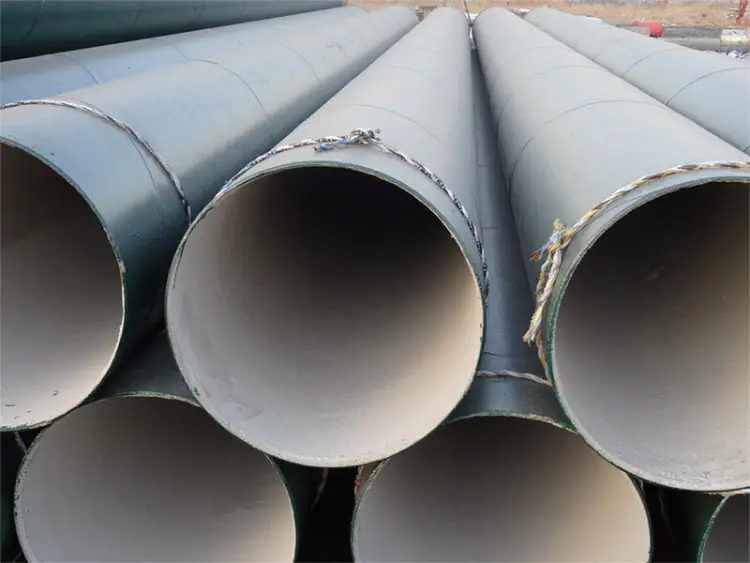
EN 10025-6 S460QL ERW Pipe
EN 10025-6 S460QL ERW Pipe: High Strength Quenched & Tempered Steel for Welded Structures
Comprehensive material data for EN 10025-6 S460QL ERW pipe with chemical composition, mechanical properties, physical properties, equivalent grades, and application guide.
Hot rolling, quenching and tempering, ERW welding, cold forming, machining
- Phone : +8618037372205
- Email : [email protected]
- WhatsApp: Contact via Whtsapp
- WeChat: +8618037372205
EN 10025-6 S460QL ERW Pipe Introduction
S460QL is a quenched and tempered fine-grain structural steel specified in EN 10025-6. It is designed for welded load-bearing structures requiring high strength, excellent toughness, and good weldability. The steel offers a minimum yield strength of 460 MPa in both longitudinal and transverse directions, making it suitable for heavy-duty applications. The designation 'QL' indicates a minimum impact energy of 30 J at -40 °C. Manufactured into ERW (Electric Resistance Welded) pipe, S460QL retains its base material properties and is widely used in crane booms, offshore structures, bridges, and heavy machinery. It is supplied in quenched and tempered condition with tight chemical composition control, ensuring reliable performance under dynamic loads and low-temperature service.
EN 10025-6 S460QL ERW Pipe Chemical Composition
The chemical composition of S460QL as per EN 10025-6:2019. These limits ensure good weldability and low-temperature toughness. Elements like Nb, V, Ti are added for grain refinement. Note that for ERW pipe, the chemical composition shall correspond to the base strip/plate; no additional element is typically introduced by the welding process.
| Element | Mass fraction (max %) | Remarks |
|---|---|---|
| C | 0.20 | Max |
| Si | 0.80 | Max |
| Mn | 1.70 | Max |
| P | 0.025 | Max |
| S | 0.015 | Max |
| N | 0.015 | Max |
| Cr | 1.50 | Max |
| Mo | 0.70 | Max |
| Ni | 2.0 | Max |
| Al (total) | ≥ 0.015 | Typically 0.020 – 0.060 |
| Cu | 0.50 | Max |
| Nb | 0.06 | Max |
| V | 0.12 | Max |
| Ti | 0.05 | Max |
| V+Nb+Ti | 0.22 | Max |
| B | 0.005 | Max |
| Note | CEV ≤ 0.53 (t ≤ 50mm) | Carbon equivalent according to product thickness |
EN 10025-6 S460QL ERW Pipe Thermal, Electrical and Physical Properties
The following physical properties are typical for quenched and tempered low-alloy structural steel and are valid for S460QL. Slight variations may occur depending on exact composition and heat treatment. These values are suitable for design calculations and are not mandatory specification limits.
| Property | Typical Value | Unit | Condition |
|---|---|---|---|
| Density (ρ) | 7850 | kg/m³ | At 20 °C |
| Elastic modulus (E) | 210 | GPa | At 20 °C |
| Shear modulus (G) | 80 | GPa | Calculated from E and ν |
| Poisson's ratio (ν) | 0.3 | – | At 20 °C |
| Thermal expansion coeff. (α) – 20-100 °C | 11.5 × 10⁻⁶ | /K | Mean value |
| Thermal expansion coeff. (α) – 20-200 °C | 12.0 × 10⁻⁶ | /K | |
| Thermal expansion coeff. (α) – 20-300 °C | 12.5 × 10⁻⁶ | /K | |
| Thermal conductivity (λ) | 45 | W/(m·K) | At 20 °C |
| Specific heat capacity (cp) | 460 – 500 | J/(kg·K) | At 20 °C |
| Electrical resistivity (ρ_e) | 0.22 – 0.28 × 10⁻⁶ | Ω·m | At 20 °C |
EN 10025-6 S460QL ERW Pipe Mechanical Properties
The mechanical properties apply to flat products and hollow sections in the quenched and tempered condition. Values for ERW pipe made from S460QL are assumed to meet the base material requirements unless otherwise agreed. Testing is performed in accordance with EN 10025-6 and EN 10219-1 (for cold-formed welded structural hollow sections).
| Property | Required Value | Unit | Test Condition / Remarks |
|---|---|---|---|
| Yield strength (ReH) – t ≤ 50 mm | ≥ 460 | MPa | Transverse or longitudinal, ambient temperature |
| Yield strength (ReH) – 50 < t ≤ 100 mm | ≥ 440 | MPa | |
| Yield strength (ReH) – 100 < t ≤ 150 mm | ≥ 400 | MPa | |
| Tensile strength (Rm) – t ≤ 50 mm | 550 – 720 | MPa | |
| Tensile strength (Rm) – 50 < t ≤ 100 mm | 550 – 720 | MPa | |
| Tensile strength (Rm) – 100 < t ≤ 150 mm | 550 – 720 | MPa | |
| Elongation (A) – t ≤ 50 mm | ≥ 17 | % | Longitudinal, gauge length 5.65√S₀ |
| Elongation (A) – 50 < t ≤ 100 mm | ≥ 17 | % | |
| Elongation (A) – 100 < t ≤ 150 mm | ≥ 17 | % | |
| Impact energy (KV) – t ≤ 150 mm | ≥ 30 | J | At -40 °C, longitudinal |
| Bend test (mandrel diameter) – t ≤ 16 mm | 3×t | mm | 180° bend, no cracks |
| Bend test – 16 < t ≤ 40 mm | 4×t | mm | |
| Bend test – 40 < t ≤ 63 mm | 5×t | mm | |
| Bend test – 63 < t ≤ 80 mm | 6×t | mm | |
| Hardness | ≤ 270 | HBW | For information |
| Additional properties | ERW pipe weld zone shall exhibit tensile strength ≥ base material minimum Rm | Per EN 10219-1 |
EN 10025-6 S460QL ERW Pipe Fully Equivalent Material Designations and Substitute Grades
| Country/Region | Standard | Grade | Remarks |
|---|---|---|---|
| European Union | EN 10025-6 | S460QL | Original specification (Q+T, -40 °C impact) |
| International | ISO 630-2:2011 | S460QL1 | Same tensile/yield requirements, impact tested at -40 °C; formerly ISO 4950-2 S460QL1 |
| United Kingdom | BS EN 10025-6 | S460QL | Adopts EN, identical |
| Germany | DIN EN 10025-6 | S460QL | Adopts EN, identical |
| France | NF EN 10025-6 | S460QL | Adopts EN, identical |
| Italy | UNI EN 10025-6 | S460QL | Adopts EN, identical |
EN 10025-6 S460QL ERW Pipe Application Introduction
S460QL ERW pipe combines high strength and excellent low-temperature toughness, making it ideal for critical welded structures. The quenched and tempered condition ensures a fine grain structure, good fatigue resistance, and reliable performance under dynamic loads. The ERW pipe format provides a cost-effective, dimensionally accurate hollow section ready for fabrication. Typical applications require strength, stiffness, and impact resistance in severe environments.
Product Applications: ERW cold-formed hollow sections according to EN 10219-1, Hot-finished structural hollow sections (if further heat treated) per EN 10210-1, Welded structural tubes and pipes for conveying fluids (with appropriate certification), Machined hollow bars for mechanical assemblies, Telescopic boom profiles for mobile cranes, Offshore structural pipe components
Processed into products: Crane boom chords and lattice members, Hydraulic cylinder barrels (honed from thick-walled pipe), Drive shafts and torque tubes, Riser pipes and conductors in offshore platforms, Heavy-duty trailer and semi-trailer chassis rails, Column and strut elements in structural engineering, Welded pipe piles and bearing piles, Pressure vessel shells when dual certified, Agricultural sprayer booms, Roll cages and protective structures (ROPS/FOPS)
Application industries: Heavy lifting and transport (mobile cranes, telescopic booms), Offshore and marine engineering (jack-up rigs, structural columns, subsea components), Bridge construction (high-strength trusses, arch bridges), Earthmoving and mining equipment (excavator arms, dump truck frames), Pressure-containing parts (hydraulic cylinders, accumulators), Structural pipe for high-rise buildings and stadiums, Agricultural machinery (plough frames, heavy-duty implements)
EN 10025-6 S460QL ERW Pipe Similar and Overlapping High-Strength Structural Steels
| Country/Region | Standard | Grade | Remarks |
|---|---|---|---|
| European Union | EN 10025-6 | S460Q | Same mechanical properties, but impact tested at 0 °C / -20 °C (Q versus QL) |
| European Union | EN 10025-6 | S500QL | Higher yield strength (500 MPa min) at comparable toughness; similar weldability |
| European Union | EN 10025-6 | S460QL1 | Even better low-temperature toughness (impact test at -60 °C) |
| USA | ASTM A514 / A514M | Grade B | Yield 690 MPa, but often used in similar applications; careful weld procedure required |
| Japan | JIS G 3128 | SHY685 | High yield (685 MPa), not a direct substitute but can be compared after engineering assessment |
| China | GB/T 16270 | Q460D / Q460E | Q460E may provide -40 °C impact; check through-thickness properties |
Notes:
S460QL ERW pipe requires strict control of welding procedure to preserve toughness in the heat-affected zone. Preheating (typically 100-150 °C) and low hydrogen welding consumables are recommended. Post-weld heat treatment is generally not required for thicknesses below 40 mm. The ERW weld seam shall be metallurgically sound and may be cold worked to improve properties. When ordering, specify the delivery condition (Q+T) and impact test temperature (-40 °C). For pressure equipment, supplementary requirements of PED 2014/68/EU or equivalent may apply. Always refer to the latest EN 10025-6 and EN 10219-1 for full specifications.
- Share



