
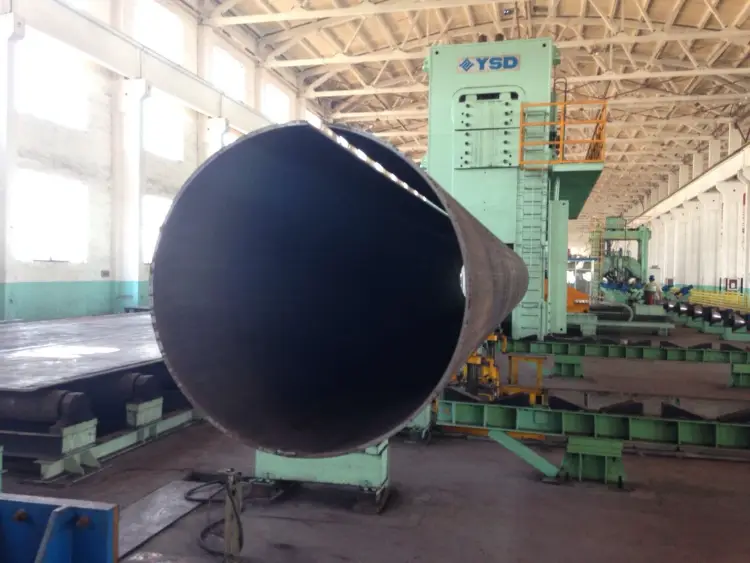
EN 10025-6 S460Q High Strength Quenched & Tempered Steel for ERW Pipes
EN 10025-6 S460Q High Strength Quenched & Tempered Steel for ERW Pipes: Properties & Equivalents
Detailed analysis of S460Q steel grade per EN 10025-6 for ERW pipes, including chemical composition, mechanical and physical properties, international equivalents, and applications in heavy engineering.
Quenching and Tempering, Welding (ERW, SAW, SMAW), Hot Forming, Cold Forming, Machining
- Phone : +8618037372205
- Email : [email protected]
- WhatsApp: Contact via Whtsapp
- WeChat: +8618037372205
EN 10025-6 S460Q High Strength Quenched & Tempered Steel for ERW Pipes Introduction
S460Q is a high-strength quenched and tempered structural steel grade defined by the European standard EN 10025-6. It is specifically designed for heavy-duty applications requiring a minimum yield strength of 460 MPa in thicknesses up to 50 mm. This fine-grained steel offers an excellent combination of high strength, good toughness, and superior weldability, making it suitable for highly stressed welded structures. The 'Q' designation confirms its quenched and tempered delivery condition, which guarantees its superior mechanical properties. When processed into ERW (Electric Resistance Welded) pipe, S460Q is used for demanding structural hollow sections, heavy machinery components, and offshore structures, where high load-bearing capacity and resistance to brittle fracture at low temperatures are critical.
EN 10025-6 S460Q High Strength Quenched & Tempered Steel for ERW Pipes Chemical Composition
The chemical composition of S460Q steel is controlled to achieve high strength, toughness, and good weldability after quenching and tempering. Maximum cast analysis values are defined according to EN 10025-6:2019 for product thicknesses ≤ 50 mm. Micro-alloying elements like niobium, vanadium, and titanium refine the grain structure, while the low carbon equivalent value (CEV) ensures excellent weldability.
| Element | Standard Value (Max, %) | Remarks |
|---|---|---|
| Carbon (C) | 0.20 | Max for t ≤ 50 mm |
| Silicon (Si) | 0.80 | Max |
| Manganese (Mn) | 1.70 | Max |
| Phosphorus (P) | 0.020 | Max |
| Sulfur (S) | 0.010 | Max |
| Chromium (Cr) | 1.50 | Max |
| Nickel (Ni) | 2.00 | Max |
| Molybdenum (Mo) | 0.70 | Max |
| Copper (Cu) | 0.50 | Max |
| Nitrogen (N) | 0.015 | Max |
| Zirconium (Zr) | 0.17 | Max |
| Titanium (Ti) | 0.05 | Max |
| Niobium (Nb) | 0.06 | Max |
| Vanadium (V) | 0.12 | Max |
| Boron (B) | 0.005 | Max |
| Aluminium (Al total) | 0.018 | Min, typically for grain refinement |
EN 10025-6 S460Q High Strength Quenched & Tempered Steel for ERW Pipes Physical Properties for S460Q
Typical thermal, electrical, and physical properties are established at ambient temperature unless otherwise noted. These values are essential for engineering design calculations, including thermal stress analysis, heat transfer modeling, and structural weight estimation. Properties may vary based on exact chemical composition and heat treatment parameters.
| Property | Typical Value | Unit | Test Condition / Remarks |
|---|---|---|---|
| Density (ρ) | 7850 | kg/m³ | At 20 °C |
| Elastic Modulus (E) | 210 | GPa | At 20 °C |
| Shear Modulus (G) | 80.8 | GPa | At 20 °C (calculated from E & ν) |
| Poisson's Ratio (ν) | 0.3 | - | At 20 °C (typical for steel) |
| Thermal Expansion Coefficient (α) | 11.7 | 10⁻⁶/K | At 20-100 °C |
| Thermal Expansion Coefficient (α) | 12.5 | 10⁻⁶/K | At 20-200 °C |
| Thermal Expansion Coefficient (α) | 13.2 | 10⁻⁶/K | At 20-300 °C |
| Thermal Conductivity (λ) | 44 | W/(m·K) | At 20 °C |
| Thermal Conductivity (λ) | 42 | W/(m·K) | At 100 °C |
| Specific Heat Capacity | 460 | J/(kg·K) | At 20 °C |
| Electrical Resistivity (ρ_e) | 0.25 | Ω·mm²/m | At 20 °C |
EN 10025-6 S460Q High Strength Quenched & Tempered Steel for ERW Pipes Mechanical Properties at Ambient Temperature for S460Q
The mechanical properties are guaranteed by the +QT (quenched and tempered) delivery condition. Requirements vary with product thickness. Values below are for thicknesses >3 mm and ≤ 50 mm per EN 10025-6:2019. The high upper shelf values for impact energy ensure this grade is suitable for low-temperature applications, preventing brittle fracture.
| Property | Standard Required Value | Unit | Test Condition / Thickness Range |
|---|---|---|---|
| Minimum Yield Strength (ReH) | 460 | MPa | t ≤ 50 mm |
| Minimum Yield Strength (ReH) | 440 | MPa | 50 mm < t ≤ 100 mm |
| Tensile Strength (Rm) | 550 - 720 | MPa | t ≤ 50 mm |
| Tensile Strength (Rm) | 530 - 700 | MPa | 50 mm < t ≤ 100 mm |
| Minimum Elongation (A5) (L0=5.65√S0) | 17 | % | t ≤ 50 mm |
| Minimum Elongation (A5) (L0=5.65√S0) | 16 | % | 50 mm < t ≤ 100 mm |
| Minimum Impact Energy (KV, Charpy-V) | 30 | Joules | At -20 °C (longitudinal) |
| Minimum Impact Energy (KV, Charpy-V) | 27 | Joules | At -40 °C (longitudinal, Option 1) |
| Bend Test, Minimum Mandrel Diameter | 3t | - | t ≤ 16 mm, 180° bend |
| Bend Test, Minimum Mandrel Diameter | 4t | - | t > 16 mm and ≤ 50 mm, 180° bend |
EN 10025-6 S460Q High Strength Quenched & Tempered Steel for ERW Pipes Completely Equivalent Material Standards & Substitutable Grades
| Country/Region | Standard | Grade | Remarks |
|---|---|---|---|
| Europe | EN 10025-6:2019 | S460Q | Original designation for quenched and tempered plate/strip. |
| Germany | DIN EN 10025-6 | S460Q | Direct adoption of European standard, replaces obsolete DIN standards. |
| United Kingdom | BS EN 10025-6 | S460Q | British adoption of European standard. |
| Italy | UNI EN 10025-6 | S460Q | Italian adoption of European standard. |
EN 10025-6 S460Q High Strength Quenched & Tempered Steel for ERW Pipes Application Introduction
S460Q steel, due to its high strength-to-weight ratio, excellent toughness, and good weldability, is ideal for applications where structural weight reduction without compromising load capacity is critical. It is widely used in the form of plates, welded components, and cold-formed welded structural hollow sections (ERW pipes). Its suitability for dynamic loads and low-temperature service makes it a preferred material for challenging environments.
Product Applications: Heavy-duty structural ERW hollow sections (circular, square, and rectangular pipes), Welded plate girders and box girders for bridges, High-integrity pressure vessels and penstocks, Lattice mast structures for cranes and transmission towers, Offshore platform legs and bracings
Processed into products: Telescopic crane boom sections formed from welded S460Q plate, Offshore jacket foundation nodes and braces, Welded chassis members for heavy-duty mining trucks, Cold-formed ERW structural tubes for stadium trusses, Rotary crane slew platforms and slewing rings, Pressurized hydraulic cylinder bodies and accumulators
Application industries: Mobile Crane Manufacturing (booms, outriggers, superstructures), Offshore and Marine Engineering (jack-up rigs, ship frames, wind turbine foundations), Bridge Building (long-span bridges, pedestrian bridges, structural elements), Heavy Transport and Railway Engineering (vehicle chassis, rail cars, special transporters), Mining and Earthmoving Equipment (excavator buckets, dump truck bodies, crusher structures), Structural Steel Construction (stadiums, high-rise buildings, steel framed structures)
EN 10025-6 S460Q High Strength Quenched & Tempered Steel for ERW Pipes Similar/Approximate Alternative Material Recommendations
| Country/Region | Standard | Grade | Remarks |
|---|---|---|---|
| USA | ASTM A514 / A517 | Grade S | High-strength quenched and tempered alloy steel plate with similar yield strength (100 ksi min). Close match for composition and mechanicals. |
| China | GB/T 16270 | Q460E | High strength structural steel in the quenched and tempered condition. Impact energy performance at -40°C is comparable to S460Q options. |
| Japan | JIS G 3128 | SHY 685 | High yield strength steel plate for welded structures. While yield strength is higher (685 MPa), it serves similar applications. |
| ISO | ISO 4950-2 | E460DD | Obsolete standard, but historical reference for 460 MPa yield class quenched and tempered steel. |
Notes:
Welding Considerations for ERW Pipe: For S460Q, the electric resistance welding (ERW) process requires precise control of heat input and post-weld normalizing to restore toughness in the heat-affected zone (HAZ). Preheating may be necessary for thicker sections or in high-humidity conditions to diffuse hydrogen and prevent cold cracking. Carbon Equivalent Value (CEV): Typical CEV for S460Q is around 0.45-0.52, indicating good weldability with low-hydrogen consumables. Post-weld heat treatment (PWHT) is not typically performed to avoid softening the quenched and tempered microstructure unless specifically required. Formability: Cold forming of S460Q ERW pipe is possible but requires sufficient bend radii due to its high strength. Shearing and punching must be done with robust tooling. Corrosion Protection: As a standard carbon-manganese steel with low alloy content, S460Q requires protective coating systems (painting, galvanizing) for long-term atmospheric or corrosive service exposure.
- Share



