
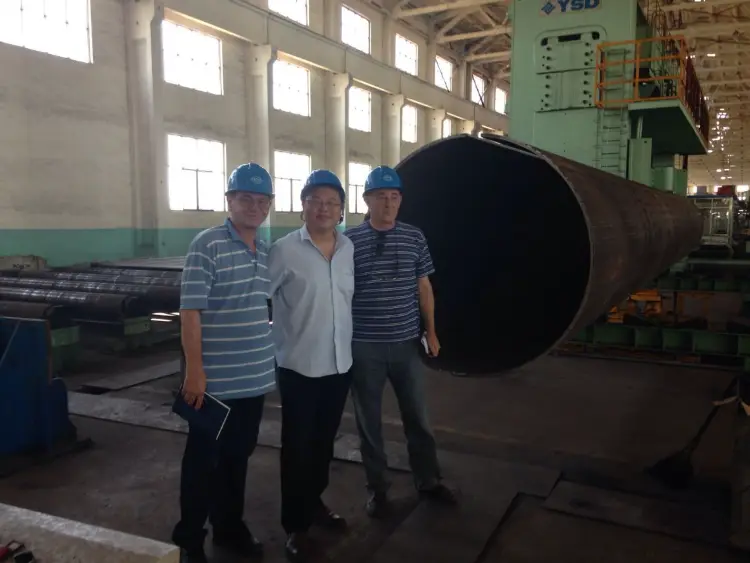
JIS G3106 SM570 SSAW Pipe
JIS G3106 SM570 SSAW Pipe: High-Strength Weldable Structural Steel for Spiral Submerged Arc Welded Pipes
Detailed material properties of SM570 steel manufactured to JIS G3106, widely used in spiral submerged arc welded (SSAW) pipes. Includes chemical composition, mechanical and physical properties, international equivalents, and application guidance.
Hot rolling, normalizing, TMCP; pipe forming by spiral submerged arc welding (SSAW)
- Phone : +8618037372205
- Email : [email protected]
- WhatsApp: Contact via Whtsapp
- WeChat: +8618037372205
JIS G3106 SM570 SSAW Pipe Introduction
JIS G3106 SM570 is a high-strength hot-rolled steel for welded structures, designated under the Japanese Industrial Standard JIS G3106. With a minimum tensile strength of 570 MPa and a minimum yield strength of up to 460 MPa for thicknesses ≤16 mm, SM570 offers excellent weldability, formability, and toughness when impact-tested grades are specified. The material is typically supplied in plate or coil form and is particularly suited for fabrication into spiral submerged arc welded (SSAW) pipes used in construction, offshore, and water engineering applications. Its balanced chemistry, with controlled carbon equivalent, ensures reliable field welding without excessive preheat. The steel can be delivered in as-rolled, normalized, or thermo-mechanically controlled processed (TMCP) conditions, depending on the required toughness and thickness.
JIS G3106 SM570 SSAW Pipe Chemical Composition
The chemical composition of SM570 steel as specified in JIS G3106 ensures high strength while maintaining good weldability. Carbon is limited to 0.18% for thicknesses ≤100 mm, and phosphorus and sulfur are strictly controlled. Microalloying elements such as niobium, vanadium, or titanium may be added at the manufacturer's discretion to achieve the required mechanical properties. Carbon equivalent (CE) is often reported to assess weldability, though not a standard requirement.
| Chemical Element | Standard Value (mass%) | Remarks |
|---|---|---|
| Carbon (C) | ≤0.18 (t≤100 mm); ≤0.20 (t>100 mm) | Maximum limit; lower values improve weldability |
| Silicon (Si) | ≤0.55 | Deoxidizer; improves strength |
| Manganese (Mn) | ≤1.60 | Increases hardenability and strength |
| Phosphorus (P) | ≤0.035 | Strict limit to avoid cold shortness |
| Sulfur (S) | ≤0.035 | Strict limit for toughness and HIC resistance |
| Niobium (Nb) / Vanadium (V) / Titanium (Ti) | Optional addition | Grain refinement and precipitation strengthening; no fixed limits, combined typically 0.02–0.10% each |
JIS G3106 SM570 SSAW Pipe Thermal and Electrical Physical Properties
Physical properties are typical for structural carbon-manganese and low-alloy steels. The values are applicable at room temperature unless otherwise indicated. These data are not part of the mandatory standard requirements but serve as engineering reference.
| Property | Typical Value | Unit | Test Condition / Remarks |
|---|---|---|---|
| Density (ρ) | 7.85 | g/cm³ | Room temperature |
| Elastic Modulus (E) | 205 | GPa | Tensile modulus, at 20°C |
| Shear Modulus (G) | 80.8 | GPa | Calculated from E and Poisson's ratio |
| Poisson's Ratio (ν) | 0.30 | — | In elastic range |
| Thermal Expansion Coefficient (α) | 11.7 × 10⁻⁶ | /K | Mean coefficient, 20–200°C |
| Thermal Conductivity (λ) | 45 | W·m⁻¹·K⁻¹ | At 20°C |
| Specific Heat Capacity (c) | 460 | J·kg⁻¹·K⁻¹ | At 20°C |
| Electrical Resistivity (ρ_e) | 0.25 | µΩ·m | At 20°C |
JIS G3106 SM570 SSAW Pipe Mechanical Properties
The mechanical properties of SM570 are defined for as-delivered steel in plate or strip form. Yield and tensile properties vary with thickness. Elongation is measured on transverse test pieces according to JIS Z2241. Bend tests are performed at 180° with specified inside radii. If Charpy impact properties are required, the steel must be ordered as SM570C (0°C) or SM570T (-20°C) with guaranteed absorbed energy values, but standard SM570 does not have impact requirements.
| Property | Standard Value | Unit | Test Condition |
|---|---|---|---|
| Yield Strength (ReH) | ≥460 | MPa | Thickness t ≤ 16 mm |
| Yield Strength (ReH) | ≥450 | MPa | 16 < t ≤ 40 mm |
| Yield Strength (ReH) | ≥430 | MPa | 40 < t ≤ 75 mm |
| Yield Strength (ReH) | ≥420 | MPa | 75 < t ≤ 100 mm |
| Yield Strength (ReH) | ≥410 | MPa | t > 100 mm |
| Tensile Strength (Rm) | 570 – 720 | MPa | All thicknesses |
| Elongation (A) | ≥19 | % | t ≤ 16 mm; JIS No.5 test piece (L₀=50 mm, d=12.5 mm), transverse |
| Elongation (A) | ≥22 | % | t > 16 mm; JIS No.1A test piece (L₀=200 mm, width=40 mm), transverse |
| Bend Test (180°) | Inside radius = 1.5 t | — | t ≤ 16 mm; no cracking after bending |
| Bend Test (180°) | Inside radius = 2.0 t | — | 16 < t ≤ 100 mm; no cracking |
| Bend Test (180°) | Inside radius = 2.5 t | — | t > 100 mm; no cracking |
JIS G3106 SM570 SSAW Pipe Completely Equivalent Material Standards and Replaceable Grades
| Country/Region | Standard | Grade | Remarks |
|---|---|---|---|
| Japan | JIS G3106 | SM570 | Original standard and grade |
| China | GB/T 1591 | Q460C/D/E | Similar yield/tensile levels; check toughness class and thickness range |
| European Union | EN 10025-4 | S460M/ML | Equivalent strength and weldability; TMCP delivery, slightly lower minimum tensile (540 MPa) |
| USA | ASTM A572 | Grade 65 | Strength close; yield 450 MPa min, tensile 550 MPa min; not identical to SM570 |
| International | ISO 4950-2 | E460 | High yield strength plate for general structural use, comparable |
JIS G3106 SM570 SSAW Pipe Application Introduction
SM570 SSAW pipe is designed for critical welded structures requiring high strength-to-weight ratios and reliable weld integrity. Typical applications span construction, marine, and energy sectors. The spiral submerged arc welding process allows economical production of large-diameter pipes with consistent mechanical properties.
- Construction and Infrastructure: columns, beams, bridge components, and high-load-bearing frameworks.
- Water and Hydropower: penstocks, water transmission mains, and pressure pipes.
- Offshore and Marine: jacket legs, piles, and structural supports.
- Energy and Wind: wind turbine tower sections, transition pieces, and monopiles.
The material can be readily formed, welded, and machined with standard practices. Preheating and interpass temperature control are recommended when welding thick sections (typically 50–100°C preheat for moderate thicknesses). Post-weld heat treatment is usually not required but can be applied if specified.
Product Applications: Spiral submerged arc welded (SSAW) pipes, Longitudinal welded pipes (LSAW), Hot-rolled plates and coils, Fabricated structural sections, Pressure piping and penstocks
Processed into products: Pipe piles and casing for foundations, Penstock tubes and fittings, Bridge box girders and panelss, Crane booms and heavy equipment arms, Wind turbine tower flanges and shells, Offshore platform legs and braces, High-stress bolted and welded connections
Application industries: Civil engineering and building construction, Bridge and infrastructure, Water supply and hydropower, Offshore oil & gas platforms, Wind energy (tower manufacturing), Shipbuilding and marine structures, Heavy machinery
JIS G3106 SM570 SSAW Pipe Similar or Alternative Material Recommendations
| Country/Region | Standard | Grade | Remarks |
|---|---|---|---|
| Japan | JIS G3106 | SM490YA/YB, SM520B/C | Lower strength variants for less demanding applications |
| China | GB/T 1591 | Q500C/D/E | Higher yield strength (≥500 MPa) but may have different weldability and tensile range |
| European Union | EN 10025-6 | S550Q/QL | Quenched and tempered steel, higher yield, but different processing |
| USA | ASTM A572/A572M | Grade 60 | Lower strength alternative; yield 415 MPa min |
| International | API 5L | X60 or X70 | Pipeline steel with comparable strength, used for SSAW pipes; slight chemical differences |
Notes:
Welding Considerations: SM570 has a moderate carbon equivalent (typically 0.38–0.43 for as-rolled products). For SSAW pipe production, the steel is designed for excellent fusion weldability using submerged arc welding (SAW) with appropriate wire-flux combinations. Preheat is recommended for thicknesses above 25 mm; correct interpass temperature and heat input maintain HAZ toughness. For critical off-shore applications, specify SM570C or SM570T grades with Charpy impact test at 0°C or -20°C respectively to ensure ductile fracture resistance. Formability: The material can be cold-formed and expanded for pipe sizing, but severe forming may require subsequent heat treatment. Corrosion Protection: External coatings (FBE, 3LPE) and internal linings are typically applied for buried or submerged service.
- Share



