
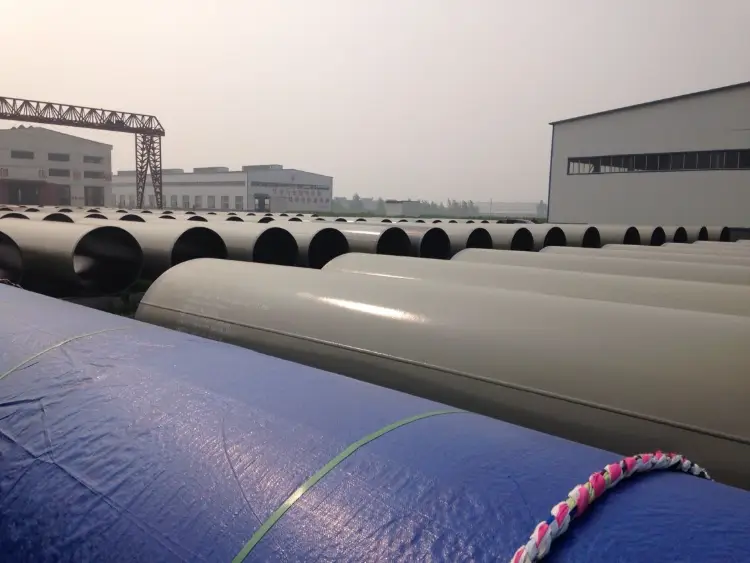
EN 10025-6 S500QL Welded ERW Pipe
EN 10025-6 S500QL High Strength Steel for Welded ERW Pipe Applications
Explore chemical composition, mechanical properties, and thermal data for S500QL steel per EN 10025-6, specifically for ERW pipe applications.
Electric Resistance Welding (ERW), Cold Forming, Hot Forming, Laser Cutting, Plasma Cutting, Machining
- Phone : +8618037372205
- Email : [email protected]
- WhatsApp: Contact via Whtsapp
- WeChat: +8618037372205
EN 10025-6 S500QL Welded ERW Pipe Introduction
S500QL is a high-yield-strength quenched and tempered structural steel grade defined in EN 10025-6. It offers a minimum yield strength of 500 MPa and excellent toughness at low temperatures down to -40 °C, making it suitable for demanding welded structures. The 'Q' denotes quenching and tempering (Q&T), while 'L' specifies low-temperature toughness. When supplied as ERW pipe, it provides a combination of high strength, good weldability, and dimensional accuracy, ideal for cranes, bridges, and offshore structures where weight reduction and durability are critical.
EN 10025-6 S500QL Welded ERW Pipe Chemical Composition
Chemical composition according to EN 10025-6 for grade S500QL. Maximum values unless indicated as a range. The steel is fully killed and fine-grain treated, providing a combination of high strength and excellent toughness.
- Key alloying elements such as manganese, chromium, and molybdenum contribute to hardenability.
- Microalloying elements like niobium and vanadium refine grain size.
- A low carbon equivalent (CEV) ensures good weldability.
| Element | Standard Value (max %) | Remarks |
|---|---|---|
| Carbon (C) | 0.20 | Max., applicable for product thickness ≤ 50 mm |
| Silicon (Si) | 0.80 | Max. |
| Manganese (Mn) | 1.70 | Max. |
| Phosphorus (P) | 0.025 | Max. |
| Sulfur (S) | 0.015 | Max. |
| Aluminum (Al total) | 0.015 min | Minimum total aluminum content |
| Nitrogen (N) | 0.015 | Max. |
| Chromium (Cr) | 1.50 | Max. |
| Copper (Cu) | 0.50 | Max. |
| Molybdenum (Mo) | 0.70 | Max. |
| Niobium (Nb) | 0.06 | Max. |
| Nickel (Ni) | 2.0 | Max. |
| Titanium (Ti) | 0.05 | Max. |
| Vanadium (V) | 0.12 | Max. |
| Zirconium (Zr) | 0.15 | Max. |
| Boron (B) | 0.005 | Max. |
EN 10025-6 S500QL Welded ERW Pipe Thermophysical and Electrical Properties
Typical thermophysical properties for S500QL grade steel at room temperature, unless otherwise specified. These values are characteristic for quenched and tempered steels of this class and are provided for design guidance.
- Density is used for weight calculations.
- Thermal expansion must be considered for welded structures.
- Elastic moduli are essential for stiffness and structural analysis.
| Property | Typical Value | Unit | Test Condition / Remarks |
|---|---|---|---|
| Density (ρ) | 7850 | kg/m³ | At 20 °C |
| Elastic Modulus (E) | 210 | GPa | At 20 °C |
| Shear Modulus (G) | 81 | GPa | At 20 °C, calculated from E and ν |
| Poisson's ratio (ν) | 0.3 | - | At 20 °C |
| Thermal expansion coefficient (α) | 12.0 | 10⁻⁶/K | At 20 °C to 100 °C |
| Thermal expansion coefficient (α) | 12.5 | 10⁻⁶/K | At 20 °C to 200 °C |
| Thermal expansion coefficient (α) | 13.0 | 10⁻⁶/K | At 20 °C to 300 °C |
| Thermal conductivity (λ) | 40 | W/(m·K) | At 20 °C |
| Specific heat capacity | 460 | J/(kg·K) | At 20 °C |
| Electrical resistivity (ρ_e) | 0.25 | Ω·mm²/m | At 20 °C |
EN 10025-6 S500QL Welded ERW Pipe Mechanical Properties
Mechanical properties at room temperature for EN 10025-6 S500QL. Actual values for ERW pipe may be verified on a flattened section of the pipe body. Properties are valid for quenched and tempered condition.
- Yield Strength (ReH) decreases with increasing product thickness.
- Toughness is guaranteed by a Charpy-V impact test at -40 °C.
| Property | Standard Requirement Value | Unit | Test Condition / Remarks |
|---|---|---|---|
| Minimum yield strength (ReH) | 500 | MPa | Nominal thickness (t) ≤ 50 mm |
| Minimum yield strength (ReH) | 480 | MPa | Nominal thickness 50 mm < t ≤ 100 mm |
| Minimum yield strength (ReH) | 440 | MPa | Nominal thickness 100 mm < t ≤ 150 mm |
| Tensile strength (Rm) | 590 - 770 | MPa | Nominal thickness (t) ≤ 50 mm |
| Tensile strength (Rm) | 590 - 770 | MPa | Nominal thickness 50 mm < t ≤ 100 mm |
| Tensile strength (Rm) | 540 - 720 | MPa | Nominal thickness 100 mm < t ≤ 150 mm |
| Minimum elongation (A) | 17 | % | Gauge length Lo = 5.65√So, Nominal thickness (t) ≤ 50 mm |
| Minimum elongation (A) | 17 | % | Gauge length Lo = 5.65√So, Nominal thickness 50 mm < t ≤ 100 mm |
| Minimum elongation (A) | 17 | % | Gauge length Lo = 5.65√So, Nominal thickness 100 mm < t ≤ 150 mm |
| Minimum Charpy-V impact energy (KV2) | 27 | J | Longitudinal, test temperature -40 °C |
| Minimum Charpy-V impact energy (KV2) | 16 | J | Transverse, test temperature -40 °C |
| Bend test (Mandrel diameter) | 3 x t | mm | 180° bend test, t = specimen thickness |
EN 10025-6 S500QL Welded ERW Pipe Directly Equivalent Material Standards and Replaceable Grades
| Country/Region | Standard | Grade | Remarks |
|---|---|---|---|
| International | ISO 4950-2 | E500QL | High yield strength flat steel products - Part 2: Products supplied in the quenched and tempered condition. Chemically and mechanically equivalent. |
| Germany | DIN EN 10025-6 | S500QL | Direct adoption of the European standard. |
| France | NF EN 10025-6 | S500QL | Direct adoption of the European standard. |
| United Kingdom | BS EN 10025-6 | S500QL | Direct adoption of the European standard. |
| Italy | UNI EN 10025-6 | S500QL | Direct adoption of the European standard. |
EN 10025-6 S500QL Welded ERW Pipe Application Introduction
EN 10025-6 S500QL ERW pipe is engineered for applications requiring a superior strength-to-weight ratio. Its high minimum yield strength of 500 MPa allows for lighter constructions compared to S355 grades, leading to savings in material, transport, and erection costs. The guaranteed low-temperature toughness at -40 °C makes it safe for use in cold climates and harsh environments. The ERW manufacturing process ensures excellent concentricity and surface finish, ideal for structural hollow sections and tubular frameworks.
Product Applications: Construction machinery booms and structural members, Long-span bridge girders and arch ribs, Offshore platform legs, nodes, and transition pieces, Heavy-lift crane booms, lattice sections, and cylinders, Tubular structural frameworks for buildings and towers, Hydraulic cylinders and thick-walled mechanical tubing
Processed into products: Crane boom chords and lacing members, Bridge arch sections and suspension tower legs, Jack-up rig leg chords and rack plates, Excavator and loading shovel arms (booms and sticks), Wind turbine tubular tower flanges and sections, Hydraulic cylinder barrels and piston rods, Penstock pipes for hydroelectric power plants
Application industries: Construction and Heavy Infrastructure (Bridges, Stadiums, High-Rise Buildings), Mobile Crane and Heavy Transport Manufacturing (Booms, Chassis, Outriggers), Offshore, Marine and Shipbuilding (Jack-up rig legs, Heavy-lift crane pedestals), Mining and Earthmoving Equipment (Dump truck bodies, Excavator arms), Renewable Energy (Wind turbine tower sections, Tidal energy structures), Pressure Equipment and Penstocks
EN 10025-6 S500QL Welded ERW Pipe Similar or Closely Related Material Recommendations
| Country/Region | Standard | Grade | Remarks |
|---|---|---|---|
| USA | ASTM A514/A514M | Grade S | High-yield-strength, quenched and tempered alloy steel plate. Comparable strength (100 ksi min YS), but chemical composition is less restrictive. Mainly for plates. |
| USA | ASTM A517/A517M | Grade S | Similar to A514 but intended for pressure vessel applications. Strength and hardness are equivalent. |
| Japan | JIS G 3128 | SHY 685 | High yield strength steel plates for welded structures. Higher strength level (685 MPa YS), but similar low-temperature toughness and application profile. |
| China | GB/T 16270 | Q500D | High strength structural steel plates in the quenched and tempered condition. 500 MPa yield strength class with toughness down to -20 °C (D grade). Note the minimum service temperature differs from 'L' grade (-40 °C). |
Notes:
Weldability: S500QL has a controlled carbon equivalent (CEV) for good weldability, but preheating and interpass temperature control are essential, strictly following qualified welding procedure specifications (WPS) due to the quenched and tempered microstructure.
ERW Pipe Specification: For ERW pipes, the delivery condition is typically based on the strip/skelp prior to forming. The pipe weld seam and heat-affected zone (HAZ) must meet the same mechanical property requirements as the parent material. Supplementary testing, such as flattening tests and weld seam toughness tests, is often specified.
Forming: Cold forming limitations must account for the high strength and limited elongation. Hot forming, if required, must be followed by a full re-heat treatment (quenching and tempering) to restore the original mechanical properties.
- Share



