
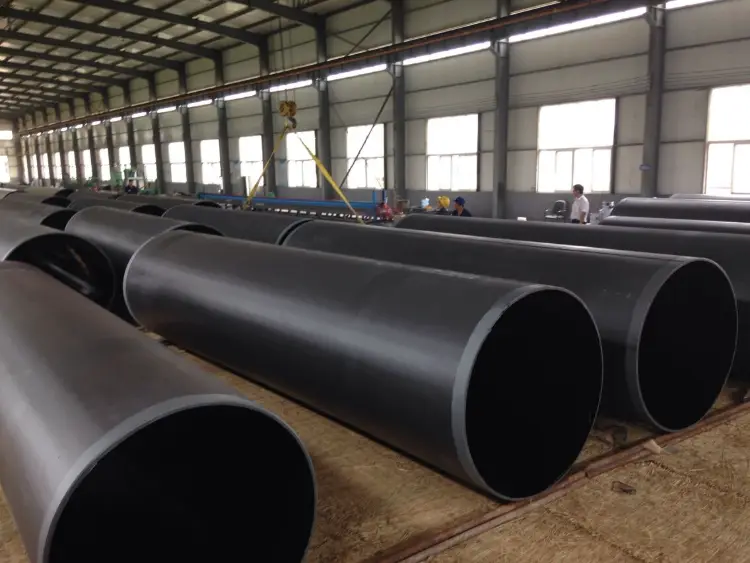
EN10025-6 S500QL1 Steel for ERW Pipe
EN10025-6 S500QL1 Steel for ERW Pipe: High Strength Quenched & Tempered Weldable Structural Steel
Explore the technical profile of S500QL1 steel per EN10025-6 for ERW pipe. Includes chemical composition, mechanical and thermal properties, international equivalents, and application guide for structural engineering.
Quenched and Tempered (Q+T), Hot Rolled, Cold Forming, Welding (HFW/ERW)
- Phone : +8618037372205
- Email : [email protected]
- WhatsApp: Contact via Whtsapp
- WeChat: +8618037372205
EN10025-6 S500QL1 Steel for ERW Pipe Introduction
S500QL1 is a high yield strength, quenched and tempered structural steel grade defined in the European standard EN 10025-6, specifically designed for heavily loaded welded structures. With a minimum yield strength of 500 MPa at thicknesses ≤ 50 mm, it offers an excellent combination of high strength, superior toughness at low temperatures (down to -20°C), and good weldability.
Primary characteristics include:
- High load-bearing capacity, enabling lighter and more slender structures.
- Guaranteed Charpy impact energy at -20°C (L for low temperature), critical for cryogenic and cold climate applications.
- Excellent through-thickness properties and homogeneity due to the fine-grain microstructure achieved through quenching and tempering (Q+T).
- Good cold-forming and hot-forming suitability, though precautions are needed after forming due to the heat-treated condition.
- Specified carbon equivalent value (CEV) to ensure safe and reliable weldability, matching with appropriate consumables.
This grade is particularly suited for high-frequency electric resistance welded (ERW) pipes used in demanding structural applications.
EN10025-6 S500QL1 Steel for ERW Pipe Chemical Composition
The chemical composition conforms to EN 10025-6 for the S500QL1 grade. The controlled low alloy content and low carbon equivalent (CEV) ensure excellent weldability and toughness after quenching and tempering.
- Key micro-alloying elements like Niobium (Nb), Vanadium (V), and Titanium (Ti) contribute to grain refinement and precipitation strengthening.
- Low impurity content, particularly Sulfur (S) and Phosphorus (P), is critical for achieving the specified low-temperature toughness and through-thickness ductility.
- CEV formula: CEV = C + Mn/6 + (Cr+Mo+V)/5 + (Ni+Cu)/15. The maximum CEV is 0.65% for t ≤ 50 mm and 0.77% for 50 < t ≤ 150 mm, ensuring reliable welding behavior.
| Element | Standard Value (≤, max %) | Remarks |
|---|---|---|
| Carbon (C) | 0.20 | Also min. 0.16% for CEV calculation consistency in some references |
| Silicon (Si) | 0.80 | Deoxidizer and strength enhancer |
| Manganese (Mn) | 1.70 | Primary contributor to strength and hardenability |
| Phosphorus (P) | 0.020 | Stringently controlled for high toughness |
| Sulfur (S) | 0.008 | Ultra-low for lamellar tearing resistance (Z-quality optional) |
| Aluminum (Al) | 0.015 min | Typically 0.020-0.050 for fine grain practice |
| Nitrogen (N) | 0.015 | Combined with Al, V, Ti to form nitrides for grain refinement |
| Chromium (Cr) | 1.50 | Enhances hardenability and corrosion resistance |
| Copper (Cu) | 0.50 | May provide minor atmospheric corrosion resistance |
| Molybdenum (Mo) | 0.70 | Critical for deep hardenability and high-temperature strength |
| Nickel (Ni) | 2.0 | Max; Crucial for low-temperature toughness |
| Niobium (Nb) | 0.06 | Micro-alloy for grain refinement during hot rolling and Q+T |
| Vanadium (V) | 0.12 | Precipitation hardening and grain refinement |
| Titanium (Ti) | 0.05 | Grain refinement and binds free nitrogen |
| Boron (B) | 0.005 | Optional element for enhanced hardenability |
| Zirconium (Zr) | 0.15 | Optional grain-refining element |
EN10025-6 S500QL1 Steel for ERW Pipe Thermal and Electrical Physical Properties
These physical properties are typical for quenched and tempered low-alloy high-strength steel grades like S500QL1 at room temperature, unless otherwise specified. Data from similar EN 10025-6 grades and general engineering references are provided. These values are essential for calculating thermal stresses, heat transfer, and structural deformation.
- Values for thermal properties vary with temperature; the table provides ambient-temperature baselines.
- Density is standard for steel, used in weight and mass calculations.
- Electrical resistivity is relevant for ERW pipe manufacturing processes.
| Property Item | Standard Requirement Value | Unit | Test Condition / Remarks |
|---|---|---|---|
| Density (ρ) | 7.85 | g/cm³ | At 20 °C |
| Modulus of Elasticity (E) | 210 | GPa | At 20 °C |
| Shear Modulus (G) | 81 | GPa | At 20 °C, calculated from E and ν |
| Poisson's Ratio (ν) | 0.3 | — | At 20 °C |
| Thermal Expansion Coefficient (α) | ~11.9 | 10⁻⁶/K | Range 20-100 °C |
| Thermal Expansion Coefficient (α) | ~13.4 | 10⁻⁶/K | Range 20-400 °C |
| Thermal Conductivity (λ) | ~25 | W/(m·K) | At 100 °C; decreases with alloying |
| Thermal Conductivity (λ) | ~30 | W/(m·K) | At 200 °C |
| Specific Heat Capacity | ~460-480 | J/(kg·K) | At 20-100 °C range |
| Electrical Resistivity (ρ_e) | ~0.25 - 0.35 | μΩ·m | At 20 °C |
EN10025-6 S500QL1 Steel for ERW Pipe Mechanical Properties
The mechanical properties of S500QL1 are determined by the quenching and tempering heat treatment. The table presents the minimum values guaranteed for flat products (plates, strips) from which ERW pipes are made. Pipe properties may vary slightly due to cold-forming and welding effects but must meet specified design values.
- The yield strength decreases with increasing product thickness.
- Charpy V-notch impact energy is guaranteed down to -20°C, designated by the 'L' suffix; the '1' suffix denotes a minimum of 27 Joules.
- Excellent bendability is a key characteristic, consistent with the specified bend radii for its strength level.
| Property Item | Standard Requirement Value | Unit | Test Condition / Thickness Range |
|---|---|---|---|
| Yield Strength (ReH) | 500 min | MPa | t ≤ 50 mm |
| Yield Strength (ReH) | 480 min | MPa | 50 mm < t ≤ 100 mm |
| Yield Strength (ReH) | 440 min | MPa | 100 mm < t ≤ 150 mm |
| Tensile Strength (Rm) | 590 - 770 | MPa | t ≤ 100 mm |
| Tensile Strength (Rm) | 560 - 750 | MPa | 100 mm < t ≤ 150 mm |
| Elongation after Fracture (A) | 17 min | % | Longitudinal, proportional test piece, t ≤ 50 mm |
| Elongation after Fracture (A) | 15 min | % | Longitudinal, t > 50 mm |
| Impact Energy (KV2) | 27 min at -20 °C | J | Longitudinal Charpy V-notch, t=10-30mm typical |
| Bend Test (Bend Diameter, d) | Mandrel test, 180° bend | - | Ratio d=3t (Thickness t ≤ 16 mm); d=4t (t > 16 mm), no cracks |
EN10025-6 S500QL1 Steel for ERW Pipe Complete Equivalent Material Standards & Substitutable Grade Recommendations
| Country/Region | Standard | Grade Designation | Remarks |
|---|---|---|---|
| Europe | EN 10025-6 | S500QL1 | Original specification, identical technical requirements |
| International | ISO 4951-2 | S500QL1 | Technically identical to EN 10025-6 grade |
| United States | ASTM A514/A514M | Grade B | Closest equivalent Q+T steel; verify exact CEV and toughness (-20°C vs -40°F) requirements |
| United States | ASTM A517/A517M | Grade E | Closest equivalent for pressure vessel plate; verify application-specific requirements |
| Japan | JIS G 3128 | SHY 600 | Similar high yield point steel plate; requires detailed grade comparison |
EN10025-6 S500QL1 Steel for ERW Pipe Application Introduction
S500QL1 steel is a premium choice for lightweight, high-strength welded structures subjected to heavy static and dynamic loads and requiring guaranteed low-temperature service performance. Its high yield-to-tensile ratio is fully utilized in yield-strength-governed designs. When used for ERW pipes, it provides a superior strength-to-weight ratio compared to lower-strength grades, reducing foundation, transport, and erection costs.
Key processing and application considerations:
- Welding: Strict compliance with pre-heating, interpass temperature, and low-hydrogen welding practices is essential. Post-weld heat treatment (PWHT) is generally not recommended for Q+T grades as it degrades mechanical properties unless very carefully controlled.
- Forming: Excellent for cold and hot forming. However, hot forming or flame straightening above 600°C invalidates the Q+T condition and requires re-heat treatment.
- Design: The high strength allows for significant reduction in section size, lowering overall structural weight. Stability and buckling analysis becomes more critical.
Product Applications: Endless high-strength ERW structural hollow sections (pipes and tubes), Cut and welded built-up sections (I-beams, box girders), Cold-formed profiles (C, Z, Sigma sections), Pre-fabricated structural modules and components
Processed into products: Telescopic crane boom sections and lattice structure chords, Load-bearing chassis frames and axle beams for heavy-duty trailers, Pile foundations and large-diameter casing pipes for deep foundations, Nodes and joints in space-frame structures, Hydraulic cylinder barrels and thick-walled mechanical tubing, High-pressure penstock and manifold pipes for hydropower plants
Application industries: Mobile crane and mining equipment manufacturing (booms, chassis, outriggers), Heavy transport and trailer engineering (load-bearing frames), Structural engineering (bridges, stadiums, high-rise building columns), Offshore and marine engineering (ship hulls, jack-up rig legs, platform structures), Renewable energy (wind turbine towers and foundations, tidal energy structures), Pressure vessel and penstock manufacturing
EN10025-6 S500QL1 Steel for ERW Pipe Recommendations for Similar/Alternative Substitute Materials
| Country/Region | Standard | Grade Designation | Remarks |
|---|---|---|---|
| Europe | EN 10025-6 | S500Q | S500Q has identical tensile properties; QL1 version specifically guarantees 27J impact at -20°C (Q guarantees at 0°C, QL at -50°C). Q is the base Q+T condition. |
| Europe | EN 10025-6 | S500QL | Superior low-temperature toughness alternative; guarantees 27J at -50°C vs -20°C for S500QL1, at potentially higher cost. |
| Europe | EN 10025-6 | S550QL1 | Higher strength alternative (550 MPa min yield); potentially different carbon equivalent (CEV) requiring stricter welding procedures. |
| Europe | EN 10025-3 | S460M/ML | Thermomechanically rolled (TMCP) alternative; similar toughness options (ML at -50°C), lower strength but typically better weldability and thickness-limited due to cooling rate. |
| United States | ASTM A709/A709M | Grade HPS 70W [70W] (Q&T) | Bridge steel grade; similar strength and toughness, but with enhanced atmospheric corrosion resistance (weathering steel). Requires detailed property comparison. |
Notes:
Special Considerations for ERW Pipe Production:
- The base material (HR coil or strip) must have a uniform, fine-grain microstructure suitable for high-frequency welding. The rapid heating/cooling cycle at the weld seam creates a hard zone; post-weld heat treatment (in-line seam annealing) is often mandatory to restore toughness.
- Dimensional Tolerance: ERW pipes from S500QL1 are normally specified to tight tolerances per EN 10219 for cold-formed welded structural hollow sections.
- Non-Destructive Testing (NDT): Ultrasonic or eddy current testing of the weld seam is standard practice to guarantee weld integrity, particularly for high-reliability applications.
- Share



