
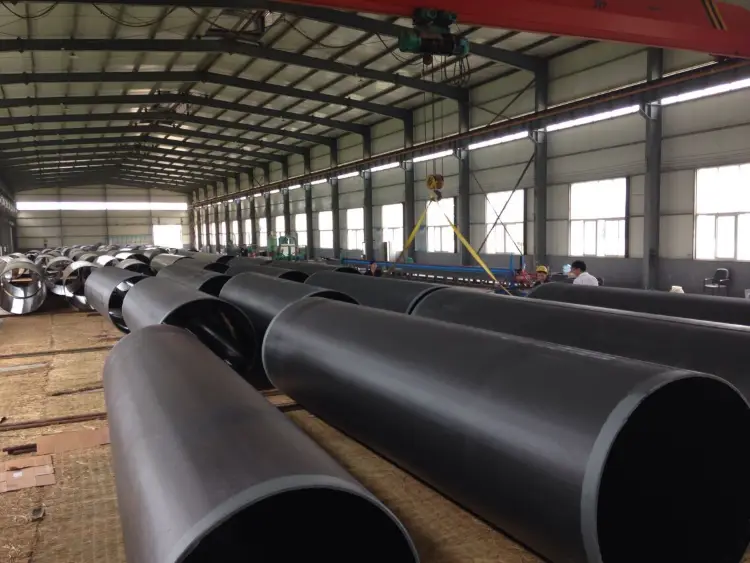
EN10025-6 S550Q ERW Pipe
EN10025-6 S550Q ERW Pipe: High Strength Quenched & Tempered Steel for Welded Structural Tubes
Comprehensive material properties and equivalent grades of S550Q steel according to EN 10025-6, commonly used for electric resistance welded (ERW) structural pipes with superior toughness and weldability.
Hot rolling, quenching and tempering, cold forming (for tubes), electric resistance welding, machining, and conventional welding processes
- Phone : +8618037372205
- Email : [email protected]
- WhatsApp: Contact via Whtsapp
- WeChat: +8618037372205
EN10025-6 S550Q ERW Pipe Introduction
S550Q is a high-strength, quenched and tempered fine-grain structural steel specified in EN 10025-6. It delivers a minimum yield strength of 550 MPa in thicknesses up to 50 mm, combined with excellent low-temperature toughness (27 J at -20 °C) and good weldability owing to its maximum carbon equivalent and controlled alloying content.
When formed into ERW pipes, S550Q offers outstanding structural performance for demanding applications such as heavy-duty cranes, offshore structures, bridges, and wind turbine towers. Its delivery condition is quenched and tempered, ensuring uniformly fine grain and mechanical properties throughout the thickness.
EN10025-6 S550Q ERW Pipe Chemical Composition
Chemical composition according to EN 10025-6 for S550Q steel with thickness ≤150 mm.
Microalloying elements (Nb, V, Ti, Al) ensure fine grain size. Carbon equivalent (CEV) is controlled for weldability.
Elements Cr, Ni, Mo, Cu, and B are optional but typically limited as shown.
| Element | Standard Value (max, unless range) | Remarks |
|---|---|---|
| Carbon (C) | 0.20 | Maximum; CEV applies |
| Silicon (Si) | 0.50 | Maximum |
| Manganese (Mn) | 1.70 | Maximum |
| Phosphorus (P) | 0.025 | Maximum |
| Sulfur (S) | 0.015 | Maximum |
| Aluminium (Al_total) | ≥ 0.015 | Minimum, for grain refining |
| Niobium (Nb) | 0.06 | Maximum |
| Vanadium (V) | 0.12 | Maximum |
| Titanium (Ti) | 0.05 | Maximum |
| Chromium (Cr) | 1.50 | Maximum |
| Nickel (Ni) | 2.0 | Maximum |
| Molybdenum (Mo) | 0.70 | Maximum |
| Copper (Cu) | 0.50 | Maximum |
| Boron (B) | 0.005 | Maximum |
EN10025-6 S550Q ERW Pipe Thermal and Electrical Physical Properties
Physical properties for quenched and tempered S550Q steel at ambient temperature.
Values are typical for low-alloy structural steels and may vary slightly with actual composition and heat treatment.
Thermal expansion and conductivity are essential for welding and service temperature assessments.
| Property | Typical Value | Unit | Test Condition / Temperature |
|---|---|---|---|
| Density (ρ) | 7850 | kg/m³ | 20 °C |
| Modulus of elasticity (E) | 210 | GPa | 20 °C |
| Shear modulus (G) | ≈ 81 | GPa | Calculated (E / [2(1+ν)]) |
| Poisson's ratio (ν) | 0.3 | — | 20 °C |
| Thermal expansion coefficient (α) | 11.1 × 10⁻⁶ | K⁻¹ | Between 20 °C and 100 °C |
| Thermal conductivity (λ) | 35 | W/(m·K) | 20 °C |
| Specific heat capacity (c_p) | 460 | J/(kg·K) | 20 °C |
| Electrical resistivity (ρ_e) | 0.25 × 10⁻⁶ | Ω·m | 20 °C |
EN10025-6 S550Q ERW Pipe Mechanical Properties
Mechanical properties per EN 10025-6 for S550Q, sampled from plate thickness ranges.
Impact energy is based on Charpy V-notch test at -20 °C.
Bend test uses a 180° bend with a mandrel diameter depending on thickness.
Values are minimum unless a range is given (e.g., tensile strength).
| Property | Standard Required Value | Unit | Test Condition / Remarks |
|---|---|---|---|
| Yield strength (ReH) | 550 | MPa | Thickness ≤ 50 mm, transverse or longitudinal |
| Yield strength (ReH) | 530 | MPa | Thickness > 50 ≤ 100 mm |
| Yield strength (ReH) | 510 | MPa | Thickness > 100 ≤ 150 mm |
| Tensile strength (Rm) | 640 – 820 | MPa | Thickness ≤ 50 mm |
| Tensile strength (Rm) | 590 – 770 | MPa | Thickness > 50 ≤ 150 mm |
| Elongation after fracture (A) | ≥ 14 | % | Gauge length L₀ = 5.65√S₀, longitudinal |
| Elongation after fracture (A) | ≥ 14 | % | Transverse direction (same min) |
| Bend test (180°) | Mandrel diameter = 4t (t ≤ 50 mm) | — | No cracks; t = specimen thickness |
| Bend test (180°) | Mandrel diameter = 5t (50 < t ≤ 100 mm) | — | No cracks |
| Bend test (180°) | Mandrel diameter = 6t (100 < t ≤ 150 mm) | — | No cracks |
| Charpy impact energy (KV, -20 °C) | ≥ 27 | J | Longitudinal, V-notch, average of 3 tests |
| Charpy impact energy (KV, -20 °C) | ≥ 20 | J | Transverse, V-notch |
EN10025-6 S550Q ERW Pipe Directly Equivalent Material Standards & Substitute Grades
| Country/Region | Standard | Grade | Remarks |
|---|---|---|---|
| International (ISO) | ISO 4951-3 | S550Q | Identical to EN 10025-6:2004 |
| China | GB/T 16270-2009 | Q550D | Quenched & tempered; impact temperature -20 °C; Mn limits may differ |
| China | GB/T 16270-2009 | Q550E | Impact –40 °C; closer toughness requirement when required |
| European Union | EN 10219 | S550QH | Cold-formed welded hollow section; base material S550Q |
| Japan | JIS G 3106 | SM570 | Rolled; similar strength but different delivery condition (as-rolled or TMCP) |
EN10025-6 S550Q ERW Pipe Application Introduction
S550Q ERW pipe excels in load-bearing structures where high strength, low-temperature toughness, and weldability are paramount.
Typical applications include:
- Offshore oil & gas platforms and riser support structures
- Boom and chassis sections of mobile cranes and heavy lifting equipment
- Wind turbine tower tubulars and transition pieces
- Bridge construction – longitudinal beams and box girders
- Structural pipe piles for deep foundations
- Pressurized vessel parts (with supplementary requirements)
Product Applications: Electric resistance welded (ERW) structural pipes and hollow sections, Welded tubular sections for bridges and stadium roofs, High-strength, weather-resistant structural assemblies, Fatigue-resistant tubular frames for heavy vehicles
Processed into products: Mobile crane booms, lattice masts, and outriggers, Wind turbine tower sections and monopiles, Bridge main girders, cross beams, and bracings, Offshore platform legs, decks, and conductor pipes, Pumping station discharge columns, Heavy-duty support columns and piling
Application industries: Civil engineering and construction, Offshore and marine engineering, Heavy machinery and crane manufacturing, Renewable energy (wind, tidal), Transportation infrastructure, Shipbuilding and pressure vessel fabrication
EN10025-6 S550Q ERW Pipe Similar Alternative Materials with Comparable Performance
| Country/Region | Standard | Grade | Remarks |
|---|---|---|---|
| USA | ASTM A514/A514M | Grade B/H/F | Quenched & tempered; yield ≥ 690 MPa; higher strength, thicker sections need careful welding |
| USA | ASTM A709/A709M | Grade 50W | Weathering steel, yield 345 MPa; not directly equivalent but used in bridges |
| Germany | DIN EN 10025-6 | S460Q | Lower strength but same Q&T family; yield 460 MPa |
| Germany | DIN EN 10025-6 | S620Q | Next higher strength grade; yield 620 MPa; best for weight reduction |
| International | ISO 4951-3 | S550Q | Identical; preferred substitute |
| Russia/India | GOST/IS | 09G2S (09Г2С) | Low alloy steel with yield ~345 MPa; not truly equivalent but used in similar cold-climate structures |
Notes:
- All data based on EN 10025-6:2004+A1:2009 for S550Q; for ERW pipe products, additional standards like EN 10219-1 (cold-formed welded structural hollow sections) or EN 10210-1 (hot-finished) may apply to the finished tube.
- Welding must follow established procedures; preheating may be required based on thickness and CEV.
- For thicknesses >150 mm, the chemical composition and mechanical properties may be agreed upon at the time of enquiry and order.
- CEV (carbon equivalent) limits ensure reliable field welding: ≤ 0.65 (t ≤ 50 mm), ≤ 0.77 (t > 50 mm) depending on product analysis.
- Share



