
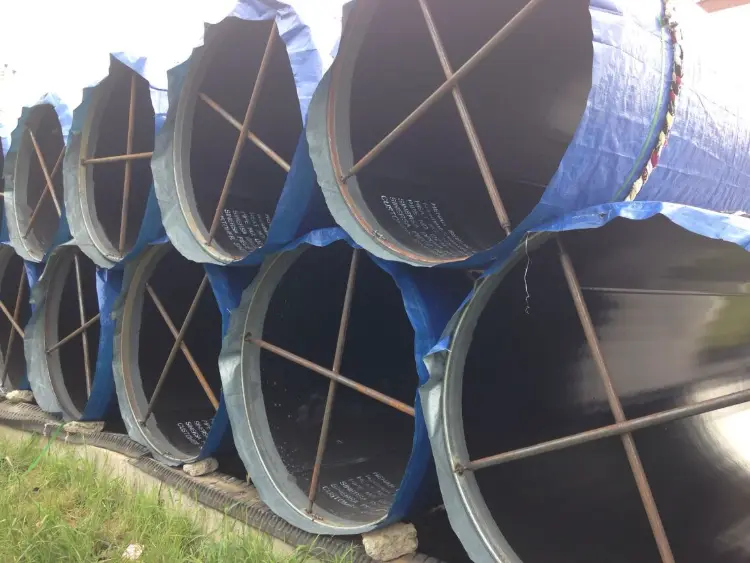
EN10025-6 S550QL ERW Pipe
EN10025-6 S550QL ERW Pipe | High-Strength Quenched & Tempered Steel for Welded Structures
S550QL ERW pipe made from EN10025-6 quenched and tempered fine-grain structural steel with minimum yield strength 550 MPa, excellent weldability and notch toughness at -20°C, suitable for heavy-duty welded structures.
Electric resistance welding (ERW) of flat-rolled steel; subsequent heat treatment (stress relief) may be applied; also suitable for cold forming, bending, cutting, machining, and welding
- Phone : +8618037372205
- Email : [email protected]
- WhatsApp: Contact via Whtsapp
- WeChat: +8618037372205
EN10025-6 S550QL ERW Pipe Introduction
The material designates a high-strength structural steel produced in accordance with EN 10025-6, delivered in the quenched and tempered condition. The designation 'S550QL' indicates a minimum yield strength of 550 MPa (for thicknesses ≤50 mm), with 'Q' for quenching and tempering and 'L' for specified impact energy at -20°C. When formed into ERW (Electric Resistance Welded) pipe, the steel retains its excellent combination of high strength, good toughness, and reliable weldability. Typical applications include structural tubing for cranes, heavy machinery, offshore structures, and pressure vessels. The steel is characterized by low carbon equivalent values, enabling welding without preheating under defined conditions. This product meets the demands of modern lightweight design in highly stressed welded constructions.
EN10025-6 S550QL ERW Pipe Chemical Composition
Chemical composition according to EN 10025-6:2019 for grade S550QL (ladle analysis). Elements are controlled to achieve the required strength and toughness after quenching and tempering. Microalloying elements such as Nb, V, Ti, and B may be present to refine grain size and improve hardenability.
- Carbon equivalent (CEV) typically specified to ensure weldability.
- Phosphorus and sulfur are restricted to ensure cleanliness and low-temperature toughness.
- The sum of Nb+V+Ti may be limited.
| Element | Standard value | Remarks |
|---|---|---|
| C (Carbon) | ≤0.20 | Ladle analysis |
| Si (Silicon) | ≤0.80 | Ladle analysis |
| Mn (Manganese) | ≤1.70 | |
| P (Phosphorus) | ≤0.020 | For improved formability and weldability |
| S (Sulfur) | ≤0.010 | For improved toughness and weldability |
| Al (Aluminium) | ≥0.018 total | Minimum for fine-grain practice |
| Cr (Chromium) | ≤1.50 | |
| Ni (Nickel) | ≤2.0 | |
| Mo (Molybdenum) | ≤0.70 | |
| Nb (Niobium) | ≤0.06 | |
| V (Vanadium) | ≤0.12 | |
| Ti (Titanium) | ≤0.05 | |
| B (Boron) | ≤0.005 | May be added for hardenability |
| Cu (Copper) | ≤0.50 | If specified |
| N (Nitrogen) | ≤0.015 | For Al-killed steel |
| Zr (Zirconium) | ≤0.15 | Optional grain refiner |
EN10025-6 S550QL ERW Pipe Physical Properties
The following physical properties are typical for quenched and tempered low-alloy structural steels like S550QL in the +QT condition. These values are indicative and may vary with actual composition and tempering temperature. They apply at room temperature unless stated otherwise.
- Density is standard for low-alloy steels.
- Thermal expansion coefficient is given for the range 20–100°C.
- Electrical resistivity is moderate as typical for alloyed steels.
| Property | Typical value | Unit | Condition / Remarks |
|---|---|---|---|
| Density (ρ) | 7850 | kg/m³ | At 20°C |
| Modulus of elasticity (E) | 210 | GPa | Room temperature, longitudinal |
| Shear modulus (G) | 81 | GPa | Calculated from E and Poisson's ratio |
| Poisson's ratio (ν) | 0.3 | - | Elastic range, room temperature |
| Thermal expansion coefficient (α) | 12.0 × 10⁻⁶ | K⁻¹ | Between 20°C and 100°C |
| Thermal conductivity (λ) | 50 (approx.) | W/(m·K) | At 20°C |
| Specific heat capacity (c) | 460 | J/(kg·K) | At 20°C |
| Electrical resistivity (ρe) | 0.25 | µΩ·m | At 20°C, typical for low-alloy steel |
EN10025-6 S550QL ERW Pipe Mechanical Properties
Mechanical properties of S550QL flat products used for ERW pipe are specified in EN 10025-6. For pipe applications, the properties correspond to the base material before welding; the weld seam strength is qualified separately. Notch toughness is guaranteed at -20°C (L-grade).
- Yield strength values apply to thicknesses ≤50 mm; for thicker products, slightly reduced values may apply.
- Tensile test according to EN ISO 6892-1.
- Charpy impact test according to EN ISO 148-1.
| Property | Required value | Unit | Test condition |
|---|---|---|---|
| Yield strength (ReH) | ≥550 | MPa | Thickness ≤50 mm |
| Tensile strength (Rm) | 650 – 820 | MPa | Thickness ≤50 mm |
| Elongation after fracture (A5) | ≥14 | % | Gauge length 5.65√S0, longitudinal, thickness ≤50 mm |
| Bend test (mandrel diameter) | 3t (minimum) | 180° bend, thickness ≤50 mm; t = specimen thickness | |
| Charpy impact energy (KV) | ≥30 (average) / ≥27 (single) | J | At -20°C, longitudinal; 10×10 mm specimen |
| Through-thickness reduction of area | Not mandatory unless Z-quality specified | % | See EN 10164 |
EN10025-6 S550QL ERW Pipe Exactly Equivalent Standards and Substitutable Grades
| Country/Region | Standard | Grade | Remarks |
|---|---|---|---|
| European Union | EN 10025-6 | S550QL | Original designation; applies to flat products for ERW pipe base material |
| International | ISO 4950-2:1995 | S550QL | High yield strength flat steel products; identical technical delivery conditions |
| Germany | DIN EN 10025-6 | S550QL | Adopted EN standard; no national modifications |
| France | NF EN 10025-6 | S550QL | Adopted EN standard |
| United Kingdom | BS EN 10025-6 | S550QL | Adopted EN standard; previous BS 4360 withdrawn |
| Spain | UNE EN 10025-6 | S550QL | Adopted EN standard |
| Italy | UNI EN 10025-6 | S550QL | Adopted EN standard |
| Sweden | SS EN 10025-6 | S550QL | Often used by SSAB for corresponding high-strength plate but note SSAB proprietary grades may differ |
| Poland | PN-EN 10025-6 | S550QL | Adopted EN standard |
EN10025-6 S550QL ERW Pipe Application Introduction
S550QL ERW pipe is widely used where high load-bearing capacity combined with low dead weight is essential. The material's excellent weldability and low-temperature toughness allow fabrication of complex structures without preheating under normal conditions. Typical sectors include
- Heavy engineering and construction machinery
- Mobile cranes and lifting devices
- Offshore oil & gas platforms
- Pressure and process piping
- Renewable energy (wind turbine towers, foundations)
Product Applications: Telescopic crane booms and lattice boom sections, Hydraulic cylinder barrels, Heavy-duty structural hollow sections for frames, Offshore platform legs, braces, and piles, High-pressure piping systems, Drilling riser pipes, Wind turbine tower sections (tubular), Trailer and chassis side members, Railway vehicle structures
Processed into products: Welded tubular joints for cranes (chord and brace pipes), Boom extension and retraction tubes, Piston rods and hydraulic cylinder pipes, Pin-bearing lugs and gussets cut from pipe, Transition pieces in monopile foundations, Riser pipes and conductor casings, Flanges and collars welded to pipe ends, Cross-bracing and diagonal members in truss structures, Spigots and bushes machined from thick-wall ERW pipes
Application industries: Construction and building, Crane and lifting equipment manufacturing, Heavy machinery (earthmoving, mining), Offshore engineering, Shipbuilding, Pressure vessel and boiler manufacturing, Wind energy and towers, Bridges and civil infrastructure, Automotive (heavy trucks, trailers)
EN10025-6 S550QL ERW Pipe Similar or Closely Related Alternative Materials
| Country/Region | Standard | Grade | Remarks |
|---|---|---|---|
| European Union | EN 10025-6 | S460QL | Lower yield strength (460 MPa), but similar toughness and weldability; often an economic substitute |
| European Union | EN 10025-6 | S620QL | Higher yield strength (620 MPa), used for more demanding applications, but may require stricter welding procedures |
| European Union | EN 10025-6 | S690QL | Very high strength (690 MPa); more alloyed, lower toughness level may need extra care |
| European Union | EN 10028-6 | P550QL2 | Pressure vessel steel with comparable strength and low-temperature toughness; suitable for pressure equipment |
| USA | ASTM A514/A517 | Grade H (or others) | Quenched and tempered high-strength plate; comparable in strength but with different chemistry and test requirements; verify properties before substitution |
| USA | ASTM A1011/A1011M | SS Grade 80 | High-strength low-alloy (HSLA) steel in the as-rolled condition; not directly equivalent due to different strengthening mechanism |
| China | GB/T 16270 | Q550D | Quenched and tempered high-strength steel with similar yield point, but impact test temperature is -20°C (D grade); check exact composition and delivery condition |
| Japan | JIS G 3128 | SHY 685N | High yield strength steel for welded structures; comparable but with Ni addition; N indicates normalized, not QT |
| International | ISO 4950-1 | S550Q | As-rolled or normalized variation of S550, not quenched and tempered; strength level similar but toughness may differ |
Notes:
- S550QL ERW pipes are typically produced from slit coils of quenched and tempered steel; the weld seam achieves strength close to the base metal after proper welding and post-weld heat treatment if specified.
- Commercial availability in wall thicknesses up to about 16 mm; thicker pipes may require SAW or LSAW process instead of ERW.
- For critical applications, Charpy V-notch tests on base material, weld, and heat-affected zone are recommended.
- The carbon equivalent value (CEV) is usually ≤0.52% based on the IIW formula, ensuring good field weldability.
- Surface condition: as-rolled and descaled or pickled and oiled; pipes may be supplied in plain, beveled, or threaded ends.
- When substituting other standards, ensure that the chemical composition and mechanical properties meet the design requirements, particularly for impact toughness and through-thickness properties.
- Share



